2 months ago
79
2 months ago
79
Federal officials tasked with implementing the Trump administration’s “mass deportation” program faced an extraordinary campaign of intimidation inside the Department of Homeland Security during the final months of Kristi Noem’s tenure and the arrival of her successor, a Guardian investigation found.
Over the past four months, the Guardian spoke with more than three dozen current and former Department of Homeland Security officials who described a climate of fear driven by Trump loyalists in senior positions, who sidelined or removed career officials who raised concerns about possibly illegal acts, and threatened termination or arrest in order to stop dissent. Several have also claimed they were subjected to polygraph examinations conducted by US military personnel.
In the past year-and-a-half, entire offices were dismantled, and oversight bodies were stripped of staff and authority. The divisions responsible for refugee policy, asylum, humanitarian protections and family unity were among the hardest hit. The practices have continued during the leadership transition to Markwayne Mullin, the current and former officials said.
“I wanted to work with refugees,” said Harun Ahmed, a former deputy chief in the refugee affairs law division at US Citizenship and Immigration Services (USCIS) in a phone interview from Texas. “I wanted to help. I believe in public service.”
Ahmed, who served in the government for nearly 17 years, was responsible for helping ensure legal protections for refugees and asylum seekers navigating the US immigration system. But after Trump’s return to office in 2025, Ahmed said, career officials increasingly found themselves under pressure to support policies they believed violated both the spirit and purpose of the system they had spent years administering.
“They wanted employees to sign off on efforts even when we believed they were immoral, illegal or ahistorical,” Ahmed said. “It didn’t matter what our expertise was. They wanted our blessing.”
Under Noem, the department carried out more than 675,000 deportations and expanded immigration detention to record levels. The administration halted nearly all refugee resettlement while fast-tracking admissions for white South Africans. It resumed family separation practices, expanded transfers of deportation to third countries, sent some immigrants to El Salvador’s Cecot mega-prison and began using Guantánamo Bay as an immigration detention facility, a move a federal judge found “impermissibly punitive”.
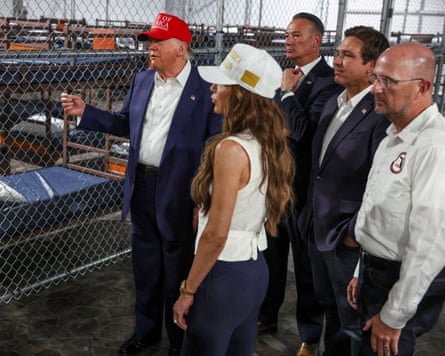
Several career staff internally objected to the changes, Ahmed said, particularly the expansion of offshore detention and the escalation of enforcement operations. “When it came to family separation, Guantánamo and the rapid expansion of enforcement, career staff raised objections,” he said. “But many of the people who pushed back were sidelined, blacklisted or removed from projects.”
Over time, Ahmed said, he realized he could no longer continue the work without compromising his ethics. When the so-called “department of government efficiency” (Doge), led by Elon Musk, offered buyouts to federal workers, including staff at the Department of Homeland Security, he eventually accepted.
“I took it reluctantly,” he said. “Not because it’s what I wanted, but because I didn’t see another path forward.”
Polygraph tests
Multiple current and former DHS officials told the Guardian that they had witnessed or personally been subjected to polygraph examinations – not as part of routine security reviews, but as a tool of intimidation. The Guardian spoke with several former and current officials who independently underwent the examinations, and their accounts corroborated one another in significant detail.
The use of polygraphs across federal agencies has been widely reported, and DHS has said it is “unapologetic” about its efforts to root out leakers. But the identities of the people conducting the examinations was previously unknown. The officials told the Guardian that the few individuals who administered their polygraphs identified themselves as air force personnel being used to interrogate civilian employees of a separate federal agency.
The Guardian submitted detailed questions to the Department of Homeland Security, US Citizenship and Immigration Services, the Department of Defense and Air Force Public Affairs regarding the polygraphing of civilian employees by military personnel, the elimination of oversight bodies, the treatment of career staff and the separation of families. The Air Force communications department declined to address the substance of the questions, instead referring the Guardian to the DHS, stating that any polygraphs of DHS personnel “would have taken place under [DHS’s] direction and authority”. The DHS did not respond to multiple requests for comments.
The polygraph tests were ostensibly prompted by unspecified concerns about the employees’ security clearances. None of the former officials said they were shown the underlying allegations or given an opportunity to respond before being ordered to appear. All said they believed the justification was fabricated and used to create a climate of fear.
Several former officials who underwent the polygraph also recalled being read their Miranda rights before questioning began.
“I was Mirandized,” one former official recalled. “Miranda warnings are only for criminal investigations and prosecutions. There is no civil or employment context for being read your rights. It strongly implied that I was going to be arrested and leave in handcuffs.”
The employees received a written notice that described the examination as voluntary. But multiple former employees said supervisors told them that senior leadership had made the consequences clear: refusal could result in the loss of a security clearance and, with it, their job.
At least three former DHS officials described being escorted into small, windowless rooms and connected to polygraph equipment, including a pulse monitor, sensors on the floor under their feet and in the seat of their chair, a blood-pressure cuff and chest bands that measured breathing patterns. They were instructed to face a blank wall while the examiner sat behind them. A video camera recorded from the corner. One room contained two-way mirrored glass.
Officials said they were warned not to alter their breathing and told that failure to comply could invalidate the results. One official recalled the blood-pressure cuff remaining inflated for long stretches, causing her hand to turn bright red. Another said they felt as though they were suffocating because they were forbidden from taking “deep breaths”.
Some examinations lasted as long as six hours. Several employees were required to return for additional sessions.
“They encourage you to spill everything, saying that you’ll ‘get through’ the questions if you don’t have anything on your mind,” one former employee said. “Trivial things from your personal life, from years ago. Then they make you feel like a very immoral person.”
Forced reassignments
For many, the examination was only the beginning.
Officials were ordered to report to offices in different parts of the country, often in roles for which they had no experience and at agencies with missions far removed from their own.
Current and former officials said the department’s sprawling structure, encompassing more than 20 agencies with vastly different missions, allowed leadership to use reassignments as a powerful pressure tactic against career employees. But employees were given only days to decide whether to accept the reassignment, the Guardian’s investigation found. Some resigned. Others accepted buyouts. A few remained.
Several current officials said they stayed not because they agreed with the department’s direction, but because of personal reasons. One official said they felt “beholden by obligations to their family”. They were often the primary providers in their households, responsible for health insurance, rent or mortgage payments, and their children’s education. One senior DHS official described the decision as a daily moral compromise.
The use of reassignment as a pressure tactic also occurred during Trump’s first term, according to Ron Rosenberg, a former senior executive service leader at USCIS who spent more than 26 years in federal service.
Rosenberg served as district director for the mid-Atlantic region, overseeing more than 450 employees across five field offices and helped lead the agency’s response to the evacuation of Afghanistan in 2021, supporting the resettlement of more than 75,000 evacuees in six months. His work earned him a presidential rank award under the Biden administration, one of the highest honors in federal service.
Rosenberg said political appointees repeatedly tried to push him out during Trump’s first term through reassignment. When repeated reassignments failed to drive him out, he said, officials attempted to relocate his position to another state, a move that would have required his family to uproot their lives. He threatened legal action against the USCIS, and the proposal was eventually abandoned. He remained in government for another six years.
But Rosenberg said the second Trump administration was fundamentally different.
“If the first one was bad, the second one was like lighting a canister of jet fuel on day one,” he said.
Within weeks, he said, career staff were being reassigned, offices were directed to remove pronouns from email signatures and employees were instructed to take down signs identifying gender-inclusive bathrooms. “Every day became another culture war issue,” Rosenberg said. “There were no filters, no constraints. They were going to move as fast and hard as possible.”
To Rosenberg, the atmosphere extended beyond policy disagreements.
“There’s a petulance and a vindictiveness that is endemic in these people,” he said. “It’s reminiscent of the anti-communist paranoia of the McCarthy era. It’s no different.”

Officials interviewed by the Guardian described an agency increasingly consumed by internal power struggles, political pressure and demands for personal loyalty.
One former senior Customs and Border Protection official with first-hand knowledge of the department’s leadership dynamics said Noem frequently clashed with senior career leaders inside CBP, including officials she lacked the authority to remove.
According to the former official, when those efforts failed, members of their staff became targets. Employees who had spent decades inside the department, including front-office personnel responsible for scheduling, travel coordination and daily operations, were reassigned, pushed aside or dismissed.
Trump fired Noem in March 2026 amid bipartisan backlash following the killings of two American citizens by federal immigration agents in Minnesota and growing scrutiny over a $200m taxpayer-funded advertising campaign promoting her leadership, as well as questions surrounding department contracting practices.
In late March, weeks after Noem’s dismissal, the Senate confirmed Markwayne Mullin, a Republican senator from Oklahoma and Trump’s fiercest defender, as the new secretary of the Department of Homeland Security in a 54-45 vote. During his confirmation hearing, Mullin pledged to bring a steadier hand to the department than his predecessor. “My goal in six months is that we’re not the lead story every single day,” he said.
Dorothea Lay, a former senior USCIS attorney at DHS and current vice-president of policy at Jesuit Refugee Service/USA, said the remark missed the larger issue.
“A desire to avoid bad press for cruel and harsh immigration enforcement is not a commitment to stop engaging in harsh and cruel practices and policies,” she said.
Mullin lacks Noem’s appetite for personal vendettas, several officials said, and the CBP commissioner has attempted to bring back some of the staff she forced out. But multiple current employees said nothing of substance has changed. Mullin, they said, has little authority to chart his own course under an administration whose immigration agenda is driven from the White House. Several officials pointed to Stephen Miller, the deputy chief of staff for policy, as the person who continues to set the department’s direction.
“As long as Stephen Miller is at the White House, he is the secretary,” said one current official who wished to remain anonymous for fear of retribution. “Mullin doesn’t get to make the calls.”
The Guardian submitted detailed questions to the Department of Homeland Security and did not receive a response before publication.
Widespread human consequences
Sarah Pierce joined USCIS in January 2023 as a senior policy analyst in the agency’s humanitarian affairs division, after several years working on immigration policy on Capitol Hill.
She worked on some of the agency’s most sensitive humanitarian programs, including refugees, asylum, temporary protected status and victim-based benefits. When Doge offered a buyout to federal career staff, some employees were given days to decide whether to leave government or remain and risk reassignment, termination or the loss of severance benefits.
She watched the panic spread through her office.
“We had large team meetings where people were crying,” Pierce recalled. “People were sharing suicide prevention resources because they were worried about everyone’s mental health during such a massive change.”
Pierce’s division, which no longer exists, was responsible for developing and maintaining the policies that governed how the federal government treated its most vulnerable cases: refugees, asylum seekers, trafficking victims and survivors of domestic violence. It was one of the offices that helped ensure protections existed for people like Wendy Hernández Reyes.

In March of this year, Reyes’s son, a three-year-old US citizen named Orlín Hernández Reyes, was brutally murdered by his uncle, Maldonado Erazo, who had been entrusted with his care after his mother was deported to Honduras in January. Throughout her detention, Hernández Reyes repeatedly pleaded with immigration officials to allow Orlín to accompany her to Honduras, according to reporting by the Washington Post, but her requests went unanswered. Her attorney, Shalyn Fluharty, said that Hernández Reyes only needed a copy of her son’s passport to take him with her.
She never received one.
For more than a decade, administrations of both parties have maintained a policy requiring immigration authorities to give parents facing deportation a choice: take their children with them or make arrangements for their care in the US. The policy existed largely because deportation can separate children from the people best positioned to protect them.
After Orlín’s death, Fluharty assumed bringing Hernández Reyes back to the US to attend her son’s funeral would be straightforward; the circumstances seemed clear. A sheriff’s office press release had confirmed the homicide. The child’s uncle had been arrested.
But securing her return required four separate negotiations with the federal government: first, permission for 48 hours. Then 56. Then enough time to hold a funeral.
“Can we please have time to bury the body?” Fluharty recalled asking.
Eventually, USCIS granted Hernández Reyes six months of humanitarian parole. She returned to Florida wearing a GPS monitor on her wrist.
In previous administrations, Fluharty said, she would have filed a complaint with the Department of Homeland Security’s office for civil rights and civil liberties (CRCL), an internal watchdog empowered to investigate misconduct, intervene in individual cases and force answers from immigration agencies.
“It’s been the purge at every level,” Fluharty said. “Even the soft tissue, the longstanding relationships within the department, so someone can pick up the phone and call the right person.”
But under Kristi Noem, the CRCL office was functionally gutted. More than 100 staff were fired in March 2025, and roughly 600 civil rights investigations were frozen. Though a federal court later ordered DHS to keep the office open, according to the Guardian, a court review found that fewer than 40 people are working; out of nearly 6,000 complaints it received, it directly investigated only 183.
“I am aware of many children in this moment who are in unsafe situations because of our government’s actions,” Fluharty said. “This case is not an anomaly.”