3 months ago
75
3 months ago
75
A piece of performance art that was blocked from representing South Africa at the upcoming Venice Biennale over its supposedly “highly divisive” tribute to a Palestinian poet will go on display at the world’s largest art exhibition after all.
South African artist Gabrielle Goliath’s project, Elegy, will be shown for three months from 4 May as a video installation at the Chiesa di Sant’Antonin church in the Castello district, a venue in the vicinity of the main site that is not part of the Biennale.
The South African pavilion, meanwhile, will remain empty as the country’s government declined to nominate a replacement for the show that was abruptly cancelled in January.
Goliath said showing her work in Venice was vital because its cancellation had set “a dangerous precedent”, coming “only as a result of [South African] culture minister McKenzie taking exception to certain aspects of the work and my refusal to change that”.
Made as a ritual of mourning for women killed in acts of sexualised or racialised violence, Elegy was first conceived in 2015 to commemorate murdered South African student Ipeleng Christine Moholane.
The performance itself is non-verbal: the screens show seven operatically trained female performers emerging from a black background and holding a single high note for as long as they can, before retreating and being replaced by another singer.
The performance on display in Venice also commemorates two murdered Nama women displaced and killed by German colonial forces in the early 20th century, as well as the Palestinian poet Hiba Abu Nada, who was killed aged 32 in an Israeli airstrike in Khan Younis, Gaza, in October 2023.
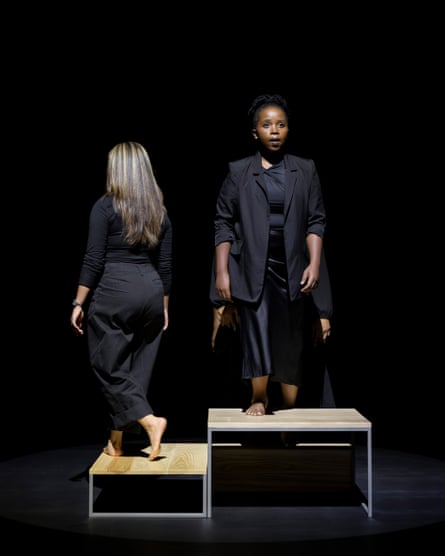
It is accompanied by a ghazal – an ancient Arabic form of ode – that pays tribute to Abu Nada’s poem I Grant You Refuge, which she wrote 10 days before her death.
The war in Gaza is not further thematised in the artwork itself. Only a curatorial statement Goliath has released references “a spectre of genocide” and talks about “thousands of women, children and civilians killed in Gaza”.
South Africa’s culture minister Gayton McKenzie said in a letter dated 22 December 2025 that the subject matter of the artist’s performance “is known to be highly divisive in nature and is related to an ongoing international conflict that is widely polarising”.
A former businessman and founder of the rightwing Patriotic Alliance (PA), McKenzie was appointed culture minister in 2024, when PA joined an ANC-led government of national unity.
South Africa’s previous government in 2023 launched a lawsuit accusing Israel of committing genocide in Gaza, but McKenzie has continued support of the Israeli state, telling the Daily Maverick newspaper “there is no genocide happening there”.
“It wasn’t the specifics of the language that have made the work ‘divisive and polarising’, but the fact that it is directed towards grieving Palestinian lives,” Goliath said.
Last month, the artist failed in an attempt to overturn the government’s cancellation of her pavilion, with a high court judge dismissing her application just hours before the Bienniale’s submission deadline.
Artists acting in support of Goliath and her curator Ingrid Masondo are continuing to appeal against the decision and the fact the judge ordered them to pay the court’s costs. “This is highly irregular and unheard of, particularly within the civic case,” said Goliath.
Opening on 9 May, the Biennale’s main exhibition features works chosen by a central curator, while governments organise national exhibition pavilions.
Swiss-Cameroonian curator Koyo Kouoh, who was to become the first African woman to head up the Biennale, died suddenly last May. Entitled “In Minor Keys”, her main exhibition is being realised by a team of collaborators she met and briefed a month before her death.
In the official section of the 61st edition of the Biennale, 111 artists will show works to represent 99 participating nations this year, up from 84 in 2024.
Goliath’s show at Chiesa di Sant’Antonin is being staged in partnership with London arts centre Ibraaz, which will host Elegy in October.