3 months ago
75
3 months ago
75
Stir-frying, as its name suggests, is the technique of frying while continuously stirring or circulating heat, and it is the heat that’s all-important. Stir-frying is all about wok hei, or ‘wok’s air’ in English, which you can think of as the ‘height of fire’, or the level of heat. It’s said that Chinese cooks have good wok hei if they have a true understanding of the heat of their wok and how to handle it in all situations, and a stir-fry’s success is based on the quality of the cook’s wok hei.
Singapore noodles (pictured top)
This dish may not actually be Singaporean in origin, seemingly drawing on influences and crossovers in cuisine from various regions throughout Asia, but it’s actually the noodles – Singapore vermicelli – that give it its name. Singapore noodles are supposed to be dry yet packed full of flavour. To get this right, follow the instructions closely and remember to keep your wok smoking hot at all times – never, ever lose your sizzle!
Prep 15 min
Cook 15 min
Serves 2
100g dried Singapore vermicelli noodles
2 eggs, well beaten
½ onion, finely sliced
½ red pepper, stalk, pith and seeds discarded, flesh finely sliced
6 large raw tiger or king prawns, peeled and deveined
1 handful fresh beansprouts, rinsed and well drained
Vegetable oil
1 spring onion, trimmed and finely sliced, to garnish
For the spice paste
1 bird’s-eye chilli, finely chopped
1 tbsp water
1 tbsp light soy sauce
½ tsp dark soy sauce
1 tsp sesame oil
1 tsp madras curry powder
1–2 pinches chilli powder, to taste
¼ tsp salt
Soak the noodles in hot water for three minutes, until they have separated, then drain and leave to dry on a clean tea towel for 10 minutes. Mix all the ingredients for the spice paste in a small bowl or ramekin.
Build a “wok clock” on a large plate or board. Start at 12 o’clock with the beaten egg, followed by the onion and red pepper at three o’clock, the prawns, beansprouts and noodles at six o’clock and finally the spice paste at nine o’clock.
Heat a tablespoon of vegetable oil in a wok on a high heat. When it’s smoking hot, pour in the beaten egg, leave to bubble for a few seconds, then lightly scramble until cooked through.
Push the egg to one side of the wok, to make space for the vegetables and heat again until smoking hot. (If you prefer, you can transfer the egg to a bowl, or scramble it in a small wok with not enough space for the veg as well.) Add the onion and red pepper to the wok, stir-fry for a minute, then add the prawns and stir-fry for 30–60 seconds, until lightly browned.
Add the beansprouts to the wok, stir-fry for 20–30 seconds, then add the noodles and stir-fry for a minute. Stir in the spice paste and cook, stirring, until all the ingredients are thoroughly combined, and the noodles have dried out a little and are just starting to stick to the wok. Transfer to a large serving bowl, scatter over the spring onion garnish and serve.
Sichuan chicken
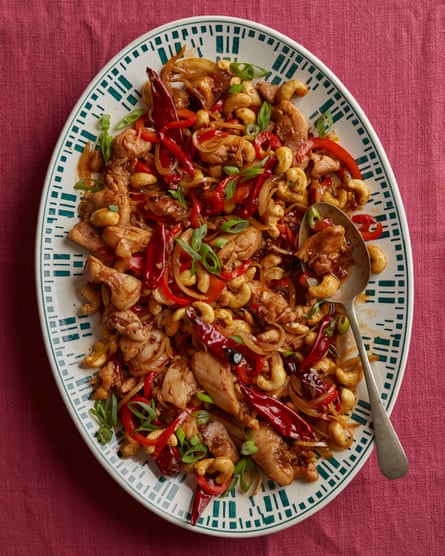
The region of Sichuan is situated on the western side of China, and is therefore heavily influenced by ingredients from Tibet and northern India. The most significant of these, Sichuan peppercorns, have become increasingly popular in the west in recent years. These dried red berries, native to China, have a distinct fragrance when crushed and provide a unique numbing feeling all over the tongue, something the Chinese call ma la. They can be easily found in most Asian supermarkets and on the world food aisle of large supermarkets.
Prep 15 min
Cook 20 min
Serves 4
400g boneless, skinless chicken thighs, cut into 3cm-wide strips
½ onion, cut into fine matchsticks
1 red pepper, stalk, pith and seeds discarded, flesh cut into fine matchsticks
10 dried red chillies
2 tsp Sichuan peppercorns, crushed in a mortar
3 garlic cloves, peeled and finely chopped
1 bird’s-eye chilli, stalk discarded, rest finely chopped
200g cashew nuts
Vegetable oil
1 spring onion, trimmed and finely sliced, to garnish
For the marinade
1½ tbsp cornflour
1 tsp sugar
1 large pinch Chinese five-spice
2 tbsp light soy sauce
1 tsp sesame oil
For the sauce
3 tbsp Shaoxing rice wine, or dry sherry
1 tbsp light soy sauce
2 tbsp hoisin sauce
2 tsp chilli paste, or chilli bean paste
Put the chicken in a large bowl, add all the marinade ingredients and, using your hands, massage into the strips until evenly coated. Mix the sauce ingredients in a small bowl or ramekin, and set aside.
Build your wok clock on a large plate or board. Start at 12 o’clock with the onion, red pepper and dried red chillies, then work your way round with the marinated chicken, crushed Sichuan peppercorns and garlic at three o’clock, the bird’s-eye chilli and sauce at six o’clock and, finally, the cashew nuts at nine o’clock.
Heat a tablespoon of vegetable oil in a wok on a high heat. When it’s smoking hot, add the onion, red pepper and dried red chillies, and stir-fry for one to two minutes, until the onion is lightly browned and slightly softened.
Turn down the heat to medium and push the ingredients to the side of the wok. Add another half-tablespoon of vegetable oil to the centre of the wok, heat to smoking point, then add the chicken and stir-fry for three to five minutes, until golden brown on all sides. Turn down the heat to medium, add the crushed Sichuan peppercorns and garlic, and stir-fry for two minutes.
Add the bird’s-eye chilli and sauce, and stir-fry on a medium-high heat for two minutes, until the sauce has thickened and reduced and is sticking to the chicken. Add the cashews and cook for a final 30–60 seconds, tossing the wok to combine all the ingredients.
Transfer to a large serving plate, scatter over the spring onion garnish and serve.
-
These recipes are edited extracts from School of Wok – Jeremy Pang’s Chinese Kitchen: Simple Techniques and Recipes to Enjoy Delicious Chinese Food at Home, published this month by Hamlyn at £25. To order a copy for £22.50, go to guardianbookshop.com