2 months ago
64
2 months ago
64
Nearly half a century ago, the US Department of Energy launched a clean energy experiment beneath the University of Minnesota with a simple goal: storing hot water for months at a time in an aquifer more than 100 metres below ground.
The idea of the seasonal thermal energy storage was to tuck away excess heat produced in summer, then use it in the winter to warm buildings.
Now, 45 years after the first test wells were drilled under the university’s St Paul campus, one of the first large-scale aquifer thermal energy systems in the country is being built less than 10 miles from the original test site.
The Heights, a mixed-use development rising from a former golf course on the city’s Greater East Side, will tap thermal energy from an aquifer 100 to 150 metres below ground.
Groundwater from wells spread across the northern half of the 45-hectare development will be drawn by high-efficiency electric heat pumps, powered in part by solar panels, to provide low-cost heating and cooling with little greenhouse gas emissions for 850 homes and several light-industrial buildings.
The groundwater could also serve as a thermal battery, storing excess heat in the summer for use in the winter, said Michael Ahern, senior vice-president for system development at Ever-Green Energy, the firm designing the heating and cooling system.
The system will be one of the first large-scale aquifer thermal energy projects operating in the US since the Department of Energy field tests in the 1980s, although more than 3,000 similar systems have been built worldwide, according to a 2024 study, with the vast majority in the Netherlands.
Marc Hoyer, a retired scientist who worked for the Minnesota Geological Survey and the University of Minnesota, worked on the St Paul project in the 1980s. He and other survey members took turns sleeping in a trailer next to wells, waking each hour to record temperature and pressure gauge readings as part of their round-the-clock monitoring of the system’s performance. Seasonal storage promised to “significantly reduce the need to generate primary energy in the United States,” and aquifers were seen as “the most cost-effective approach,” concluded a federal report published in 1991 by what is now known as the Pacific Northwest National Laboratory.
Hoyer, now 82 and living in Maryland, said it felt good to hear that the technology was drawing renewed attention in the US. “I figured nobody cared about it,” he said.
‘The LED of heating and cooling’
Compared with conventional heating and cooling methods, aquifer thermal energy storage can significantly reduce greenhouse gas emissions by up to 74% according to the 2024 study. That represents an efficiency increase similar to switching from conventional incandescent lighting to light-emitting diodes, or LEDs, according to the Department of Energy.
“This is the LED version of heating and cooling,” said Yu-Feng Lin, director of the Illinois Water Resources Center.
Aquifer-based heating and cooling works similarly to air-source heat pumps, an electric technology that relies on outdoor air to warm and cool buildings. The devices are highly efficient, but when temperatures spike in the summer or plummet in the winter, the fans and compressors used by air-source heat pumps have to work harder, reducing their efficiency when they are needed most. But while the air temperature in Minnesota can swing from the 30Cs in the summer to under -10C in the winter, the aquifer beneath The Heights remains approximately 10C throughout the year.
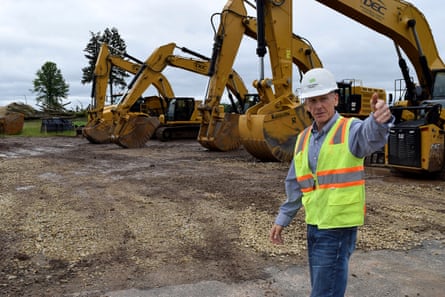
“Think about how much energy you are saving there,” said Lin, who is a principal investigator for an international consortium led by the US Geological Survey that develops standards and best practices for thermal energy storage. “A lot of people think about geothermal as just hot lava [and] hot steam that pushes a turbine to generate electricity. That’s not all of geothermal.”
And charging a portion of the aquifer with warm water in the summer can raise its temperature by several degrees, making winter heating even more efficient, Lin said, while cooling other parts of the aquifer with cold water in the winter can reduce the amount of energy required for air conditioning in the summer.
The system is similar to geothermal heating and cooling networks already in use elsewhere in the region, which use layers of rock and sediment as sources and sinks of thermal energy. The main difference is that aquifer geothermal requires far less drilling.
The costs for the two approaches are comparable, as the water wells used for aquifer geothermal are larger and significantly more expensive to drill. Aquifer geothermal also requires access to shallow underground aquifers, which do not exist everywhere but are a good fit for Minnesota, which has an abundance of subsurface water.
“It kind of makes sense to utilise that local resource,” said Rob Thornton, president and CEO of the International District Energy Association, an industry group.
A local resource
On a tour of the site in late June, Ahern’s boots sank into soft mud from a recent rainstorm. “This was all just a golf course. You can kind of get a sense of it from the rolling hills.”
While the Trump administration is quickly phasing out tax incentives for wind and solar, credits for geothermal projects approved as part of the Inflation Reduction Act remain largely intact. The aquifer thermal energy system at The Heights – including the wells, heat exchangers and pipe network – will cost about £8.9m ($12m) to construct. This does not include the heat pumps and other equipment that will go in each building. Federal tax credits should cover about 50% of the system’s total cost, Ahern said.
For Cheniqua Johnson, a St Paul city council member representing Ward 7, an adjacent neighbourhood on the city’s east side, the projected cost savings for residents of The Heights could be significant.
“It is the difference between paying a $200 to $300 per-month bill, and less than $100,” said Johnson, who is also treasurer of the Saint Paul Port Authority. “That is what we’re striving for.”
Johnson added that many people in her community had had their gas or electricity shut off by their utility company because they were unable to pay their bills.
Darcy Solutions, an aquifer geothermal energy startup in St Paul, is overseeing well drilling for a separate geothermal system on the location which will provide heating and cooling for a new service center for Xcel Energy, a gas and electric utility that will be the first large employer to move in at the site.
Kristine Williams, Saint Paul Port Authority’s chief development officer, said the geothermal effort there could be a sign of things to come.
“I think that this type of industrial development, while it’s unique today, is what we will see going forward,” Williams said.
This article originally appeared on Inside Climate News, a nonprofit, non-partisan news organisation that covers climate, energy and the environment. Sign up for their newsletter here