2 months ago
92
2 months ago
92
Just six months after the world rallied to defend poor Paul Dano, vulnerability may now be a hot commodity for an actor. What is “weak sauce” for Quentin Tarantino, who attacked Dano, can be mighty savoury for others. So it’s good timing that Théodore Pellerin, with his gangly frame and huge eyes, exudes that quality in the new French character study Nino. Gauche, hesitant and withholding, Pellerin is magnetic as a young Parisian locked out of his apartment for a weekend after a papillomavirus (HPV)-related cancer diagnosis.
Pellerin explains Nino’s predicament, his inability to be candid with his loved ones, almost down to the cellular level. “His throat cancer isn’t insignificant,” he says. “It’s the part that links the head to the body. There’s a dissociation from the body – a distancing of his emotions. And because it comes from a sexually transmitted disease, his sexuality – a strong life force – is stunted too. So his mission is to speak and to ejaculate.” Urgently in the case of the latter: Nino must freeze his sperm as his treatment will make him infertile. His odyssey around Paris is the gen Z answer to French New Wave classic Cléo de 5 à 7, which also revolved around a cancer diagnosis. Only this time, it’s about the impossibility of finding a good place to masturbate.
Reeling off his character’s diagnosis with cool self-assurance via a Zoom call from his home in Montréal, Canada, Pellerin doesn’t seem vulnerable in real life. Plaid shirt rolled up his forearms, with cropped brown hair and tidy oval glasses, he has the brisk air of a business student between lectures. He is actually between projects, waiting for a new shoot to begin in August having recently finished Tom Ford’s 18th-century drama Cry to Heaven.
His stock is rising fast, thanks not just to Nino but also to last year’s caustic psychological thriller Lurker, in which he played a parasocial LA hipster desperate to ingratiate himself with a pop star. In that film his vulnerability segues into a dangerous neediness, but it always seems to remain Pellerin’s centre of gravity. Even more strident roles – like a loose-cannon apprentice hoodlum in the 2018 Québécois crime film Family First, or the pyramid-scheme proselytiser tutoring Kirsten Dunst in the 2019 TV series On Becoming a God in Central Florida – have a disarming innocence.
Nino director Pauline Loquès, who also co-wrote the script, recognised that Pellerin has a particular quality. “Théodore had this ability to give life to silences,” she says. “They became charged with other dimensions – poetic, mysterious or psychological.” She insists that he understood the character she created better than her – quite a feat considering this was a very personal project, drawn from her outrage at the death from cancer, aged 37, of a family member she will only identify as “Romain”.
Pellerin pointed out that Nino is fundamentally a film about parenthood – which came as news to Loquès, despite the number of parental or quasi-parental encounters (including an aftershave-proffering Mathieu Amalric), and the suddenly accelerated biological clock ticking in the background. Loquès, 39, used to be a journalist. Did Pellerin feel there was any risk in signing up for her first foray into directing? Au contraire: “Plenty of big directors make really bad films. And if you write a magnificent screenplay, the film will be great – because you’re close to your subject, you’ve mastered it.”
He goes on: “I never had the impression of having to force anything, or add a layer of fiction on top of what I was ‘living’ with the other actors.” Maybe this ambience was what allowed him to succeed with the pivotal masturbation scene. It would have been easy to overdo it, or hit an unfortunate comic note, instead of making it a touching moment of liberation.

“It was a bit stressful for Pauline because she didn’t want to sexualise a moment that was really important for the film,” says Pellerin. “She was a bit uncomfortable talking to me about the scene. We just had to stick close to what we were really saying, and what it represented for the character and the film. I’d just played Karl Lagerfeld’s boyfriend Jacques de Bascher in a TV series, with an orgy scene where I masturbate in a T-shirt. So Nino wasn’t really a big deal.”
If Pellerin talks like someone seasoned, it’s because he got off to a quick start, spurred on artistically by both sides of the family. His mother, Marie, is a choreographer; his father, Denis, a painter. After attending a secondary school that specialised in dramatic arts, he starred in his first TV series, the popular school drama 30 Vies, aged 16. “I grew up in theatre dressing rooms, with the dancers from my mum’s troupe. So the theatrical space was one I loved. It was playful, personal. Being an artist wasn’t necessarily what I always wanted to do when I was young – but it’s never been an impossibility from my perspective.”
Pellerin is speaking to me in French, his Québécois twang growing as the interview goes on. He quickly racked up credits in his native tongue, playing a younger version of Vincent Cassel’s character in Xavier Dolan’s It’s Only the End of the World in 2016, and a highly annoying little brother and possibly mentally ill street tough in Family First. But he identified English-language roles as the way forward in his career, and learned the language to appear as a teenager struggling with his sexuality in 2017’s Never Steady, Never Still, opposite Shirley Henderson.
Sidling around the edges of Hollywood, with a brief appearance as one of Joaquin Phoenix’s fantasy sons in Ari Aster’s Beau Is Afraid, Pellerin hit on bigger acclaim with Lurker. His LA drawl in the film is flawless – and the same is likely to be true of the RP he had to master as a castrato music professor in Cry to Heaven. In anglophone roles, he says, it’s all a question of rhythm: “There’s a bit more of an intellectual process to go through with English, because phrases are constructed in such a way that, for them to have the right sense, consciously or unconsciously, you have to hit the right accents. In French, you don’t have to worry about the rhythm. In English, it’s more pap-a-pap-a-pap-pap-pap.” His hand vaults up and down an imaginary score, like a conductor’s.
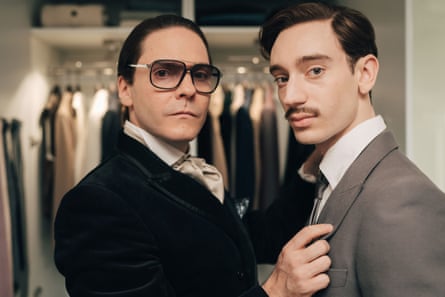
in Becoming Karl Lagerfeld. Photograph: Caroline Dubois - Jour Premier/Disney
Pellerin is landing leading roles in both languages now, but he needs time to work his way fully into them – he has spoken in the past of being slow. Loquès elaborates: “He often says, ‘I’m not a great actor but I know how to read a script really well.’ That’s the difference between him and other actors – he’s very strong at doing research upstream. It’s a place of expansion for him. Then he tries to forget it all before coming on set.”
The roles that have stayed with him are the ones he went to town on, unsurprisingly. With Family First, he feared he might remain permanently in a sadistic frame of mind, while Lurker’s milieu of celebrity leeches and hangers-on took its toll too. “It was a kind of cynicism. The feeling of rejection was very strong, because that’s what the character was going through in every scene.” Nino, however, was a character he didn’t want to let go. “It was more of a return to my life, to frivolity. I wasn’t confronting mortality in the same way. I found it hard: it was like a loss of poetry in my life.”
The way Pellerin is going, though, there will soon be other characters to mine. I want to ask if he is already slipping into someone else’s skin, upstream of this August shoot – but we’re out of time. He has already told me he has to go at noon sharp. It turns out he is digging into a character, though: his own. “Er, I’ve got my therapy session on Zoom now, so that’s what I’ll be doing with my psychologist.” And with a wry smile and a “merci”, he’s gone. Being vulnerable is a full-time job.