3 months ago
91
3 months ago
91
When authorities in the Brazilian state of São Paulo transferred nearly 800 suspected gang members to maximum-security prisons in May 2006, the crime group launched a wave of prison riots and attacks on law enforcement officers. Fifty-nine police and prison officers were killed.
In the following nine days, police officers took their revenge, killing more than 500 people in what were described as shootouts with “criminals”, but which human rights organisations and forensic studies attribute, at least in large part, to executions, including of innocent people.
Twenty years later, the vast majority of those murders remain unresolved, and victims’ relatives are still demanding the truth from the Brazilian state.
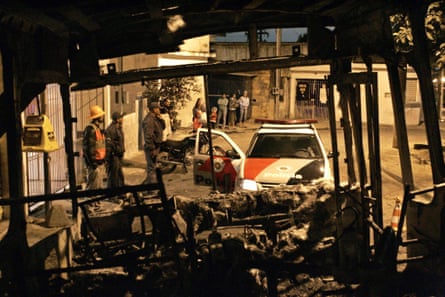
Brazil’s superior court of justice is expected to finally rule soon on long-sought compensation for the victims.
“There is no amount of money that can pay for the life of a child,” said Débora Maria da Silva, founder of the Mothers of May Movement, the main organisation bringing together relatives of the victims.
Da Silva learned of the death of her eldest son, Edson, 29, when a radio presenter read out a list of those killed in what were described as “confrontations with police”.
She spent the following years trying to discover what had happened to him, tracking down a witness and eventually managing to have his body exhumed and reburied in 2012. In the course of her investigation she discovered that, her son, a street cleaner, had been approached by eight police officers at a petrol station.
“When he said he was a worker and had done nothing wrong, they beat him,” said Débora. Shortly afterwards, he was shot five times and killed.
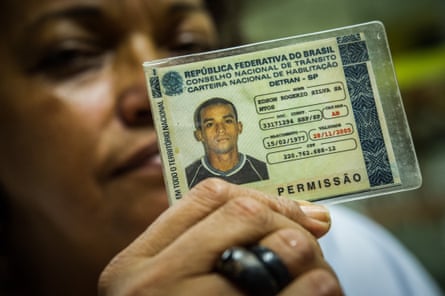
After years of legal battles, the state was ordered to pay her £72,000 ($97,000) in compensation and a pension equivalent to one-third of the monthly minimum wage (£80).
The judge ruled that police had responded to the PCC attacks in a manner that was “violent, unreasonable and indiscriminate and therefore illegal”. But none of the police officers involved was ever identified.
“The crimes of May 2006 were one of the gravest chapters in Brazil’s history,” said the lawyer Gabriel Sampaio, a director at the NGO Conectas, which assists some of the victims’ families.
Even the killings of public officials saw little resolution. A recent report by the newspaper Folha de S Paulo identified only 15 convictions, such as that of the PCC leader Marcos Willians Herbas Camacho, known as Marcola, who was sentenced to 50 years in prison for ordering the execution of a firefighter.
As far as is known, only one police officer was convicted: a corporal who was found guilty of murder for opening fire on three young men who were chatting on a street.
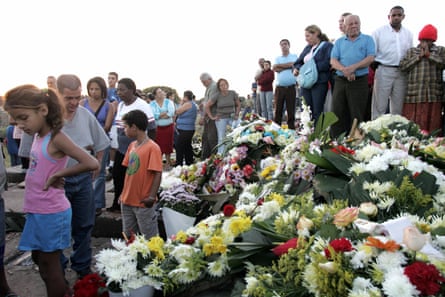
“Civilians were killed in circumstances that, according to forensic reports, clearly indicate summary and extrajudicial executions and torture,” said Sampaio.
Only 6% had criminal records – and Sampaio notes that, even if they had committed any crimes, there is no death penalty in Brazil. Most of the 505 civilians were young Black men from poor neighbourhoods and favelas.
Individual accountability became extremely difficult because “the state failed in its investigative duties,” added Sampaio, noting that police failed to preserve crime scenes, often removing victims’ bodies to hospitals under the “false pretext” of “providing assistance”. In many cases, the victims were already dead.
An analysis based on forensic reports from 124 bodies – all recorded as the result of alleged “shootouts” with police – found that most gunshots hit highly lethal areas, and were fired at close range and from above. The forensic expert concluded that these elements “point to a scenario more consistent with execution than with a gunfight”.
São Paulo police did not respond to requests for comment, but in recent statements have maintained the same position held over the past 20 years: that all the killings were investigated “in a regular and rigorous manner”.
Since then, the PCC has continued to grow, evolving from São Paulo’s largest criminal faction into one of the largest in Latin America and expanding cocaine exports to more than 20 countries, including in Europe and the US.
“The state’s response to the PCC attacks was so misguided that it produced no restraint to the organisation,” said Sampaio.
In 2018, a public prosecutor filed a lawsuit seeking compensation for the families of the victims and the 110 injured survivors, but the state court rejected it; the case is now awaiting resumption at Brazil’s superior court, with proceedings scheduled to resume on 10 June.
“There needs to be an apology,” said Débora, from the Mothers of May, whose name references Argentina’s Mothers of Plaza de Mayo, formed in the 1970s by mothers searching for children disappeared under their brutal dictatorship.
Débora said the Brazilian movement was seeking not only justice but also changes to Brazilian legislation.
“The Brazilian state continues to produce ‘mothers of May’ and we cannot say there is democracy here while Black people and the poor continue to be persecuted and killed by the police,” she added.