3 months ago
99
3 months ago
99
Isn’t it weird that dentistry and medicine have been kept largely separate? Why should our mouths be treated differently from the rest of our bodies? Going to the dentist often feels like more of a lifestyle and cosmetic add-on, especially for adults in the UK. And, even if you can find an NHS dentist, the service is not free at the point of use like medical doctors are.
The origin story for this rift is that dentistry began, in the middle ages, as a trade – with tooth extractions handled by “barber surgeons” and dentures crafted by jewellers and blacksmiths. Today, dentistry and medicine still have their own separate training routes, professional bodies and NHS setup. Generally speaking, medical doctors can’t act as dentists, and dentists aren’t medical doctors. But the tide is turning on this conceptual separation, because the links between oral health and systemic healthcare are becoming ever more apparent.
Cardiologists and doctors treating type 2 diabetes, for example, are increasingly concerned with the state of their patients’ mouths. Specialists in everything from rheumatoid arthritis to cognitive decline may soon be too, if recent research is any indication.
“People forget that the mouth is an open portal, a gateway into the bloodstream and your lungs, and inside your body,” says Steve Kerrigan, professor of precision therapeutics at RCSI University of Medicine and Health Sciences’ school of pharmacy and biomolecular sciences in Dublin. Our mouths host about 700 species of bacteria, he says. Gum disease is extremely common: around half of UK adults have it in some form, caused by bacteria-harbouring plaque building up on teeth. Gingivitis is the milder, reversible version (a tell-tale sign is bleeding when you floss or brush). Periodontitis is when inflammation leads to teeth detaching from gums; this is the main cause of adult tooth loss and is irreversible.
“Gum disease is now classed as a chronic inflammatory condition in its own right,” says Kerrigan, “up there with asthma, COPD [chronic obstructive pulmonary disease], Crohn’s disease and ulcerative colitis.” Some studies have shown that “up to 90% of people with cardiovascular disease also have gum disease”, he says. Research into the relationship between the two is the most advanced in terms of investigating oral and systemic health, showing some actual causation, rather than mere associations. This is an important question when it comes to the connections between oral and general health. It is one thing knowing that people with gum disease are more likely to also have certain other conditions; but how do we know which is causing which, or whether both are simply signs of a body compromised by general poor health?
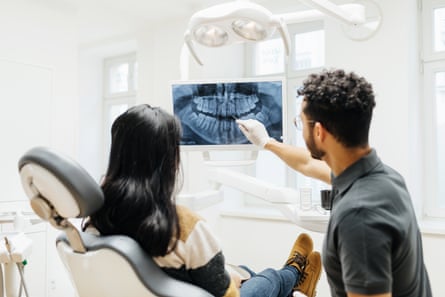
It is already well established that oral infections can cause bloodstream infections. This is why patients with replacement heart valves, for example, have long been given prophylactic antibiotics before tooth extraction or deep descaling procedures. But oral bacteria can also leach into the bloodstream through rotten teeth or bleeding gums and slowly, imperceptibly, damage the cardiovascular system in other ways.
There’s a condition called atherosclerosis, where cholesterol, fat and calcium build up into plaque on artery walls, restricting blood flow. This plaque is different from dental plaque, which is a sticky bacterial film, although both harden over time and are associated with inflammation. “The majority of bacteria in atherosclerotic plaque is from the mouth,” says Kerrigan. Now, scientists need to figure out whether bacteria from the mouth get into the bloodstream and cause atherosclerosis to develop, or whether the plaque was triggered by some other mechanism but is sticky, so when the bacteria from the mouth are in the bloodstream, they adhere to it. Either way, once the bacteria are there, they can increase inflammation and create other health problems.
Oral bacteria can also increase the risk of blood clots and strokes. “Once these bacteria breach the barriers in the mouth,” says Kerrigan, “they get into the bloodstream, and they can bind to the blood clotting cells, called platelets.” Platelets help stop us bleeding when we cut ourselves. “When these bacteria bind to platelets, it causes them to stick together the exact same way as when you cut yourself. What that means is that you’ve got a clot circulating in your bloodstream, and that clot will eventually get stuck in a small blood vessel. And if that small blood vessel is feeding the brain, then you end up with either a transient ischemic attack – a mini-stroke – or a full-blown stroke.”

If the clot gets stuck in one of the vessels in your heart, he says, “you can suffer a heart attack as well”. And when a clot forms on your heart valves, “that leads to a condition called infective endocarditis. This prevents your valve closing properly, which can lead to heart failure. These things are quite well recognised.” Nearly all of the bacteria found that trigger these clots are oral bacteria, says Kerrigan.
Diabetes is another condition with a fairly well-established link with oral health. One of the latest developments was recorded in a 2025 study, which found that having root canal treatment significantly lowered blood sugar levels (diabetes is characterised by excessively high blood sugar levels). Root canal treatment also lowered blood cholesterol and fatty acid levels, providing an additional boost for heart health. This finding suggests that removing damaged or infected pulp deep inside a tooth, and sealing the roots, could not only save your tooth, but also help protect against type 2 diabetes.
The diabetes connection is a two-way street. If you have gum disease, you’re more likely to develop diabetes, as systemic inflammation from oral infections can mess with blood sugar control; conversely, if you have diabetes and your blood glucose levels are persistently elevated, you’re more vulnerable to gum disease. “People with gum disease or periodontitis and diabetes have a three times higher mortality risk than those without gum disease,” says Kerrigan.

Correlations between oral health and dementia are also under ongoing investigation, although no causal link has been proved, says Jing Kang, a senior lecturer in medical statistics at the faculty of dentistry,oral and craniofacial sciences at King’s College London. And if oral diseases are affecting cognitive decline, there is again a chicken-and-egg question here, not least because cognitive impairment can make it harder to maintain oral hygiene. A 2016 study by Kang’s colleagues found that the presence of gum disease was associated with a six-fold increase in the rate of cognitive decline over six months. The study also found that, over the six-month follow-up period, gum disease was associated with “a relative increase in the pro-inflammatory state”, which leaves us more vulnerable to major illnesses – from cancers, to neurodegenerative and metabolic diseases, to depression.
One theoretical route for oral health contributing to developing dementia, says Kang, is that “it is all related to the immune response and inflammation”. But it’s hard to pinpoint a precise causal mechanism – and there could be many: “It is possible that behaviours, such as our choice of food or choice of lifestyle, could also impact on our oral health.” As part of a bigger, systemic picture, cardiovascular disease and chronic metabolic diseases associated with oral health could be affecting brain degeneration, too. It’s a complex, multifactored situation. Poor education in childhood could be a factor, Kang says, leading to worsening oral health gradually over time; then, when we’re older, the resulting inflammation affects cognitive function. Studies usually look at people from middle age at the earliest, but whole lives need to be accounted for, she says. “There are all sorts of hypotheses, but it’s hard to prove and further studies are needed.”
Meanwhile, if we do feel gum pain, we could see it as a potential window into what’s happening inside the body, says Kang. She and her colleagues are working towards establishing whether treating oral health issues promptly “would prevent or delay cognitive decline”. They’re only at the small, proof-of-concept study stage so far – but, she says, it’s never too late to take better care of our mouths.
The evidence for the oral-brain axis so far is more to do with gum disease and less to do with the teeth. But in terms of oral care, the two go together.
Advanced gum disease and tooth decay can in themselves be painful, as well as smelly and unsightly. This affects quality of life, Kang says, which can in turn affect our overall health and wellbeing: “Oral health is reflected in how we feel, our appearance, our confidence.” When her team has studied this, “people who are suffering from gum disease are less confident and don’t want to socialise, compared with people who have healthy teeth. That may affect the brain or other parts of the body. And because of the pain and inflammation, people need to take more medication – and some medication has side effects on oral health because it reduces saliva generation. So everything is interlinked.”
According to Kang’s research, brushing twice a day and flossing wherever possible may even help fix your aching knees. “People who had arthritic knees were more likely to have had gum disease, and vice versa. People suffering from more gum disease were diagnosed [with arthritis]; or they saw deterioration much quicker than those who had healthy teeth.”
None of this means we should panic and assume the worst at the first hint of toothache. Kang is careful to point out that this is all statistical evidence, “from the population level. It does not apply to individuals. So don’t worry too much, if when brushing your teeth there’s blood, that you’re going to get dementia the next day. It is just a message to deliver to the public to keep our teeth and gums healthy.”

The government’s last oral health survey, in 2021, found that a quarter of adults with natural teeth reported teeth, fillings, crowns or fixed bridges that were damaged, cracked or broken. But getting emergency help, or even treatment, on the NHS is increasingly hard, leading to reports of people self-treating and even pulling out their own teeth. And, as Kerrigan says, even if a tooth is taken out professionally, “a vast majority of people won’t be able to afford implants to replace that tooth, so everything changes in your mouth. If you don’t have teeth, the microbiome in your mouth is going to change. And we already know that the bacteria that are in your mouth are critically important because they are the first step in digestion.”
What can we do to minimise the risks? “You’re meant to brush your teeth at least twice a day, morning and evening,” says Kerrigan. “That’s the bare minimum, but during the day is great as well, if you can do that.” He says electric toothbrushes with rotating heads “are probably much better for moving and pulling the bacteria off your teeth”. Flossing, of course, and cleaning between your teeth, are recommended.
“Diet plays a really important role here as well,” he says. “When you snack, it’s [likely] going to be on sugary foods. So obviously, the more sugar you put into your mouth, the more you’re feeding the bacteria. You want to avoid that as much as possible, because the more bacteria, the more damage they’re going to do to your teeth and to your gums. But again, you have to look at the person.”
Clearly, we shouldn’t suddenly only focus on oral health at the cost of everything else; it’s just one important aspect of an overall healthy lifestyle. You often find, says Kerrigan, that “the person who runs several times a week – they probably have perfect oral hygiene as well. And if you look after one part of your body, you tend to look after all parts of your body.”