2 months ago
53
2 months ago
53
The inscription on the large 13th-century stone slab on display at York Minster does not bode well: “Qui ceci dit svp er caput rogeri de Ripvn.” Or, as it translates: “Which fell on the head of Roger of Ripon.”
“We don’t quite know who Roger of Ripon was,” said Jennie England, research coordinator at the cathedral. “But he survived, and a miraculous incident was reported in the 1280s when a stone fell on someone’s head.”
The slab, found in a York drain in the 19th century, has gone on display at a new exhibition marking the 800th anniversary of Saint William – a forgotten, once adored martyr said to be responsible for that miracle and others.
At the centre of the exhibition is a cutting-edge, digital recreation of an imposing shrine to William that once stood in York Minster’s nave but was broken up and buried to protect it from the ravages of Henry VIII’s reformation.
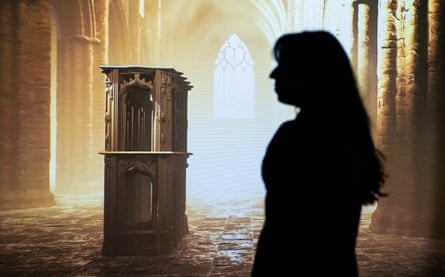
“The shrine is absolutely stunning,” said England. It reflects, she added, the high regard William was once held in. He is the patron saint of York but is “largely forgotten”.
William Fitzherbert was archbishop of York twice, from 1141 to 1147 when Cistercian monks thought him unsuitable and, after the deaths of enemies, from 1153 to 1154.
He was clearly a popular figure and such was the joy when he returned to York from Rome in 1154 that large crowds gathered to greet him. So many people were on the wooden bridge over the River Ouse that it collapsed. William, it is said, called on God and no one drowned.
That is considered William’s first miracle, but his triumph was short-lived, and he died after becoming violently ill while celebrating mass. His death remains suspicious to this day.
The Ouse Bridge miracle and others after his death – including curing a woman who inadvertently swallowed a frog – led to William’s canonisation by Pope Honorius III in 1226.
His then resting place in York Minster’s nave became one of the most significant sites for pilgrimage in England and was the reason for the 3.8-metre-tall shrine, erected in the 14th century.
“It was a massive monument, beautifully decorated and hugely popular and it helped shape the minster but that can feel slightly lost to us now,” said England. “That is one of the joys of the exhibition.”
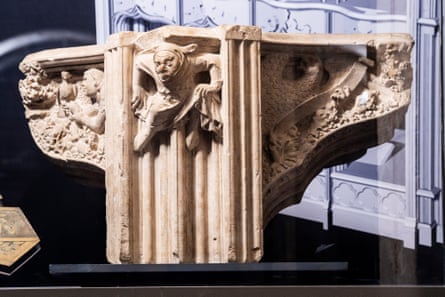
The shrine was dismantled in the 16th century, with pieces buried across the city. England said it was clearly done with care, “perhaps with the hope that they might return”. That had now happened in a way they could never have imagined, she added.
Fragments of the shrine uncovered in the centuries since the Reformation are in the care of York Museums Trust, while others remain hidden under buildings and pavements. The fragments that have been found include three of four corners of the shrine.
Visitors to the cathedral will be able to see the digitally recreated shrine in a new film, made by Viridian FX, a visual effects company. Actual fragments will also be on display.
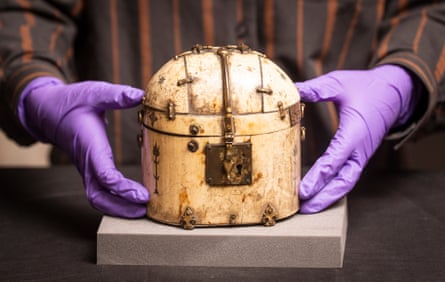
Other exhibits include a 12th-century bible and an ivory casket, probably made in Sicily and acquired by William when he visited the island in 1147.
Dominic Barrington, the Dean of York, said one could not help but be moved by the legacy of William, an “often overlooked” saint.
“The artistry he inspired, seen in stained glass, the surviving shrine fragments, and artworks, has left a lasting impression on this very building,” he said.
“Yet this artistry is not a thing of the past. Our commitment not just to conserving this building, but to continuing to meet the needs of the hundreds of thousands who journey through our doors each year, means that today our craftspeople are using incredible technology and traditional skills to reveal lost shrines.”