3 months ago
72
3 months ago
72
On a rainy afternoon last weekend, plans got cancelled and I found myself at a loose end. Given that I’m someone who likes to have backup plans for my backup plans, my initial response was panic. Now what? I wandered aimlessly from room to room, grumpily tidying away random items.
Noticing for the first time in weeks that most of my houseplants were critically ill, I decided to give them a spa day. I moved the worst cases to a south-facing windowsill and painstakingly removed the (many) dead leaves. For good measure, I organised a triage box containing plant food, a mister and a watering can. I might have got carried away and ordered a “beautifying leaf shine” too.

It’s a funny thing, isn’t it, how we often hurtle through life fuelled by busyness and adrenaline, secretly yearning for rest. But when the opportunity finally arises, it feels uncomfortable. Somehow, though, my botanical A&E session instilled a soothing sense of nesting. It was getting dark and, feeling weirdly smug, I went round replacing the missing bulbs in various lamps and turned the lights down low. Snoozing on the sofa under an electric throw and half listening to a podcast, I spent the rest of the day in this dozy state. After dinner, I decided to have an early night. I slept better than I had in ages.
Despite the palpable benefits, my initial reluctance to slow down is not unusual. Research has shown that people often underestimate the extent to which they will enjoy inactivity. There’s a tendency for human beings to prefer to do something, even something unpleasant, than the alternative. This was proved to an extraordinary degree by Harvard University psychologists whose study revealed that given the choice between sitting alone with their thoughts for as little as six to 15 minutes or giving themselves an electric shock, participants preferred to be zapped.
So why is it that so many of us have an aversion to idleness? “It’s not even an aversion, I think it probably doesn’t even occur to a lot of people,” says Gabrielle Treanor, author of The 1% Wellness Experiment.
“Nowadays there is always something to occupy us. We are connected to everything all the time,” she says. “So the opportunity to do nothing rarely arises.” Social media, for one, is constantly bombarding us with ideas for new things to do. “We’re inspired by ways to do up our house or places to visit or new things to try. It’s easy to feel that life offers endless possibilities. We try to cram everything into our days.”
There’s another factor: guilt – particularly about appearing to be lazy. Increasingly, being busy carries a sense of status and moral superiority. “Many of us grew up with the phrase ‘the devil will find work for idle hands’,” says Treanor. “And a lot of us are all too aware of he extra things we feel we ought to be doing. We’re trying to live up to the idea of being a great parent, a great son or daughter, a great colleague or employer, a great friend. All that combined is pretty weighty and it makes it impossible to be OK with doing not very much at all, even for a little while.”
Of course, one person’s idea of doing nothing is another’s concept of a busy afternoon. I have an office mate who regularly skulks off to a quiet corner for a mid-afternoon siesta. Meanwhile, a neighbour of mine often talks about having spent the weekend doing “nothing much” before cataloguing a long list of fitness classes, brunches and catching up with work deadlines.
Many of us simply fear boredom. Sandi Mann is a psychologist at the University of Lancashire and author of The Science of Boredom. Her research revealed that boredom, far from being a bad thing, can make us more creative. A group of participants was given the tedious task of copying out numbers from a telephone directory. At the end, they were asked to come up with as many uses as possible for a plastic cup. They performed better than the control group. But then a second group were given a much duller assignment, to simply read the numbers aloud, and they did even better at creative brainstorming.
“When we are bored, our brain is frantically searching for neural stimulation, and everyone has a different level that’s optimal for them,” says Mann. “So when we’re bored, and there’s nothing to do, and we can’t meet the level of neural stimulation that we need externally, our brains will kind of search internally, within our own minds for it, and that’s why we start mind wandering and daydreaming. These two states have been linked to creativity.”
The reason is that when the brain zones out, it has access to the default mode network. “It’s not like night dreaming, but we are still in this kind of semiconscious state which allows the brain to make connections and come up with ideas that it wouldn’t have done when more awake,” says Mann.
When we’re alert and fully rational, our critical, judging mind is ruling the show. Or as Mann puts it: “If you’re daydreaming, you haven’t got that inhibition, that voice in your head saying, ‘Don’t be silly, that’s a ridiculous idea!’ Instead, our minds are free to roam outside the box looking for things we wouldn’t necessarily come up with when we are more conscious.”
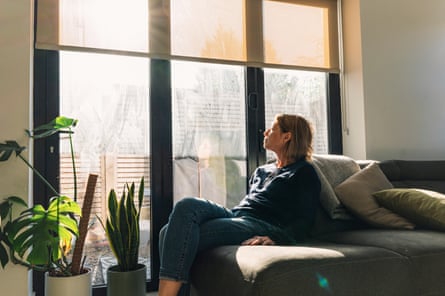
Mann goes as far as to suggest we should schedule activities that allow us to be productively unproductive into our daily routines, especially if we have got a conundrum we want to solve. “You want to do something that uses up the least amount of cognitive load as possible. Going for an aimless walk is good (as long as you know where you’re going). Or, find somewhere to lie down and simply stare up at the clouds or somewhere to sit and watch the world go by.”
She warns against confusing mindless pursuits with mindful ones though. “Watching TV, or swiping and scrolling online, doesn’t boost creativity. Quite the contrary. They engage the brain and stifle daydreaming. Similarly with writing, doodling or drawing: these activities do still take up some cognitive load. However, with the latter, say you’re in a really boring work meeting, those would be really good activities to try.”
Ah yes, work. This is one area where doing nothing is obviously a bad idea. Karoline Schubert at Friedrich Schiller University Jena has studied the impact of corporate idleness. She cites American research that shows the average worker is idle for more than a fifth of the working day waiting around for tasks. This could range from a call centre operator waiting for the phone to ring to anyone logging in and waiting for a computer update to load. Her paper What to Do When There Is Nothing to Do looks at how we might best harness this dead time.
“What we know is that idle time at work tends to have negative effects. It can reduce people’s wellbeing and their performance. It is linked to boredom, which is not surprising, but also to fatigue. It’s not just frustrating or dull, it actually drains people’s mental resources,” she says.
Schubert’s research revealed that there was a big difference between anticipated downtime and unexpected stretches of doing nothing. “In some jobs, downtime happens a lot. We interviewed one woman who typically had about six hours of it in an eight-hour work day. So she went to work expecting that. She made the best of it, offering to help colleagues, watering the office plants and even learning a new language.”
If you want to get better at being productively unproductive, there are strategies. “See it as an experiment and bring some lightness and play into it,” suggests Treanor. “Especially if you are someone who feels panicky when your phone battery is running out, wondering how you are going to spend your time. I think a lot of us on a long train journey will have the sensation of wondering how on earth we are going to pass the time. It’s fear of the unknown.”
Rather than setting yourself up for failure by pledging to take 2o minutes of staring into space every morning, Treanor suggests starting small. “If you walk the dog every day wearing headphones or chatting to a friend, remove a layer. Try going without. You are more likely to notice your thoughts even though you are still doing something. Or play a game of noticing something new on each walk, even if it’s only a new shop or the way a little kid is skipping along the road.”
If you’re feeling really brave, she suggests going cold turkey and sitting doing nothing for two minutes. “Be proud of yourself for having a go. Acknowledge that it’s really hard and uncomfortable. You don’t have to judge yourself for not enjoying it. Next time you could try for longer.”
That’s a lovely idea, which I will certainly try sometime. But right now, I’ve got some plants to resuscitate.