2 months ago
46
2 months ago
46
The three friends fill yellow jerrycans and help each other lift them on to their heads for the short walk home. Nyandong Chang lives five minutes from the water kiosk and is here up to six times a day. “It’s still hard work,” she says, “but at least nowadays water is available and clean.”
Until last year, women and children in Bor, the capital of South Sudan’s Jonglei state, faced a much tougher chore – going all the way to the filthy stretch of the White Nile that runs near the town to draw the family’s drinking, washing and cooking water and carry it back.
“It was dirty and could make people sick at home, but we had no other option,” says Chang.
But that was before Bor’s new water treatment plant transformed the town in what is being seen as a beacon of climate crisis adaptation.
Bor was entirely submerged when the White Nile broke its banks in late 2020. Although used to its seasonal overflow – bor means flood in the Dinka language – it was flooding people here had not seen for 60 years.
Parts of Jonglei have remained under water, and extreme flooding, which experts say is down to climate breakdown, has this year displaced close to 380,000 South Sudanese people, according to the UN’s office for humanitarian affairs.
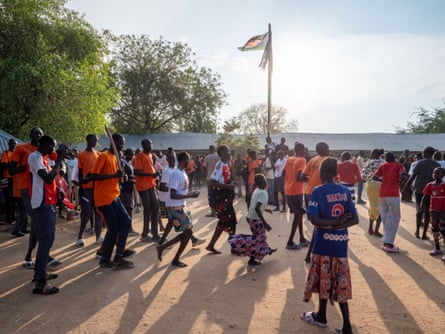
But Bor has recovered, and last month a completed $5.4m (£4m) project, funded by the Netherlands and South Korea, was formally handed over to the management of the state-owned corporation (SSUWC).
“In 2020, the major flood emergency really eroded the infrastructure, including the water-supply system, and that left the community hugely vulnerable to waterborne diseases,” says Thewodros Mulugeta, Unicef’s chief of water, sanitation and hygiene (Wash) in South Sudan.
“So the initial phase of the project started as a humanitarian, critical emergency response. Then there was a strategic shift to finding long-term, durable solutions to the water supply.”
Dykes were built along the river and drainage systems established for rainwater.
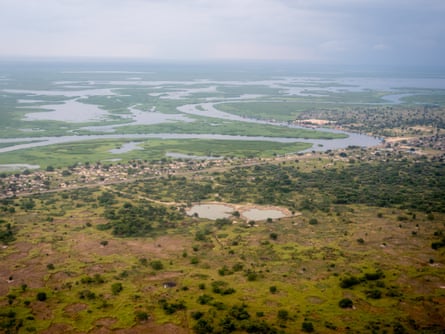
An existing treatment plant was overhauled into a “climate-resilient” installation: built on raised ground, it runs on solar power, minimising running costs and carbon emissions.
“Bor, like no other town, knows the challenge of water,” says Jacob Chol, a Jonglei state minister. “We live along the bank of the majestic Nile, yet accessing reliable drinking water has remained a persistent challenge for too long.”
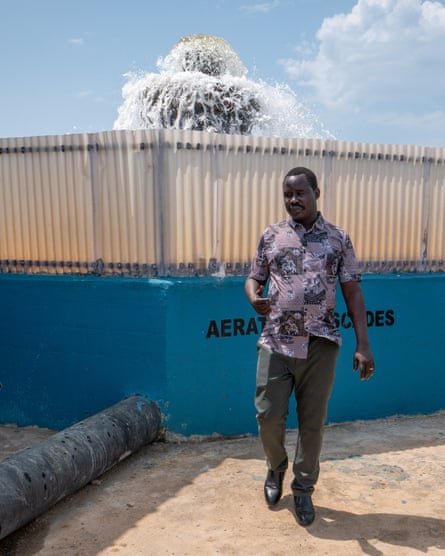
The governor of Jonglei state, Riek Gai Kok, also praised the project as something that “will restore the dignity of our people”.
It has brought jobs – 30 core staff have been trained for the plant – electricians, pump mechanics, plumbers and lab technicians to test the water quality, with accountants to oversee revenue. Manager John Jurkuch Yaak is confident in the plant’s sustainability after international partners withdraw: “We won’t let anybody down,” he says.
Commercial management was, he adds, crucial: “How to read the meters, how to prepare the bills, how to produce reports about the consumption to present to the stakeholders … so that customers can trust our service,” he says.
To date, 28 community kiosks, 704 households, seven schools and a hospital have been connected to the 33-mile pipe network.
With 96,000 users, 80% of Bor’s population, there should be revenue to sustain and expand. By local standards, the price of 3,500 South Sudanese pounds (about 60p) for a cubic metre is affordable for most people.
Water kiosks are managed by women such as Adeng Lek, a widow feeding her four children thanks to this job. She says the kiosks have become a social hub.
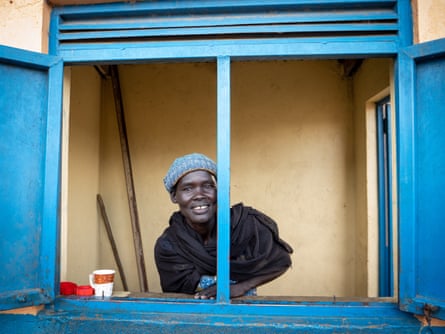
“This water has changed many lives. People can come here with their bottle to drink for free,” she says. Regular customers pay about 2p for a 20-litre jerrycan.
after newsletter promotion
Near Bor’s reservoir, Achol Teresa’s house has been connected: a pipe with a tap and a meter stands in her garden, where she grows okra, bananas, mangoes and coffee. The irrigation means she has been able to harvest okra three times this year. “I pay the water bill from the sale of my products in the market,” she says. She shares, giving water to three elderly neighbours. “It used to take us more than one hour to fill just one jerrycan before. At the borehole, the queue was long. This water has made everything easier.”
St Andrew high is among the schools connected this year. The head teacher, John Kuer Barach, says attendance and performance have improved since water arrived. “We used to have only one shift, in the morning, then because of the lack of drinking water here, the kids would then go home and return only the next day. But now, their parents are happy to let them come back for the afternoon class.”
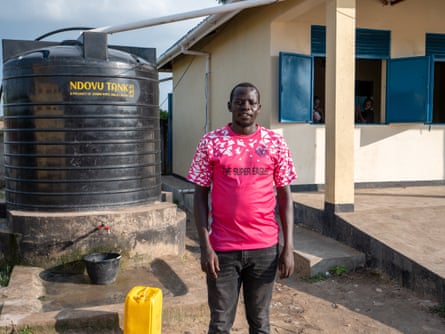
Students also noticed a big change says Nathaniel Thon, 17. “When the flooding came in 2020, there was a lot of stagnant water and it brought many diseases. I caught bilharzia because we didn’t have good water here in school, only one borehole and the water was not purified. It gave a lot of stress to my parents, because they had to buy bottled water from the shop, on top of paying school fees. We don’t see such problems any more.”
The taps mean less work too for girls, who can now be in class. “Going to bring water from the borehole was very dangerous for us,” says Abuol Agou, 14. “We had to cross the street to go to the borehole, and carrying a jerrycan is not easy. I was almost hit by a car, I was very scared.”
Her friend Tuna, 13, says the school has become a better place for girls having their period. “We don’t have to stay at home, we can wash and change here at school and not miss our lessons.”
What is changing lives in Bor however is still not the wider reality – only 40% of South Sudan’s 13 million people have access to drinking water within a 30-minute walk, says Mulugeta. “Massive investment is required to bring the sector to a basic, acceptable level,” he says.
Yar Paul Kuol, managing director at SSUWC, overseeing five national water treatment plants, considers Bor a model facility because of its low running costs.
As international aid and funding is increasingly hard to find, she adds: “We want to see the government funding such projects before we start asking the donors.”
Ssemabira Steven and Sserwanja Hamza sell water door to door. The two Ugandans, who came to Bor looking for work seven years ago, transport 10 jerry cans at a time on their bicycles. They fill them up at the kiosk, then wheel their bikes around the neighbourhoods in all weathers, until all the water is sold.
“Since they have changed the system, water is available all day long, and it is saving our time and energy,” says Sserwanja Hamza “Before, we have been suffering. We would not be able to serve all our customers. We were under pressure. But now we can get water anytime.”
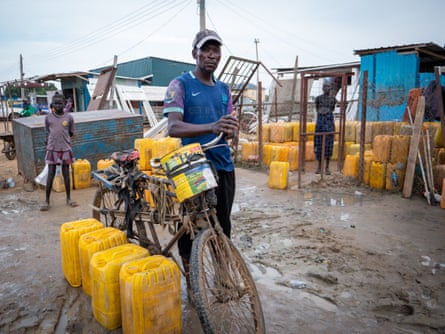
They do not mind that they have lost custom, as families connected to the new water system no longer need their services.
“We used to go fetch water from the riverside when the water was closed here, and that water is not good, people got sick. Now, no need to spend all that energy,” Ssemabira Steven says. “I need only 10 minutes to go and serve my customers.”