3 months ago
83
3 months ago
83
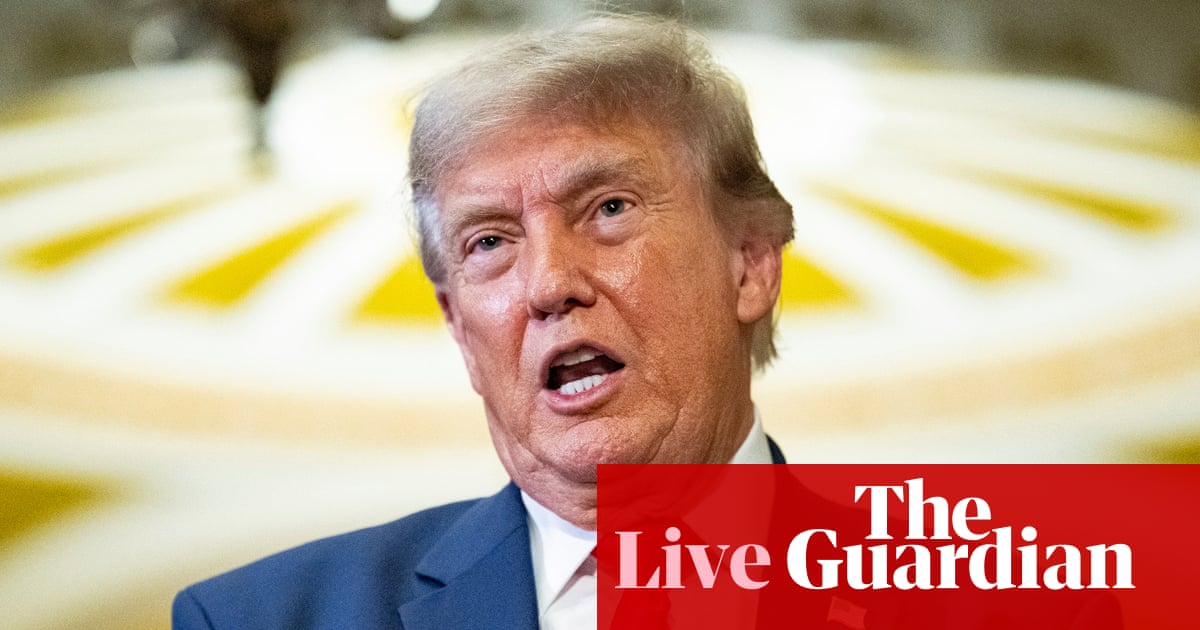
Donald Trump has extended by five days his deadline to “hit and obliterate” Iran’s power stations and energy infrastructure if Tehran does not allow shipping to move freely through the strait of Hormuz, claiming that the US and Iran have held “very good and productive conversations” on an end to the three-week-old war.
There was no immediate official reaction from Tehran to Trump’s announcement, which was made in a post on Truth Social and appeared to avert a potentially massive escalation of the conflict, at least for now.
The Fars news agency, which is linked to the Islamic Revolutionary Guard Corps, denied any talks, saying there were neither direct nor indirect communications with the US, and the state-owned IRNA newspaper reported that Iran’s foreign ministry said no negotiations had taken place with the US.
Oman, Turkey, Egypt and Pakistan have all been reported to have been involved in efforts to broker an end to hostilities in recent days, though it is unclear how substantial or productive such contacts have been. Oman’s foriegn minister, Badr Albusaidi, said on Monday that Oman was working hard to secure safe passage through the strait of Hormuz.
Trump made his ultimatum on Sunday, setting a deadline of 48 hours before the destruction of Iran’s energy infrastructure. In response, Iran threatened to target power plants supplying US bases across the Middle East, vital desalination facilities in Gulf countries, and to intensify strikes on Israel.
Fars said it had been told by an unidentified source that Trump retreated after hearing that Iran would target all power plants in west Asia, and Iranian state television put up a graphic that read “US president backs down following Iran’s firm warning”.
Iranian attacks have in effect closed the strait of Hourmuz, which carries a fifth of global oil and liquefied natural gas, threatening a deep and durable global economic crisis, with stock markets plummeting early on Monday before Trump’s announcement that he had extended his deadline.
Since then, oil prices have eased back and financial markets regained some of their recent losses.
Trump’s announcement came as the United Arab Emirates reported that its air defences were attempting to intercept new incoming Iranian fire and Israeli and US warplanes continued their intense offensive against targets across Iran.
Trump wrote in his post that the US and Iran “have had, over the last two days, very good and productive conversations,” adding that he had “instructed the Department of War to postpone any and all military strikes against Iranian power plants and energy infrastructure for a five-day period, subject to the success of the ongoing meetings and discussions.”
From Trump’s statement it is not clear how Iran and the US might agree to “a complete and total resolution” to end the ongoing conflict, which was launched by Israel and the US last month with an airstrike that killed the supreme leader Ali Khamenei and many senior regime officials.
Trump previously said the goal was regime change and called on “the Iranian people to take back their country”. On Friday he complained that the US had “nobody to talk to” in Iran, adding in apparent contradiction: “We like it that way.”
He claimed: “Their navy’s gone. Their air force is gone. Their anti-aircraft is all gone. It’s all gone. Their radar is all gone. Their leaders are all gone.”
Analysts say it will be hard for the US to fully reopen the strait of Hormuz through military means alone. There are also concerns about Iran’s stockpile of enriched uranium, whose whereabouts are unclear.
In public, Tehran has made demands for a ceasefire that would be impossible for Washington to meet, such as an end to a US military presence in the Gulf and massive compensation for damage caused during the war.
Trump’s ultimatum came hours after two Iranian missiles struck southern Israel, injuring more than 100 people, in the most destructive attack since the war began. The Israeli prime minister, Benjamin Netanyahu, vowed to retaliate “on all fronts”.
The Iranian response was defiant, observers noted. Tehran said it would “irreversibly destroy” essential infrastructure across the Middle East, including vital water systems, if the US followed through on Trump’s threat.
Iran also said it would hit power plants in all areas that supplied electricity to American bases, “as well as the economic, industrial and energy infrastructures in which Americans have shares”.
More than 2,000 people have been killed in the war that the US and Israel launched on 28 February, the majority of them in Iran.