3 months ago
95
3 months ago
95
British homes will need air conditioning to survive predicted levels of global heating, the government’s climate advisers have warned in a report, as measures such as drawing curtains, opening windows and growing trees for shade are not likely to be enough.
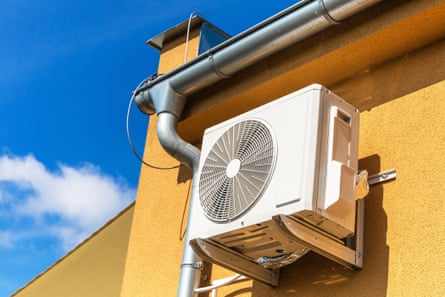
Air conditioning should be installed in all care homes and hospitals within the next 10 years, and in all schools within 25 years, according to the Climate Change Committee (CCC), which published a major report on adapting to the impacts of global heating on Wednesday.
The government should also set a maximum temperature for working, indoors and outdoors, the advisers said. The UK should prepare for 2C of global heating by 2050, as attempts to limit temperatures to 1.5C above preindustrial levels under the Paris agreement appeared likely to fail.
Heatwaves are expected to exceed 40C in all parts of the UK by 2050. Periods of hot weather will be longer, which could lead to an additional 10,000 heat-related deaths a year. About nine in 10 UK homes are likely to overheat.
Julia King, the chair of the adaptation subcommittee of the CCC, said of the many climate threats laid out in the report, extreme heat posed the most immediate risk to life. “Extreme heat is certainly the most deadly of the climate impacts on the UK, so we need to see cooling rolled out at scale,” she said.
“Sometimes this will mean shading, but sometimes it will mean air conditioning. And either way, we’ve got to get serious about protecting our most vulnerable people in hospitals, in care homes, and in schools.”
In 2022, when temperatures rose above 40C, it resulted in about 3,000 excess deaths, with periods of extreme heat likely to become “the new normal”. Rather than install cooling everywhere, people could choose to have one cool room to be used during heatwaves, the report said.
However, air conditioning is energy-intensive, accounting for about 4% of global greenhouse gas emissions. More efficient modern systems can use heat pumps, which are already subsidised by the government to replace gas boilers, but these are rarely installed at present.
Sam Alvis, the head of energy security at the IPPR thinktank, called for more solar panels on roofs, alongside air conditioning. “We are going to have to get used to being a hot country, which is quite a mindset shift for the UK,” he said. “Air conditioning is actually a great pair for solar from an energy system point of view because it matches supply and demand, and your aircon is only going to be needed above certain temperatures.”
Emma Howard Boyd, a professor in practice at the London School of Economics, said heat was already killing people, but received too little attention. “Heat resilience cannot continue to be treated as an afterthought,” she said. “It belongs alongside flood preparedness and water security at the very top of the national resilience agenda and the wider prosperity of the UK.”
The climate crisis is costing the UK about £60bn a year, or about 2% of GDP, including flood damages and the loss of crops to farmers. “The UK was built for a climate that no longer exists today and will be increasingly distant in years to come,” the report found.
The committee also found:
The 7m UK properties at risk of flooding could increase by 40% by 2050, without action, and peak flow in rivers could be 45% higher. Sea levels will increase by 20cm to 45cm, putting some coastal areas at risk, and heavy rainfall intensity could increase by 60%. By the end of the century, if temperatures rise by 4C, the storm surges that currently occur once every 100 years would happen every year.
Natural flood defences, such as wetlands and “rewiggling” rivers, will not be enough, and more concrete flood barriers will be needed.
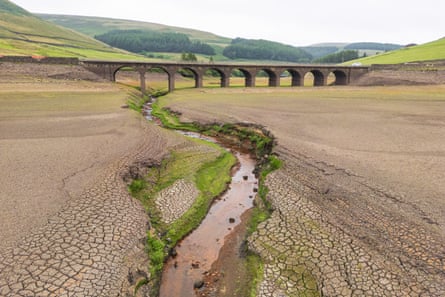
Droughts will also become much more frequent: river flows are likely to be about a third lower in summer than they were 20 years ago, and by 2050 the shortfall in the water supply could reach 5bn litres every day – the equivalent of about 2,000 Olympic swimming pools, or a small reservoir. More reservoirs must be built, to avoid the serious risk of the taps running dry.
By 2100, summers as dry as 2018 and 1976 would become the norm. Even by 2050, the number of high-risk days for wildfires are likely to double, and the wildfire season will extend into early autumn.
Schools should consider the impact of heat on pupils taking exams, not only related to classroom temperature but also to pupils’ ability to sleep at night when temperatures remain above 20C.
Domestic food production is under threat, and the government should take steps to ensure at least 60% of the UK’s food continues to be produced here. Food prices will rise under the impact of reduced crop yields for UK farmers, with potential disasters overseas.
Protecting people and infrastructure would cost about £11bn a year, the CCC estimated, with about half coming from the private sector. Every £1 spent would yield about £5 in benefits, however, and the UK invests 50 times this amount every year, some of it on infrastructure that exacerbates the climate crisis or vulnerability to it.
The cost of failure to act is rising, from about £60bn a year, and could reach £260bn a year in just over two decades.
None of the UK’s existing national adaptation plans – which are produced by each of the devolved governments – was fit for purpose, the CCC found. Preparing for the impact of the climate crisis, and reducing greenhouse gas emissions to lessen the impact, should be treated as national security issues, King said.
“With the right decisions, we can protect the people and the places we love,” she said. “So, the strong message is that decline is a choice, it’s a political choice, it’s not inevitable. We can do something about it.”
Water supplies also require urgent action. “We are facing a potential world where in 2050 you could turn the tap on and nothing would come out,” King said. “We need more new reservoirs. We need to be able to move water around the country. We need to address leaks, and we need to address water efficiency.”
Emma Reynolds, the secretary of state for the environment, made no new financial commitment after the CCC’s advice, but said the government was already acting. “We have invested a record £2.65bn to repair and build flood defences, protecting tens of thousands of homes and businesses, and have deployed the largest nature-friendly farming budget in history to support sustainable food production and security,” she said.