3 months ago
80
3 months ago
80
To his neighbours, Kevin Rees did not seem like an extremist. The shy 63-year-old lived on a tree-lined street in suburban Sidcup, in Bexley, south-east London. He appeared to be enjoying retirement after a career mending dishwashers and other domestic appliances. “He’s a quiet character – I’ve lived opposite him for 10 years and never really spoken to him,” says Sam, who declined to give her full name.
Behind the lace curtains, Rees was much more abrasive, at least online. Under the user name the “Exterminator” he ranted about London’s mayor, Sadiq Khan, and the ultra-low emission zone (Ulez) which in 2023 was expanded to the capital’s outer borough, including Bexley.
It was only when Rees’s online ire went beyond keyboard skirmishes and crossed over into real life violence that his neighbours realised they had an extremist in their midst.
This week, at Woolwich crown court, Rees was found guilty of blowing up a Ulez camera with a homemade bomb. The explosion, a jury agreed, was likely to endanger life.

This dark turn is now being seen as a cautionary tale about how increasingly influential online communities, such as anti-Ulez groups, can radicalise even suburban pensioners.
Rees began tinkering with homemade weapons and explosive materials that he kept in his loft. At 6.45pm on 6 December 2023 he lit the fuse on a home bomb. It blew up a Ulez camera on Willersley Avenue, a residential street four minutes’ drive from Rees’s front door.
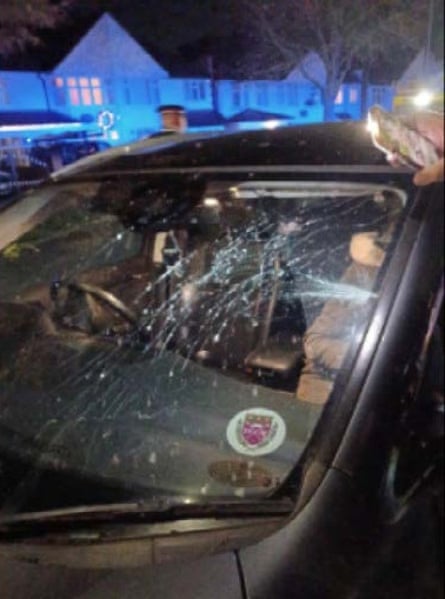
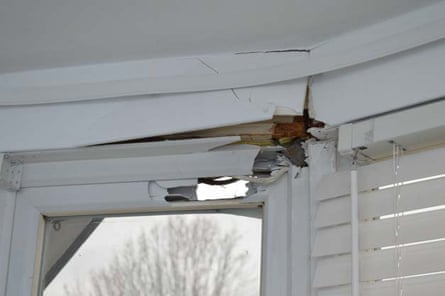
Shrapnel from the blast travelled 100 metres. It dented a van, blew out a car tyre, splintered a window frame in a child’s bedroom and damaged a wendy house.
“Any of us could have been hurt. It just shows that you don’t know what’s going on in individual homes when someone in a quiet household was making a bomb inside,” Sam said. “They’ve got a little Smart car, which would qualify for Ulez, so I don’t know why he did it.”
As well as the explosion charge, on Wednesday Rees was also convicted of three counts of having a prohibited weapon.
Bethan David, head of counter-terrorism at the Crown Prosecution Service (CPS), said it was “pure chance that no one suffered serious injury or worse”. She said she hoped Rees’s conviction would send “a clear message to other protesters considering taking the law into their own hands”.
If the message has been heard in the corners of the internet that Rees once occupied, it does not seem to have sunk in. Despite the grave nature of Rees’s crime and the threat it posed to passersby, including children, the attack has been openly celebrated online as an act of heroism.
“Give him a medal,” said one Facebook comment that was liked by more than 1,300 users. When the CPS posted on X about the conviction, it was criticised in the replies while Rees was praised for his “public service”, patriotism, and “doing the lords [sic] work”.
Stefano Borella, leader of the Labour group on Bexley council, whose 76-year-old mother heard the bomb blast, said: “It disappoints me that he’s being hailed as a hero, but it doesn’t surprise me.
“Social media is the cesspit of humanity, but the silent majority would be very shocked by this, whatever their views of Ulez. The problem is, Rees looked at anti-Ulez Facebook groups and was enthused by that behaviour.”
Borella also criticised Conservative-led Bexley council for failing to condemn Rees’s attack at the time. He said: “If you don’t condemn it, people will think it’s OK. If this is had been an Islamist attack, there would have been protests and condemnation.”
The anti-racist group Hope Not Hate is also alarmed by how Rees was radicalised. Georgie Laming, its director of campaigns, said: “The anti-Ulez movement has for some time now been co-opted by the far right. Local residents join groups to protest traffic measures and are suddenly confronted with conspiracy theories, disinformation, and Islamophobia.
“It’s very worrying to see this kind of acceleration. This type of reckless sabotage goes well beyond any mainstream opposition to Ulez. It’s extremism.”
Rees told the court he joined anti-Ulez groups because he was “bored” and looking for “a community”. He denied the charges against him and blamed his arrest on “Facebook police”.
In 2024 Greenpeace’s Unearthed team and the Observer, published an investigation into a network of 36 private anti-Ulez Facebook groups with 38,000 members. The groups, which included a number of local Conservative politicians, celebrated vandalism against Ulez cameras by so-called blade runners. They were also found to be a platform for racism, Islamophobia, and conspiracy theories.
The article highlighted the Bexley group, where members complained of Islamists taking over Britain and there was a call for Khan to be “taken out”. Confronted in court with his own Facebook posts against Khan and Ulez, Rees said he was “strongly opposed” to the mayor. “I dislike what he has done to London,” he said.
John Oxley, associate fellow at the centre-right thinktank Bright Blue, said Rees’s case “deserves more attention”. He said: “We worry about young people online, but actually there’s some vulnerable older people who spend a lot of time in some fairly toxic online spaces.”
Oxley said vandalism against Ulez and speed cameras was often treated in the media as “Dad’s Army-ish” because of sympathy for the cause in the press. He said: “Considering this was a bomb going off in a suburb of London, the coverage has been remarkably light. If you’ve got these networks of people who’ve been radicalised and are stewing in this information environment, what could be next?”
Rees is due to be sentenced later this year.