3 months ago
130
3 months ago
130
This year, the biggest ever World Cup will feature 48 teams, an increase from 32, opening up the tournament to even more upsets, shocks and surprises. The vagaries of the World Cup draw have given rise to classic underdog victories over the years, from an amateur USA team’s shock defeat of the then-favourites England in 1950 onwards. But what does the data tell us about upsets in football’s modern era?
Starting from the launch of the Fifa men’s world ranking system in 1993, we have analysed each World Cup match in which an underdog beat a higher-ranked team, along with the ranking disparity between the teams: the bigger the gap, the higher the “upset score”, and the larger the circle in the graphics below. Upsets are marked in red, while matches decided on penalties are represented with a white border.
USA 1994: regional rivalries and Bulgarian brilliance
This World Cup was characterised by a consistent stream of upsets, particularly in the group stages, with a couple of surprise regional rivalries including Belgium (Fifa ranking 27) triumphing over the Netherlands (2) and Saudi Arabia (34), in their World Cup debut, seeing off Morocco (28).
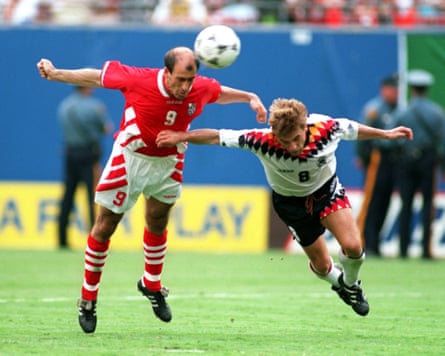
The first World Cup after the dissolution of the USSR featured the first appearance by a unified German team and arguably the tournament’s most iconic underdog moment, when a header by Yordan Letchkov secured Bulgaria’s (29) victory over top-ranked Germany (1) in the quarter-finals. Bulgaria enjoyed a strong competition overall, including beating Argentina (8) in the group stages and a surprise round of 16 win against Mexico (16) in a penalty shootout.
France 1998: upsets all the way
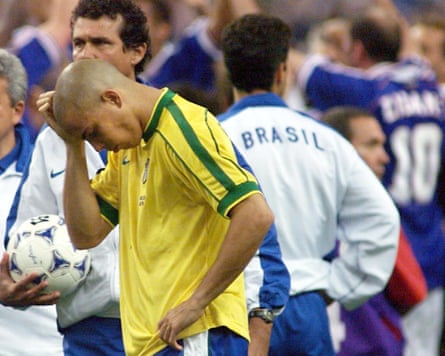
This was one of the few recent World Cups to culminate in an underdog victory, as the hosts, France (17), thrilled a Stade de France packed with home fans when they beat the top team, Brazil (1), 3-0. The team’s historic victory was secured with two spectacular headers from Zinedine Zidane.
The biggest upset, however, was from Nigeria (74), who beat Spain (15) 3-2 in the group stages, as well as conquering Bulgaria (35) 1-0. There were also unpredictable quarter-finals, as Croatia (19) knocked Germany (2) out of the tournament, while the Netherlands (25) saw off Argentina (6).
South Korea and Japan 2002: hosts beat the heat; France crash out
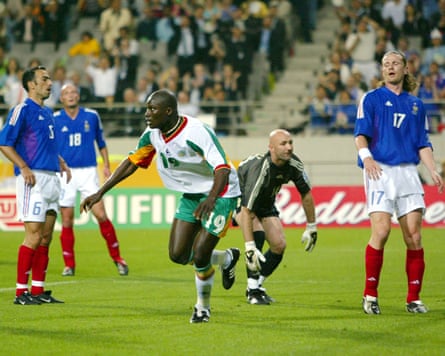
The hosts, South Korea (40), were the tournament’s champion underdogs, making it all the way to the semi-final via victories over Poland (38), Portugal (5), Italy (6) and Spain (8). But perhaps the most significant upset came in the opening game when the World Cup first-timers Senegal (32) took on the reigning champions, France (3). Senegal scored half an hour in, then defended successfully against a much older French team – including stars Zidane, Marcel Desailly and Fabien Barthez – which struggled in Seoul’s heat and humidity. At the final whistle, crowds back home in Dakar erupted in shock and joy as the former colony triumphed over the one-time imperial power.
Germany 2006: the most unpredictable modern World Cup?
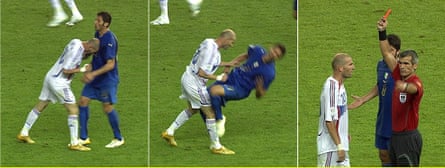
Germany 2006 wasn’t memorable only for Zidane’s notorious head-butt on Marco Materazzi in the final between France (8) and Italy (13). The numbers show it was the most surprising World Cup in recent history, with 21 upsets throughout the tournament, and five in its later stages – including Ukraine’s (45) round-of-16 victory over Switzerland (35) at their first World Cup. Other countries making their debut included Angola (57), Ghana (48), Côte d’Ivoire (32), Trinidad and Tobago (47) and Togo (61), making this an underdog-heavy tournament.
South Africa 2010: a huge upset, but underdogs struggle
Despite defeating France (9) with the biggest “upset score” of our analysis, South Africa (83) became the first host nation in World Cup history to be eliminated at the group stage. Other notable underdog victories included South Korea’s (47) defeat of Greece (13), and Slovakia’s (34) defeat of Italy (5), with France and Italy both failing to progress to the knockout stage. In their first appearance, the underdogs North Korea (103) lost all three of their group matches and received a public mauling for “betraying” the communist nation’s ideological struggle.

Brazil 2014: Costa Rica v champions in the ‘group of death’
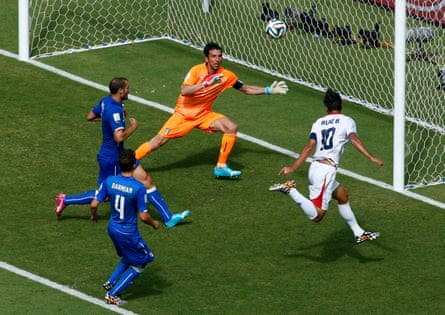
The 2014 World Cup was notable for the champions, Spain (1), crashing out at the group stage, along with the hosts, Brazil (3), losing 7-1 to Germany (2) in the semi-finals. The tournament’s “group of death” was Group D: the first ever to sport three former world champions – England (10), Italy (9) and Uruguay (7) – along with Costa Rica (28). But the underdogs more than proved their mettle, beating Italy 1-0 via a Bryan Ruiz header before going on to draw with England and progress to the knockout stage, while Italy and England were eliminated.
Russia 2018: controversy and semi-final surprises
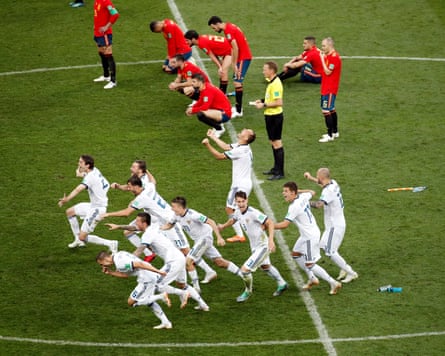
This World Cup was a wild ride, starting with controversy around the choice of host, continuing as reports of abuse of migrant labourers building stadiums emerged, and culminating in a tournament full of unpredictability and upsets. As in many tournaments, Russia (70) enjoyed a host country boost, beating Spain (10) in the round of 16 after triumphing against Saudi Arabia (67) and Egypt (45) in the group stages. There were surprises in the semi-finals too, as Croatia (20) memorably knocked out England’s (12) talented but inexperienced team, and France (7) deprived Belgium (3) and its “golden generation” a chance of a major trophy.
Qatar 2022: Morocco work magic at a winter World Cup
The first World Cup held in the Middle East was shifted to the winter months to avoid Qatar’s intense summer heat. Amid disruption to many domestic leagues and controversies over the treatment of migrant workers and minorities, there was one undisputed star underdog story: the rise of Morocco (22). The first African and first Arab team to reach the semi-finals beat Belgium (2), Canada (41) and Portugal (9) along the way, but perhaps their most thrilling victory was against Spain (7) in the round of 16. After a goalless draw the game went to penalties, Moroccoprevailing 3-0 in the shootout and fans packing the stadium went wild as their side reached the last eight for the first time.

Will underdogs triumph at Canada-Mexico-USA 2026?
This year, the expanded format means a hectic match schedule is spread across 16 cities in three countries and four time zones, with some teams at risk of dangerous heat stress while others play in air-conditioned stadiums. Throw in a volatile political backdrop and the participation of teams that would usually struggle to be granted US visas, and this could be the most unpredictable World Cup yet.
Four countries – Cape Verde (69), Curaçao (82), Jordan (63) and Uzbekistan (50) – are making their World Cup debuts, and potential upsets include:
Haiti (83) v Scotland (43) – 13 June, Croup C: Haiti will be looking to add their name to a list including Peru, Iran and Costa Rica to send shivers down the spines of the Tartan Army. Haiti drew with Iceland in their latest warm-up match, and present a tricky opener for a Scottish team that has lost Billy Gilmour and will be forced to come out and attack, with both sides knowing Morocco and Brazil await them next.
New Zealand (85) v Iran (21) – 15 June, Group G: After losing every match in their first World Cup and drawing every game in their second, New Zealand’s opener offers a golden chance for a historic first win. They face an Iran team plagued by uncertainty – facing potential entry issues due to the US conflict with Tehran, alongside possible fan and player protests. The All Whites may never get a better shot at an upset.
Cape Verde (69) v Uruguay (17) – 21 June, Group H: Uruguay frequently reach the later stages of the tournament, but have had bad results under their polarising coach, Marcelo Bielsa. Cape Verde, making their World Cup debut, came through tough African qualifiers and are defensively strong.
-
Sources: World Cup match data from football.db, Fifa rankings by year from Inside Fifa