3 months ago
68
3 months ago
68
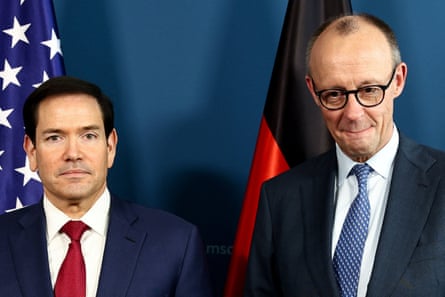
The US acting alone has reached the limits of its power and may already have lost its role as global leader, Friedrich Merz, the German chancellor, warned Donald Trump at the opening of the Munich Security Conference.
He also urged the US president to recognise it is still possible to exhaust Russia economically and militarily, to the point where it is willing to come to the negotiating table over Ukraine.
In a speech on Friday designed to set a firm yet conciliatory tone about the future of the transatlantic partnership, Merz argued the old order had ended and in this new age of superpowers even the US was reaching the limits of going it alone.
Referring to those that warned the international rules-based order was about to be destroyed, Merz said: “I fear we must put it even more bluntly. This order, however imperfect it was even at its best, no longer exists in that form.”
Switching to English to ram home his message, Merz said: “In the era of great power rivalry, even the United States will not be powerful enough to go it alone. Dear friends, being a part of Nato is not only Europe’s competitive advantage. It is also the United States’ competitive advantage.
“So let’s repair and revive transatlantic trust together,” he added. The German chancellor’s speech opened the annual gathering of top global security figures including many European leaders and the US secretary of state, Marco Rubio.
At last year’s conference, held a few weeks into Trump’s second term, the US vice-president, JD Vance, stunned European leaders by lecturing them about the state of democracy and freedom of speech on the continent – a moment that set the tone for the last year.
A series of statements and moves from the Trump administration targeting allies has followed, including Trump’s threat last month to impose new tariffs on several European countries in a move to secure US control of Greenland, a semiautonomous territory of Denmark, a Nato ally.
Merz drew most applause from an audience brimming with hostility toward US unilateralism when he directly criticised the current American administration, saying: “The culture war of the Maga movement is not ours. Freedom of speech ends here with us when that speech is directed against human dignity and the basic law. We do not believe in tariffs and protectionism, but in free trade. We stand by climate agreements and the World Health Organization.
“In the age of great powers, our freedom is no longer a given, it is threatened,” he said, adding that “firmness and willpower will be needed to assert this freedom”. Challenging Trump’s unilateral style, Merz added: “Autocracies may have followers, democracies have partners and allies.”
At the same time, he said Europe must cast off its excessive dependence on the US, emphasising: “We won’t do that by writing off Nato.”
As one of the European nations doing the most to boost its own defence spending, Merz clearly felt in a strong enough position to insist the US needed to do more to listen to European concerns about its security and the legitimacy of a sustained European pillar of Nato.
Describing the Munich conference as a seismograph for the state of US-European relations, he said the Ukraine war “had forced Europe to return from a vacation from world history. Together we have entered an era that is once again marked by power and big power politics.”
These big powers, Merz said, “make their own rules. It is fast, harsh and often unpredictable. These powers exploit natural resources, technologies and supply chains using them as bargaining tools.”
Merz was speaking as the fourth anniversary of the Russian invasion of Ukraine approaches and one year after Vance used his speech in the same hall to criticise Europeans for not taking enough control of their own defence arrangements and ignoring the demands of its electorates.
Merz responded by saying it was crucial for the continent to change its mindset and fully exploit the “enormous” military, political, economic and technological potential of a “sovereign Europe”. Germany was striving for “partnership-based leadership” in Europe but retained no “hegemonic fantasies”.
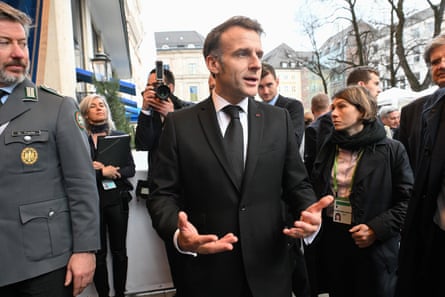
Merz added he had begun talks with the French president, Emmanuel Macron, about European nuclear missiles, an issue on which Macron is due to make a statement shortly. This deterrent, he said, must be firmly integrated into Nato’s nuclear arsenal and would not see some parts of Europe more defended than others. The chancellor stated that Germany was not abandoning Nato but wanted to establish a “strong, self-sustaining pillar” within the alliance.
There is, however, tension between France and Germany about their respective roles in a revised Nato in which the US takes a less dominant role. Germany is aiming for the key position of chair of the military committee.