2 months ago
62
2 months ago
62
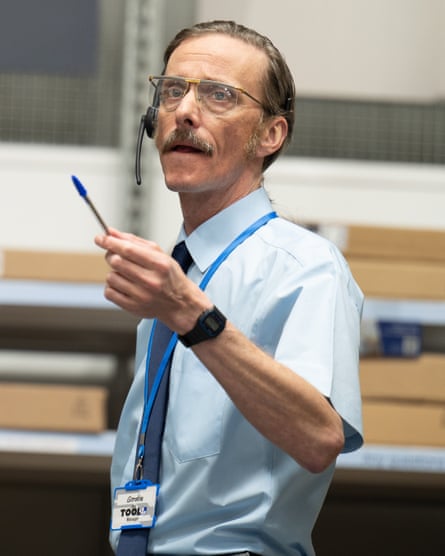
In Small Prophets, BBC Two’s new six-parter, Mackenzie Crook plays Gordon, the manager of a massive DIY store. Sometimes it feels as if we’re falling through time, because it’s like watching Gareth, Crook’s breakthrough part in The Office, a quarter of a century on. “Pedantic and jobsworthy, he could be Gareth grown up, just with more disappointment, without the West Country accent,” says Crook. “I wrote Gordon as a monster, but by the end, I was actually quite fond of him.”
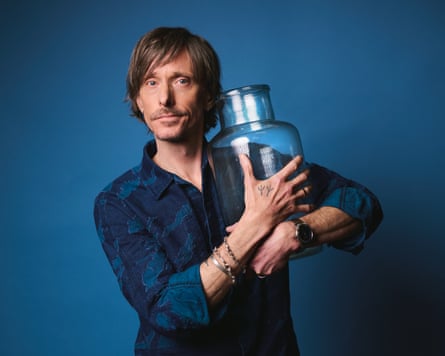
In person, Crook has a jumpy, modest energy. When he was young, on screen it used to look like nerves, but now looks more like curiosity. He has a surprising number of tattoos, but maybe I should stop being surprised when people have those.
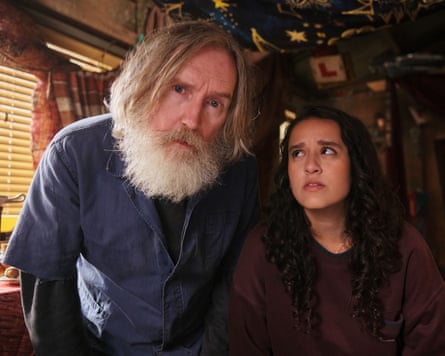
Gordon isn’t the hero of Small Prophets; he’s not even the antihero. This is the story of Michael, played by Pearce Quigley, in a performance so comically, subtly heartbreaking you can rarely figure out what you’re melancholy about. Fiftyish, bearded, a twitcher and a hoarder, he works in the DIY store and visits his dad, Brian (a lovely performance from Michael Palin), every afternoon. Michael has a huge tragedy in the recent past – his girlfriend Clea disappeared without trace seven years before – but he would never make a song and dance about it.
At first sight, it could be a delicate and truthful rumination on middle age. “Of course it is,” says Crook. “I’m a little bit obsessed by being middle-aged. It crept up on me. Everything seems to have been 20 years ago. It’s a surprise to find myself with grownup children.” He pauses, then says gravely: “‘Grownup children’ is a horrible expression. ‘Have you got children?’ ‘Oh yes, they’re grownup now.’” This is a classic Crook tangent – you’ll know it if you loved Detectorists – a thought delivered with bottomless sorrow, which is true but so amped up and exaggerated that it becomes funny. Honestly, having grownup children (Crook has two: Scout, 19, and Jude, 22 – a standup comedian) isn’t that sad. Time passing isn’t that bad. It’s better than if it didn’t pass. The butt of the joke is melancholy itself, but the melancholy is also real.
Anyway, in a midlife rut is where Michael starts. Then his dad throws in the spanner that he knows how to grow homunculi – miniature, fully (if weirdly) formed humans of whom you can ask any question and they have to tell you the truth. Brian beseeches his son to follow the recipe; maybe the creatures can tell him what happened to Clea. Michael does as his dad asks, trying to be kind, thinking he’s losing his marbles. He follows the instructions, and when he taps each of the clouded bell jars to reveal the homunculi, the effect – maybe because it’s so unexpected, maybe because of the low-key ordinariness of the suburban street, the hero, the neighbours, maybe because magic realism is a thing only a few people can pull off – is fabulous, in every sense. “I’ve always been fascinated by stories of lonely people. And I’ve also been fascinated by stories of ordinary people that something extraordinary happens to, and turns their life upside down.”
Life carries on as if the supernatural hasn’t happened. Work is still mundane and the neighbour still moans constantly about the state of Michael’s front garden. He was written as a villain, too, “but [actor] Jon Pointing brought something to him that made me feel sorry for him. He just wants some peace and quiet, some order, and he’s living next to this chaotic rogue who seems to have an inner peace. How can this bearded guy, this hoarder, be more content than I am? I wrote these quite two-dimensional, old-school sitcom characters – the boss, the next-door neighbour – and they didn’t come out that way.”
This is a project drawn from a life of influences; giants of experiment and surrealism – David Lynch and Michel Gondry, Charlie Kaufman and Spike Jonze – but also 70s and 80s shows, The Good Life, Ever Decreasing Circles, “their lack of cynicism, their lack of cruelty”. It’s landed somewhere unique, though it couldn’t not remind you of Detectorists in its core sensibility. “After The Office, I wanted to write something that wasn’t cruel humour, that didn’t have a cringe factor. And in doing so, I stumbled upon my genre – gentle comedy.” I’m not wild about the term; it sounds both unfunny and as if you’re trying not to offend anyone. “OK, it’s probably more complicated than I know. I don’t want to flag up anything. I don’t want to tell people when to laugh, when to cry, what to feel. I like downplaying stuff.”
The Office played down nothing, and no awkward situation would end before it had got a thousand times more awkward. Crook – who was born Paul Crook, but changed his name when registering with Equity, the actors’ union – rewatched it for the first time recently and got what sounds like a PTSD flashback. “In series two, a fire alarm goes off and everyone’s evacuated. Watching it, I had this real Pavlovian reaction where my heart just sank, because I knew something awful was coming up. I’d forgotten all about it.” (David and Gareth start trying to get a disabled employee down the stairs, then give up halfway through, saying if it was a real fire they’d definitely come back for her. It’s excruciating.) The show famously popularised the spoof TV documentary, but it also put the pain into “painfully funny”.
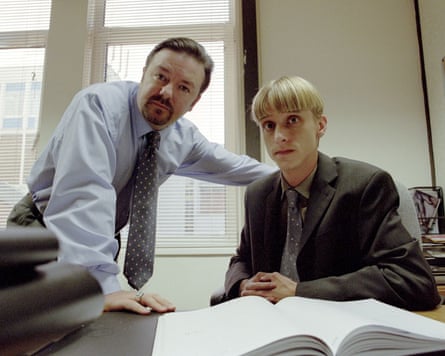
It was a hard landing into fame for Crook in the 00s. “It became this thing in the press, I was the weird-looking bloke. And I thought: ‘You’ve put that on me; I don’t think I do look weird. You’re thinking of Gareth, and now you can’t see past Gareth, so I will for ever be weird-looking. Or maybe I am weird-looking? But surely if I was weird-looking, that would have been what kids at school said?’” What did the people at school say? “Well, I was small. And my name was Paul. So I was Small Paul.”
He’s also much happier writing, editing and directing. “Acting I’m not that fussed about. It’s fun. But I’m not that into it any more. And I’ve never been convinced by my acting. I can always see myself acting my socks off, honestly. When I look at The Office, in my eyes, I seem to be in a different show to everyone else. Martin Freeman is so natural, so believable, and then my Gareth comes in, and it’s like: ‘What are you doing, mate? Tone it down a bit.’ But people like the character so it might be just me thinking that.”
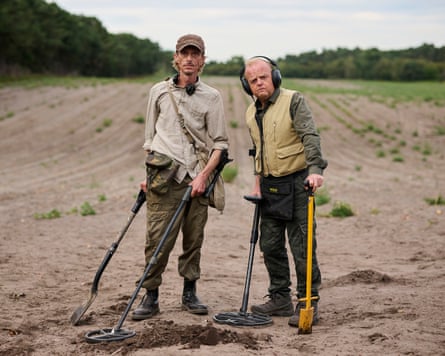
When he had the idea for Detectorists, which first aired in 2014, it was quite different to what landed on the screen. “It was bleaker. The whole thing with metal detecting is that it happens in the winter months when there are no crops, so I envisaged two men in parkas standing in the crosswinds in a ploughed field. But we shot the pilot on the hottest day of the summer, and it just looks so beautiful, I realised we would be missing a trick to set it in greyness. The weather and the countryside became a big part of the show.” Andy (Crook) and Lance (Toby Jones) have this symbiotic, very quiet heroism – every day a miniature triumph over the disappointment that seems to hover on every horizon. It’s written into their hobby! Metal detectorists rarely find any Saxon coins.
Detectorists has the kind of superfans that only really idiosyncratic dramas have, which Crook says is because the BBC let him do what he wanted. “It was so low stakes that they didn’t have to meddle with it, they just let me go away and do whatever. And it turned out to be this thing that people love and hold dear. On Small Prophets, the stakes are a little higher, because it’s got these surreal, magic realism elements in it, so it’s more expensive.” When he pitched it to the BBC, it was a show in which things happened that might never get resolved – maybe you’d never find out what happened to Clea; maybe the kids who steal a security van would just get away with it. “And that’s how it’s worked. It’s fantastical and strange, but hopefully not forced, although the way I just described it, it does sound forced.”
The homunculi are stop-motion animation, not CGI, because he wanted the nostalgia – “it was a deliberate attempt to put some magic into it” – and the creatures, rather than the characters, are where the idea started. “You know, I don’t believe in the supernatural at all,” he starts, before allowing, “I remember as a kid getting The Unexplained magazine – pictures of ghosts and spontaneous human combustion – and wanting to believe it, wanting stuff to exist that you can’t explain. I guess those are the elements of the stories I loved as a child, James and the Giant Peach, lonely kids, lonely orphans. I don’t know why, because I came from a happy, loving family with siblings and friends, but there’s something romantic about it. Sad escapism. Maybe that’s my genre.”
Small Prophets is on BBC Two and iPlayer from 9 February.