3 months ago
69
3 months ago
69
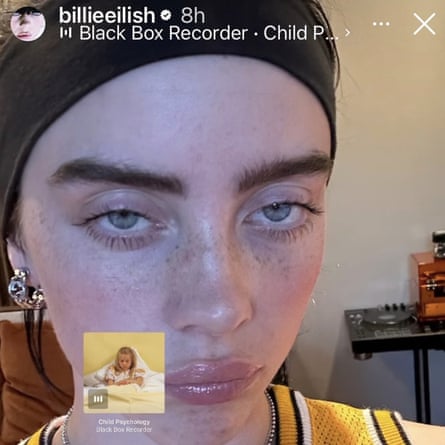
John Moore, the guitarist in Black Box Recorder, adopts a weary tone as he tells this story. “Our daughter said to us, ‘Have you heard of Billie Eilish?’” His response was not what she was expecting. “Yes,” he said. “She’s fucked up our retirement.” This spring, he, Luke Haines and vocalist Sarah Nixey (the mother of said daughter, though she and Moore are long separated) will return to the stage for the first time since 2009, in part thanks to their streaming numbers going stratospheric after Eilish posted videos of herself listening to their 1998 debut single Child Psychology.
The song, about a disruptive girl who has refused to speak, been expelled from school and fallen out with her family, is typical of Black Box Recorder’s obsession with psychological breakdown in a peculiarly English, often suburban and middle-class setting: stories related by Nixey in her sparkling yet deadpan vocals. It’s a mix that later broke Black Box Recorder into the UK Top 20 with 2000 single The Facts of Life, and produced three albums that still stand apart from the rest of British pop.
The trio are seated in thespot where it all began in the late 1990s – a table in the corner window of the Spread Eagle pub in Camden, London. Haines, who had a measure of Britpop-adjacent success with his band the Auteurs, and Moore, who had been the drummer for the Jesus and Mary Chain, dreamed up an avant-noise project that would release one song called Black Box Recorder: a recording of a slowed-down washing machine that was supposed to sound like an air crash. Haines suggested they try writing more conventionally, and thus Black Box Recorder became, as Moore puts it, “a pub friendship with some songs attached”. They just needed someone to sing them.
Moore had seen Nixey do backing vocals in a band called Balloon and asked her to sing for Black Box Recorder, promising: “We’ll make you famous.” Then 23, she wasn’t fazed by this approach from two blokes who kept going on about how old they were, despite only being around a decade her senior. “John really reminded me of Withnail,” she says, referring to Richard E Grant’s louche wild man in Withnail and I, the 1987 black comedy. “And I didn’t know what to make of Luke. We circled each other for a little bit, then realised we did actually like each other. I knew we could get something interesting out of this.” She adds that she “rolled her eyes a lot” but also found them hilarious. She tells them: “You’d found something in each other you didn’t see in other people.”

They used their music industry connections to cadge free studio time. When Nixey heard the demo of Girl Singing in the Wreckage, she felt that – as this song about the violent aftermath of a car crash was so emotionless – she should sing it in an equally deadpan style. “These songs had to be delivered in a really emotionally restrained way, which is why they worked.” Her unashamedly RP vocals and affectless delivery combined with the disturbing content of the lyrics to discomfiting effect.
It meant that Black Box Recorder’s 1998 debut England Made Me stood out amid the post-Britpop bloat. However, Haines insists that, despite the title, it wasn’t a conscious reaction to what they saw around them in the streets of Camden: scenesters “covered in grease” falling out of George and Nikki’s cafe opposite the Spread Eagle. Black Box Recorder, he says, “completely lived in its own world. It was an England way before Britpop.”
“It was an England of Graham Greene,” Moore continues. Their lyrics were shaped by his circumstances at the point he and Haines had met. “I was a penniless guy who was signing on, doing a part-time job, everything was threadbare; friendless and floating with no prospects at all. You have to hit rock bottom to start a band like Black Box Recorder.”
Nixey “hadn’t really seen two men having such a literary relationship, or talking in the way they did”. Haines and Moore had a shared sensibility shaped by Greene, Louis-Ferdinand Céline’s Journey to the End of the Night, Wyndham Lewis’s post-war novel Rotting Hill, “British seediness” and a keen sense of the absurd, plus the absinthe that Moore was importing. The England of Black Box Recorder was “a deranged model village, murky yet ornamental”, Haines says.
Plans for their first single to be Girl Singing in the Wreckage were abandoned as it was felt to be too soon after the death of Diana, Princess of Wales, when Britain had descended, as Haines puts it, “into a form of hysteria”. It was arguably one of the first of what he describes as the “national moods” that have swept us ever since. “So much is based around hysterical reactions that we can’t make head nor tail of,” he says. “You get these weird political moves coming out of it.”
Nixey believes that, although these weren’t explicitly political songs, they were “about pressures created domestically within society, adolescence, the mundanity of it – a contained despair”. This is why they’ve landed so sweetly with a new generation facing new kinds of ennui and a toxic interpretation of Englishness.
When Moore says, “The old fans think the songs are about death, the young think they’re about life”, his joke has an element of truth. Nixey feels that Black Box Recorder are taken seriously by young women as representing where they are in life, whereas in the 90s listeners wrongly assumed that they were being ironic. Their most notorious line is probably the show-stopping chorus of Child Psychology: “Life is unfair, kill yourself or get over it.” It caused Nixey some trepidation about young listeners being unduly influenced before she concluded: “No, there’s not a real risk. There’s a managed risk. It’s matter of fact, like a cold weather report. People get in touch and say that songs have really helped them.”
Today, her understated vocal style comes as a pleasing contrast to some of pop’s less restrained stars, who express themselves in earnestly empowered honking. “Vulnerability is performed and sometimes that feels too much,” she says. “When you listen to somebody emotionally restrained, who’s a bit more in control, there’s a safety.”
As the ambiguity of Nixey’s vocals connect with the emotions of a global audience of young women, Black Box Recorder’s ambivalence about England makes them strikingly relevant in the turbulence of our contemporary moment. We’re experiencing a polarisation between a nostalgic view of a nation that never was, its worst instincts manifested in anti-immigrant racism, and on the opposing side, a simplistic concept of an irredeemable right-wing dump. Black Box Recorder’s interest in the nation’s seedy, violent, drab but also literary and amusing aspects is a far more interesting lens through which to explore our present.
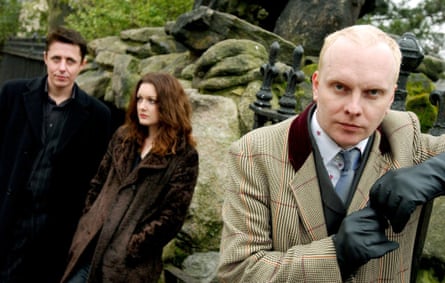
The decision to reunite was apparently easy. However, they are reticent as to whether there will be new Black Box Recorder songs, perhaps about the family Moore recently saw shaving their heads for charity in an English country pub, or the man who fell to his death while tying a union jack to a lamp-post. These incidents are “very Black Box Recorder”, he says, but they don’t want to force their creativity. For now, the forthcoming gigs will be a chance to, as Haines puts it, “psychologically own” their songs. “They’re our wayward kids, and it’ll be nice to give them a talking to and set them off into the world again.”
There is an irony that Black Box Recorder’s first run ended as the music industry buckled from piracy taking hold in the early 2000s, only for the band to be revived by the new incarnation, where influencers and streaming company algorithms have the power to launch or relaunch acts. Perhaps Haines – whose books Bad Vibes: Britpop and My Part in Its Downfall and Post Everything: Outsider Rock and Roll mercilessly detailed those years of turmoil – has had the last laugh. “None of us have any complaints,” he says with a smile. Moore adds: “We don’t want Billie Eilish to explain herself and apologise.”