3 months ago
97
3 months ago
97
Trillions of insects embark, largely unnoticed, on epic journeys every year across mountain ranges, deserts and seas, and it is only now, as their numbers suffer huge declines, that scientists are tracking their movements
On a cloudless sunny day in October 1950, ornithologists Elizabeth and David Lack stood on a mountain pass in the Pyrenees and observed a once-in-a-lifetime spectacle – clouds of migrating insects.
The Puerto de Bujaruelo pass in 2021
Up to 500 butterflies were fluttering past them every hour through the 2,200m-high Puerto de Bujaruelo mountain pass on the French-Spanish border. By mid-afternoon dragonflies were skimming through, outnumbering the butterflies by 10 to one. The spaces between were filled with thousands of tiny flies.
That day became the first record of fly migration in Europe – the skies were packed with tiny travellers on remarkable long-distance journeys unknown to science. It would be decades before the concept of insect migrations was widely followed up.
Today, we know that insects – many of which have wings smaller than a human fingernail – are among the planet’s most prolific migrants, with trillions travelling large distances every year, including over deserts, mountain ranges and even crossing oceans.
Can butterflies cross the Atlantic?
In 2013, Spanish entomologist Gerard Talavera was on a beach in French Guiana looking for butterflies. On the last day of his search, he spotted something remarkable.
That single observation – of tired looking painted lady butterflies not thought to live in South America – launched a decade-long investigation to answer the question: can butterflies really cross the Atlantic Ocean? It was something that had never been proved and defied existing understandings about insects’ capabilities. Talavera assembled a team of biologists, geneticists and atmospheric scientists to reconstruct this seemingly impossible journey.
BUTTERFLY SLIDES GO IN HERE (see Google Doc) / please don’t move or delete this
The findings, published in Nature Communications in 2024, represent the first direct proof that any insect had crossed the Atlantic. Although the discovery was exceptional, “it’s likely it happens quite often”, says Talavera. Meanwhile, 10 years ago researchers first proved the painted lady was crossing the Sahara as part of its annual migration.
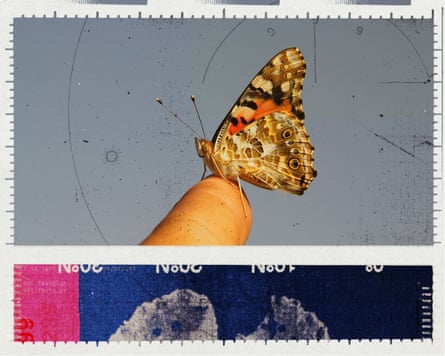
The painted lady cannot overwinter in cooler climates so it has to move as the seasons change. The decision to migrate is due to environmental cues, such as day length, temperature and how much plant food is available for them. They strategically use winds to get to their destination.
Once they arrive at their breeding grounds, fresh vegetation allows the females to reproduce extensively, with a single female capable of laying more than 1,000 eggs. When the seasons change again, subsequent generations may make the same decision to migrate to pastures green.
Can moths read the stars?
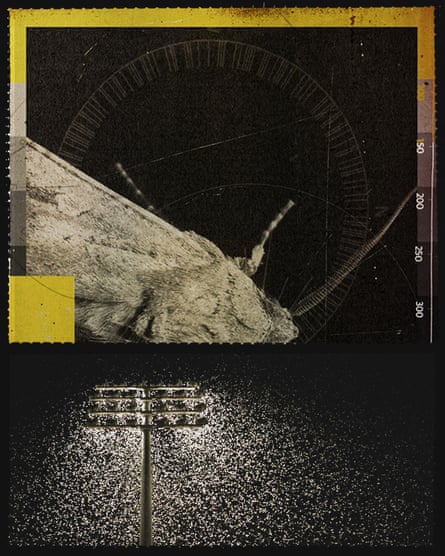
Not all insect migrations are invisible. For thousands of years, people have known that bogong moths migrate in Australia. First Nations people would smoke them out of caves and have big festivals in which they ate these nutritious insects. Their swarms can be so large meteorologists have mistaken them for rain clouds.
By the 1970s, scientists had worked out that birds that migrate at night use stars to guide them, and it was suspected bogong moths were doing the same.
BOGONG MOTH SLIDES GO IN HERE (see Google Doc) please don’t move or delete this
Scientists knew that dung beetles could use the sky to navigate in a straight line for a couple of metres, but this showed an insect (with a brain one-10th the size of a grain of rice) could use the starry sky as a compass over hundreds of kilometres, night after night.
“That was a truly new discovery,” says study author Dr David Dreyer, a research engineer from Lund University in Sweden. “Try to walk from Amsterdam to Vienna in a straight line without your phone or a compass, at night-time and without ever having been to Vienna, good luck!” On a cloudy night, moths can still navigate as they are able to fall back on the Earth’s magnetic field as a compass. However, light pollution may be a problem for bogong moths. “On their spring journey to the Australian Alps, they pass over several large towns which might disorient or even trap the moths,” says Prof Eric Warrant, a biologist at Lund University. Every few years they gather around buildings in the capital, Canberra, causing mild panic among inhabitants.
Bogong moth populations have seen catastrophic declines in recent years, most probably driven by severe drought, habitat loss from agricultural expansion, and the increasing use of pesticides. At the beginning of the 2017 drought – which was the most severe in recorded history – there was a 99.5% drop in the bogong moth population.
This has had a big impact on other species such as the mountain pygmy possum, which relies on the moths for food when it emerges from hibernation in early spring. After the drought, baby pygmy possums were found dead in their mothers’ pouches.
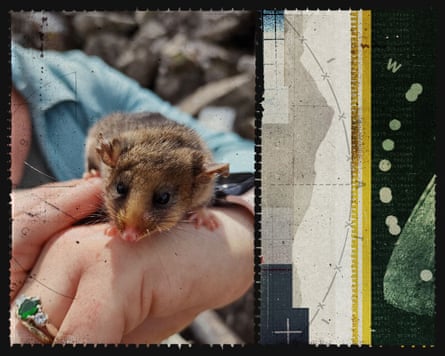
In recent years, it appears bogong moths have started to make a partial recovery, although their numbers remain well below levels recorded before the crash. Droughts in south-east Australia are expected to get worse, so the moth is facing an increasingly uncertain future.
How do you track an insect?
Unlike birds, insects are generally too small to tag (except for the monarch butterfly), and too numerous to follow. This makes studying them uniquely challenging.
Over the decades, scientists have come up with all kinds of creative ways to unpick these mysterious migrations. Some have followed them in aircraft (for example, tracking hawk moths as they ride winds across Switzerland), while others have used “glitter bombing”, dusting insects with fluorescent powder in the hope of catching them later.
Dr Jason Chapman – a behavioural ecologist from the University of Exeter who has transformed the field – took a different approach and used a radar and a blimp to quantify the invisible conveyor belt of insects hundreds of metres above our heads.
For more than a decade his team had two radars pointed a kilometre into the sky like searchlights, recording anything that crossed their beam. At Cardington airfield in Bedfordshire, Chapman and his team suspended a net from a 5m-long blimp. It worked like a trawler net, except it fished insects from the sky.
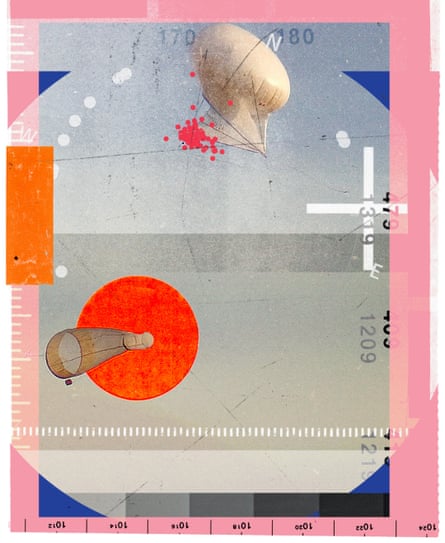
Over several hours, the one-metre wide net scooped up hundreds of insects, including species so small they were invisible to the radar. It flew around the clock for seven months. “We camped on site, and would wake up at ungodly hours to bring the balloon up and put it down,” says Chapman. He sifted through thousands of insects himself and recruited enthusiastic amateurs to help identify the more obscure specimens.

Their study found that more than 3 trillion bugs travel over southern England each year. “It was the first paper to look at insect migration as a mass of species,” says Chapman, describing it as “largely unknown before then”.
There are more than 24,000 species of insects in the UK and most have not been studied. Roughly 5% of species are migratory, says Chapman. “Some of the migratory species are among the most abundant and successful,” he says, including ladybirds, lacewings and aphids. Insect migrations typically unfold over several generations – so no one individual does the whole thing.
Insects flying over the Puerto de Bujaruelo pass
Seventy years after the Lacks’ observations, scientists returned to the same mountain pass in the Pyrenees with nets, traps and ways to systematically count the invisible migrations. They found that 17 million insects fly through the pass every year. “The air was full of magic,” wrote biologist Dr Will Hawkes, who carried out the research.
An estimated 90% of insects that fly through the Pyrenean mountain pass are pollinators. As they migrate, they move pollen hundreds of kilometres, improving the genetic diversity of plants. Insects such as drone hoverflies decompose waste and recycle nutrients so they can be used again by plants and animals.
Other migratory insects – such as hoverflies – eat pests that damage agricultural crops. They also provide mobile banquets for migratory birds such as chaffinches and goldfinches flying in the same direction.
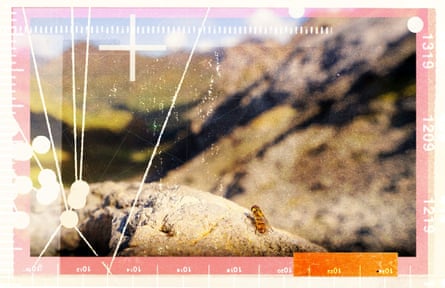
Due to climate breakdown, habitat loss (driven by industrial farming) and pesticide use, the number of insects flying around our world is in decline. A study from Germany found there had been a 97% decline in aphid-eating migratory hoverflies over the past 50 years.
For centuries, insects migrated around the planet largely unnoticed. Now, as scientists are finally starting to unravel the mysteries of these long migrations, the insects are vanishing in front of our eyes.
Additional credits
Illustrations by Alex Williamson.
Video of the Puerto de Bujaruelo mountain pass by Dr Will Hawkes.
Photos of the painted lady butterfly by Gerard Talavera and Lucas Foglia, author of Constant Bloom.
Photo of guiera senegalensis by Claire Felloni.
Video of Bogong moths flying over caves by David Dreyer.
Video of dragonflies and butterflies flying over the Puerto de Bujaruelo mountain by Karl Wotton.
With thanks to Andrea Adden for her data and guidance on the bogong moth’s neural activity.
Find more age of extinction coverage here, and follow the biodiversity reporters Phoebe Weston and Patrick Greenfield in the Guardian app for more nature coverage