3 months ago
63
3 months ago
63
I met the man I’ll call Randy Johnson 13 years ago, as I began research in South Central Los Angeles. I’m an anthropologist who explores how people think about food and use food in their everyday lives. As executive director of a large food justice organization focused on K-12 education throughout the city, Randy was a key source. He talked to me about South Central’s status as a food desert, where its majority Latinx and Black residents had little access to groceries or healthy food. A middle-aged white man, Randy told me of his work in South Central, which centered around encouraging school-age children to eat more fresh vegetables.
He described South Central as a wasteland of sorts. “There is just nothing there,” he said, pointing to the common but false idea that there were no grocery stores there. He then pivoted to talking about the residents. “I see them having almost zero education when it comes to [making healthy eating choices]. They don’t know that what they’re eating is destroying them slowly. It’s just that we, as a society, have failed our citizens to educate them that they shouldn’t be buying the fries every day.”
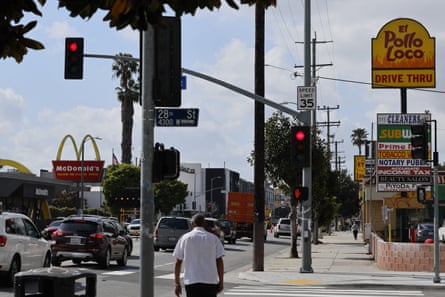
Randy was not alone in portraying South Central as a place with nothing, filled with people who know next to nothing. Over and over again, I heard this idea of a knowledge and resource gap from food justice advocates, usually applied to communities of color. In 2024, a call for grant proposals stated that “fresh fruit and vegetables are almost nonexistent in South Los Angeles food retail stores”. My research found quite the contrary, documenting the dozens of full-service grocery stores, smaller independent markets, fish markets and myriad other places where residents access food in South Central.
For over a decade, I have watched groups of well-meaning food justice activists, who were rarely from South Central, draw on a range of assumptions about what people in places like South Central eat and how they should change what they eat. Their assumptions were wrong. But they still built programs and projects based on those notions. And as I explain in my new book Food Justice Undone: Lessons for Building a Better Movement, that mistaken foundation – and the fact that advocates rarely asked what people actually ate and what they wanted – is one of the fundamental problems with the food justice movement and why it’s made relatively few gains despite the efforts of thousands of people.
Assuming that residents don’t know how to cook healthy food, many food justice organizations have focused their attention on nutrition education through cooking demonstrations and workshops. As part of my research, I observed many cooking workshops and saw the disconnect between what food justice activists assumed and the knowledge of cooking in the room.
In one cooking demo, Molly (using a pseudonym due to anthropological confidentiality practices), who’d recently earned a master’s in urban planning, stood behind a white plastic folding table with the ingredients for “healthy tacos” spread before her: small bowls of steamed cauliflower, diced tomatoes and onions, cilantro, and whole wheat wraps. Molly explained to the classroom of high school students in east Los Angeles, a majority Latino area of the city: “Using a whole wheat, low-carb wrap instead of white flour tortillas is a healthy option for making tacos at home.” She held up a wrap, stiff and brown, to demonstrate.
Molly scooped the steamed cauliflower into the wrap, but it broke straight down the center. A student interjected: “Tortillas aren’t supposed to break like that.” One asked: “Is it old?” Another added: “You need to heat it up.” Molly continued from her script: “Using steamed cauliflower is a good substitute for meat. It gives the taco something big to bite into, and it is way healthier than beef or pork or even chicken.” Molly tried to fold the “healthy taco” enough to take a bite. The wrap broke some more. She took a bite and smiled at the students, who watched politely. When she finished chewing, she said: “This could be a good after-school snack for you, or you can try to tell your parents to make these for dinner.”
From my perspective, the students’ comments indicated that they knew quite a lot about cooking, possibly more than Molly. But those kinds of comments generally went unacknowledged in food justice circles. If people like Molly were trying to help this population, why weren’t they listening to them? This was the case in many food justice projects that I observed. I found such disjunctures to be perplexing and decided to study them more.
Instead of a problem of knowledge deficit, most residents tell me that food costs are too high. Living within conditions of food apartheid, they are angry about the food access inequalities they face in comparison to residents of other parts of the city. While there are grocery stores in South Central, there are fewer per capita than in other parts of the city. And residents complained of both overcrowding and the age and state of disrepair in the stores that exist there. They questioned why new grocery stores and major store renovations seemed to pop up everywhere in the city but South Central.
Residents also linked the issue of food affordability with other structural problems, including educational inequality, access to well-waged jobs with benefits, or, most broadly, poverty. I interviewed residents like Ms Corrinne (also a pseudonym due to anthropological confidentiality practices) who “always shop the specials”, collecting the weekly store circulars to buy food on sale and stock up on things when prices are low. She explained her buying practices to me: “If I can find ground turkey for $4.99 a pound or less, ideally the $3.99 per pound specials, I will drive to each store buying the limit, usually four packs, until I can’t find any more in my freezer. That way, I never have to pay $7.99 or more. I refuse to pay those kinds of prices!” This is a place where the median individual income is $18,995.
While many food justice activists acknowledged the role of these longstanding structural problems, the politics of non-profit work and funding structures forced them to focus on tangible outcomes that they could accomplish within short time frames. Few, if any, had the capacity to address these underlying structural issues. With these barriers on their work, they turned to more feasible projects: cooking demos, corner store and liquor store conversions, neighborhood gardens and a variety of K-12 interventions. They focused on projects that could show results in short periods of time so that they could generate more funding.
But this way is not the only way, in Los Angeles or the food movement more broadly. Local grassroots and Black-led organizations focus on plant-based African diasporic food traditions that have long existed in the community. Organizations like Black Women for Wellness focus more holistically on healing, inspiring and supporting community members. Organizations like the South Central Run Club and the Social Learning Institute tend to understand what the community wants because, most often, they are members of that community.
That produces a whole different approach to programming, one that is less focused on individual dietary change. Instead, it’s focused on long-term strategies for personal and community self-sufficiency and liberation. National level organizations like the Ujamaa Cooperative Farming Alliance (UCFA), the Black Urban Farmers and Growers (Bugs), and the National Black Food and Justice Alliance (NBFJA) also do this work on a much larger scale. In my research, these types of organizations helped me see big differences between how grassroots organizations understood justice and healing compared with outsider-led organizations.
Although food justice started out as a movement attempting to right the wrongs of our inequitable food system, somehow along the way, it became about bringing “healthy” food to places like South Los Angeles and educating residents about cooking and nutrition. These projects imagined these locations as devoid of life, health and capacity, not the robust, knowledgable and culturally rich areas they are. The more grassroots-oriented organizations helped me see that the ways different activists understood “health” and “justice” were often at odds. In order to build a more equitable food system, we need to fundamentally rethink our definition and approach to justice. We need to move away from the idea that nutrition education and dietary advice are adequate solutions for the deep-seated, historically constituted structures underlying our unequal food system.
-
Hanna Garth is assistant professor of anthropology at Princeton University