3 months ago
109
3 months ago
109
A briefcase-sized console with a large, sleek keypad, the MPC One drum machine is an eye-catching piece of kit. It can’t be easily overlooked among the various synthesisers, guitars, amps, samplers and vinyl albums in Renell Shaw’s studio in Wood Green, north London. This month, when the 38-year-old musician plays a double-bill show at Kings Place, five miles down the road, the treasured black box will travel with him – and it has special sounds.
“On stage, I’ll have my score and the MPC, with my grandparents’ voices stored in there. They’ll be there with the band in front of me,” says Shaw, artist-in-residence for Kings Place’s Memory Unwrapped season, a series of musical performances that explore nostalgia, transformation and future.
The testimonies of his elders are an integral part of The Windrush Suite, the first of two extended compositions Shaw will perform that are entirely personal. “I needed to tell real stories, not just the facts, about West Indians coming over on a boat called the Windrush in 1948. Our story is of growth, and it’s a love story, too. I mean, my grandmother came over here from Jamaica looking for work, and my grandfather came over to chase my grandmother!” he chuckles. “When you approach migration on a human level, you connect with it, whether it’s your culture or not, because it can be about triumph over adversity irrespective of gender, race, age.”
Shaw is intent on presenting the Windrush generation as more than the “children of the empire” who, in prevailing narratives, helped to rebuild austere postwar Britain by making invaluable contributions to public services. The anecdotes he has recorded add gravitas to music that is eclectic if not cinematic, with jazz-inflected horns and classical strings blending with taut, crisp funk performed by a 12-piece group.
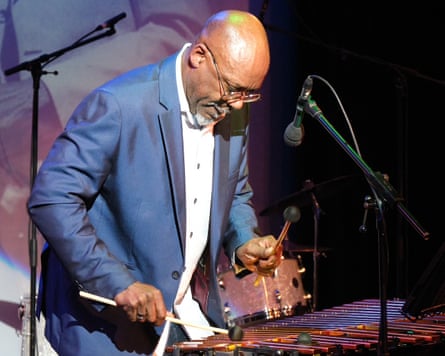
The group, meanwhile, has a wide span of ages, from 65-year-old marimba player Orphy Robinson to 30-year-old drummer Romarna Campbell via 41-year-old cellist Ayanna Witter-Johnson. “Having different generations in the same room means the music carries lived experience, inherited memory and future perspective all at once,” says Shaw.
Known first and foremost as a bassist and producer (he has worked with soul-opera singer Carleen Anderson, rapper Speech Debelle and drum’n’bass act Rudimental), the London-born Shaw is also a talented composer, scooping an Ivor Novello award for The Windrush Suite in 2020. That piece and its sequel, Echo in the Bones, were originally performed on screens during the pandemic, with musicians all playing parts in different studios at a time when the world was in a state of isolation. Shaw bristles at the memory, but also puts a positive spin on lockdown. “One of the few good things about Covid was that all my favourite people were at home, so I could hire them to play my music, as they weren’t on tour!”
At the same time, “it was weird not having a live audience to respond to, even though there were ‘likes’ and ‘shares’”, says Shaw. For the marimba player Robinson, who mentored Shaw back in 2002 (we speak a few days after my visit to Shaw’s studio), the move from virtual to actual is even more resonant today given the creeping disposability of real musicians. “This is the time of AI, never mind what we went through with Covid,” he says. “I’d say that live gigs are more important than ever. We have to connect with an audience in the same room as us. It’s really got to be art rather than artificial.”
As upbeat as Shaw is about the forthcoming show, he is also keen to stress that the suites broach inconvenient truths that need to be told. Echo in the Bones chronicles the experiences of his parents, who were born in Britain rather than being Caribbean migrants. The oppression they had to endure, particularly police brutality at the height of the infamous stop and search SUS laws in the 1980s, is shocking.
“When I heard my uncle and dad talk about police, and being beaten in the back of a van, I felt that they understood that this didn’t have to be tolerated in a way that my grandparents hadn’t,” he says. “I think my parents felt like they had a level of ownership being born here, so there’s a bit less compliance, there’s more resistance in Echo in the Bones. I spent a lot of time talking to my parents, first-generation Black Britons of Jamaican and Dominican origin. I wanted to tell their story. They’re basically saying: ‘No, this is my country, we’ll fight back.’”
Shaw underscores that stance in songs featuring powerful lyrics penned by poet-vocalist Afronaut Zu, but he is sufficiently ambitious to lend to all his suites a comprehensive spectrum of mood and texture. Certain instruments were chosen for their unique qualities. The deft pattering of Robinson’s marimba – a large, handsome xylophone with wooden bars – infuses a strong African resonance to the music but it also sits well on the more classically inflected passages.
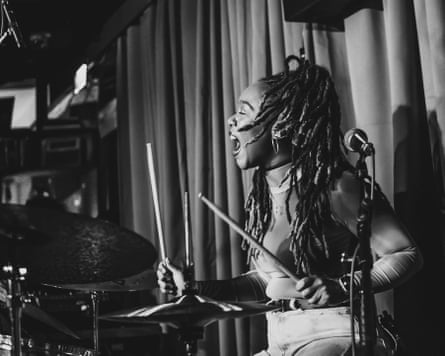
Another central element of Shaw’s sound world is provided by the Birmingham drummer Romarna Campbell, who has drawn plaudits for work with her own trio as well as collaborations with artists such as idiosyncratic Mercury prize-winning singer Benjamin Clementine. Campbell is adept at designing unique drum kits for every new project, often imaginatively combining acoustic and electronic components. She first worked with Shaw on the play Black Power Desk, a musical named after a controversial police surveillance unit founded in 1967 to disrupt burgeoning Black activism, and feels that this forthcoming performance enables her to flourish artistically.
Because Campbell was trained in both jazz and classical, she plays a wide range of drums and percussion. “I’m using bits of a standard kit, timpani and percussion related to the Caribbean, but it’s subtle, not overpowering. Making everything precise for what Renell has created is really important, so all these things are chosen and assembled very carefully. It’s like I’m building little spaceships.”
Seeing Campbell take off with both feet on the ground – musically speaking – while Robinson and co thread together the intricate parts of Shaw’s score should be even more thrilling on stage than it was in lockdown.
While looking forward to the in-person concerts, Shaw is also keen to challenge his audience as much as welcome them through the door. In October at Kings Place, he will also premiere Remember Us Tomorrow, the third and final chapter of The Windrush Suite, which focuses on newer generations of Black Britons. He promises the work will be as thought-provoking as its predecessors.
“I think audiences do not demand higher qualities of art in the way they used to, and so artists don’t feel the need to deliver higher qualities of art,” he states pointedly, before referring to a modern-day icon known for her political work, which was often as controversial as it was uncompromising. “I have to reflect the times, just as Nina Simone said, and make music that allows listeners to be more curious about the world. I’m trying to figure out how I can be me as I do that but I feel I’m on my way.”
Renell Shaw’s The Windrush Suite and Echo in the Bones are at Kings Place, London, on 25 June; Remember Us Tomorrow is on 9 October.