3 months ago
68
3 months ago
68
Key events Show key events only Please turn on JavaScript to use this feature
Pairs results and standings (6/8 stages complete)
155.55 Miura/Kihara (JPN) – personal best for what was already the best pair here
139.70 Metelkina/Berulava (GEO)
136.61 Conti/Macii (ITA)
135.36 Kam/O’Shea (USA)
134.42 Pereira/Michaud (CAN)
Standings
51 USA
49 Japan
45 Italy
41 Georgia
41 Canada
The Japanese pair gets underway, and they’re not quite landing things smoothly at first. But a graceful throw gets a 7.27 for the moment, well ahead of the base value of 5.30.
Still, a death spiral (which sounds like a Norwegian metal band) is under review. This might not be so simple.
The rest is impressive, though – a lift and a throw that far exceed their base values, then a final lift that is the most dazzling of the evening. (And yet it’s under review.)
Miura pumps her fist while being held aloft at the end. It’s an 80.75 on technical scores for the moment, and that might come down into the 77-78 range, but that’ll be plenty.
The Georgians have finished, and it’s a sizable advantage on the technical scores – nearly 10 points ahead of the Italian pair.
So if we’re going to think only in terms of how this affects the USA, consider this – what if Japan does not get 10 points in the pairs? What if Georgia snags the top spot instead? It won’t lift Georgia onto the podium, but might be one more point toward keeping Japan off the top step.
Scores are in: 139.70. Actually not that much of an edge over Italy, especially given the advantage in technical scores.
Final pair: Miura and Kihara from Japan. They have to win this in order for Japan to keep the pressure on the USA.
Metelkina and Berulava, the heart of Georgia’s team, take to the ice. Berulava tosses her into the air like a drummer tossing a drumstick. Their side-by-side jumps are nearly perfect – maybe we could quibble over one skater’s leg being slightly higher than the other’s, but they’re not messing around.
Another throw. Metelkina lands like she just took a small step while walking on solid ground. Nothing to it. We can surely forget any chances that they’ll be in anything but first place with one pair to go.
Johnny Weir reminds us that the Italian pair will have the edge on the artistic scores. It’s not hard to see why, even if you know nothing about figure skating. They’re mesmerizing.
And there it is: 136.61, 1.25 points ahead of Kam and O’Shea.
Conti and Macii start with a solid throw, but they’re at sea on a jumping sequence, with Conti not completing one jump and each of them having some wobbly landings. They bounce back on their next jumps, and Conti firmly and gracefully lands a throw. Macii hoists Conti into the air – looked great from here, but the yellow “review” sign pops up.
It’s a stunningly graceful program. And when Conti lands a triple salchow throw, it’s hard to imagine the US score holding up for first place.
But … their technical score is lower! Could it be? It’s 69.18 (for now) to the Americans’ 69.65.
And it drops to 68.23!
The lowest free skate score this season for Italy’s Sara Conti and Niccolo Macii is 130.92, but that was early on. In Grand Prix competition, their low was 134.89.
So they’ll need to be on point to knock the USA off the top spot. Will skating at home be a boost, or will it bring extra pressure?
The last time Italy hosted the Winter Olympics, the ice dance duo of Barbara Fusar Poli and Maurizio Margaglio finished their free dance with a disastrous fall, leading to this viral moment in which Fusar Poli shot Margaglio a heartbreaking look of despair and disappointment.
Canadians’ scores: 134.42! It’s a season best by far, but it doesn’t catch Kam and O’Shea. Job done for the US pair, earning at least one more point than the minimum.
Pereira and Michaud nails their first couple of elements. All green to start. (“Green” meaning they’re getting what was expected or better on a particular element.) But Pereira has to take several extra steps to stay upright on a throw triple loop.
They march onward, though, and Pereira lands the next throw beautifully. The Canadians are giving up fourth place in this segment without a fight.
In fact, forget fourth here – the other pairs are going to have to be on top of their games here to beat all these upstart North Americans.
Kam and O’Shea got 69.65 on their technical elements. Pereira and Michaud finish with … are you kidding? 69.73!
But at least one element is under review.
In fact, as I type, it has dropped to 69.54.
Kam and O’Shea score 135.36, a season high. Also a personal best.
For comparison – Canada’s Pereira and Michaud have a season high of 123.22.
Get ready to hear some Hans Zimmer …
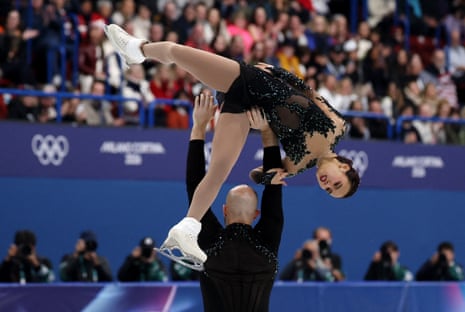
A fierce look of determination on Ellie Kam’s face as the non-Eurythmics version of Sweet Dreams starts. The first throw is solid, though it looks like something (maybe a piece of glitter?) flew off. Their first synchronized jump has a bobble from Kam.
Kam successfully lands on the throws, if only just.
As the music pulsates (a sturdy remake of Everybody Wants to Rule the World), O’Shea’s lifts are breathtaking. Pairs skaters have to be stronger than a lot of athletes in other disciplines. The crowd loves it, and O’Shea is smiling as if he knows he’s putting on the skate of his long career.
Tara Lipinski and Johnny Weir, NBC’s stellar commentator duo, are beside themselves.
This should be good …
Kam/O'Shea open pairs free skate
Gotta love their musical selections – Sweet Dreams, Eleanor Rigby and Everybody Wants to Rule the World.
Some of their elements include Triple Twist Lift, Triple Toeloop, Triple Salchow+Double Axel+Double Axel, Throw Triple Lutz and Throw Triple Loop.
The difference in the technical elements …
Sato’s planned program includes these jumps/combinations:
-
Quad Lutz
-
Triple Axel+Single Euler+Triple Salchow
-
Quad Toeloop+Triple Toeloop
-
Quad Toeloop
-
Triple Axel+Double Axel
-
Triple Loop
-
Triple Lutz
Malinin?
-
Quad Flip
-
Quad Axel
-
Quad Lutz
-
Quad Loop
-
Quad Lutz+Single Euler+Triple Flip
-
Quad Toeloop+Triple Toeloop
-
Quad Salchow+Triple Axel
Skaters can change their minds during the course of the program. But packing in seven quads to Sato’s three is quite the statement of intent.
Start lists and analysis
Pairs
The USA will open with Ellie Kam and Danny O’Shea. Then it’s Lia Pereira and Trennt Michaud (Canada), Sara Conti and Niccolo Macii (Italy), Anastasiia Metelkina and Luka Berulava (Georgia) and finally Riku Miuru and Ryuichi Kihara (Japan).
All five of these pairs competed in the short program, where the order was Japan, Georgia, Italy, Canada and the USA. But Kam and O’Shea (66.59) weren’t far behind Pereira and Michaud (68.24), so if they can improve just slightly, they can gain another valuable point. Miuru and Kihara have gone silver, gold, silver, gold in the last world championships. The Georgia pair took fourth last year and also won the world junior championship. Conti and Macii have been on the podium two of the last three years.
Best-case scenario for the USA would likely entail picking up seven points (fourth place) to Japan’s 10.
Women
Starters are Madeline Schizas (Canada), Anastasiia Gubanova (Georgia), Lara Naki Gutmann (Italy), Amber Glenn (USA) and Kaori Sakamoto (Japan). The one change from the short program is for the USA, where Glenn replaces Alysa Liu. Sakamoto took first in the short program, followed by Liu, Gutmann, Jia Shin (South Korea), Gubanova and Schizas. Sakamoto won three straight world championships but dropped to second this year behind Liu. Glenn won last year’s Grand Prix final.
So this is likely 1-2 for Japan and the USA. If the USA took fifth in pairs, then we’ll have a tie going into the last phase …
Men
List is Nika Egadze (Georgia), Matteo Rizzo (Italy), Stephen Gogolev (Canada), Ilia Malinin (USA) and Shun Sato (Japan). The good news for the USA is that Malinin has dominated men’s skating since the last Olympics, and he has overcome a slightly shaky short program in the past. In the free skate, he’ll line up so many quad jumps that he can afford a few mistakes and still win. The other good news for the USA: Sato isn’t Kagiyama. So this will be Malinin’s – and the USA’s – to lose.
Let’s set the stage …
The team competition is pretty simple. Finish first in a particular program, and your team gets 10 points. Second place is 9 points. Third is 8. Halfway through, we cut down to the final five.
So the current scores, after five of eight stages are …
44 USA
39 Japan
37 Italy
35 Canada
32 Georgia
So the USA are virtually assured of their second medal of the Olympics this evening. It’s expected to be a second gold. But Ilia Malinin was expected to win the men’s short program, and he was second to the brilliant Japanese skater Yuma Kagiyama yesterday after some small errors on his jumps.
Malinin will skate again today in the men’s free skate. Kagiyama will not.
And that could be pivotal. Japan could make up four points in pairs to pull within one point with two events left.
Competition starts with pairs in about 25 minutes (1330 ET). The women start at 1445 ET, then the men at 1555.
Get comfortable. Get popcorn. Get tissues. Enjoy.
Beau will be here shortly. In the meantime, here’s Bryan Graham on how an eventful women’s downhill competition played out:
There was always a version of this story that ended in a single, violent instant. Lindsey Vonn was 13th to push out of the start gate on Sunday in Cortina d’Ampezzo knowing exactly what she was racing with: a fully ruptured ACL in her left knee, a heavy brace wrapped around the joint, and the accumulated wear of a career spent flirting with speed and consequence.
She barely made it out of the opening phase of the run.
Not 13 seconds into her descent, under bright late-morning sunshine on the Olympia delle Tofane, the 41-year-old American appeared to clip her right pole on a gate. The contact was subtle, almost imperceptible at full speed, but catastrophic in effect. She lost her balance, lurched violently to the right, twisted awkwardly in the air and landed hard on her side before being pitched backward down the piste.
You can read the full article here:
You can also keep up to date with the latest events in other disciplines here:
And check out our schedule, results and medal table.