3 months ago
90
3 months ago
90
In a rare meeting with Taiwan’s opposition leader, China’s leader Xi Jinping declared people on both sides of the Taiwan Strait are Chinese and want peace.
Friday’s meeting in Beijing between Xi and Cheng Li-wun, the chair of Taiwan’s Kuomintang (KMT), is the first such contact in a decade. The visit has sparked controversy in Taiwan, with Cheng’s critics accusing her of being too close to China, a country that many in Taiwan see as a threat.
Cheng has previously said that it is a “very natural thing” to identify as Chinese – a stance that is increasingly at odds with mainstream opinion in Taiwan where polling suggests that two-thirds of people see themselves as being primarily Taiwanese.
Meeting Xi in Beijing, Cheng said that Taiwan should “no longer be a flashpoint for potential conflict” and should instead become “a symbol of peace jointly safeguarded by Chinese people on both sides of the strait.”
Cheng arrived in China on Tuesday and has visited several cities on her way to Beijing, including Nanjing, a former capital of China when it was ruled by the KMT before the Chinese Communist party (CCP) took power in 1949.
After their defeat by the CCP, the KMT fled to Taiwan. The self-governing island has since been the subject of intense debate between its local rulers and the CCP in Beijing, which claims it as part of Chinese territory.
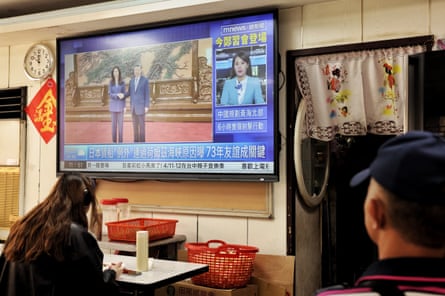
The visit comes as China has increased military pressure around Taiwan. Xi sees “reunifying” China and Taiwan as an important part of his legacy and has not ruled out the use of force to achieve that aim.
Cheng, who was elected as KMT chair last year, is a divisive figure in Taiwan. She has advocated much closer ties with Beijing and has even been nicknamed by some Chinese internet users as the “goddess of unification”.
Taiwan’s last three elections have been won by the Democratic Progressive party (DPP), a pro-sovereignty outfit detested by Beijing. The CCP has particular disdain for Lai Ching-te, the DPP’s leader who was elected as Taiwan’s president in 2024. Chinese state media has portrayed Lai as a parasite being roasted over a flaming Taiwan.
Cheng has argued that Lai’s strained relationship with Beijing creates more risk for Taiwan than her approach.
Since the DPP took power in 2016, China has increased its military activity around Taiwan, including excursions that look like rehearsals for a blockade.
Before she departed for China, Cheng described her tour as a “peace trip” and said that it would show “the sincerity and determination of the Chinese Communist party to engage in peaceful dialogue and exchanges across the Taiwan Strait”.
The trip comes at a time when Taiwan’s domestic politics is bogged down in a quagmire over a $40bn special defence budget that Lai’s party is trying to push through the legislature. Opposition parties including the KMT have blocked the budget, saying that it is too big and too vague.
Cheng has denied accusations from the DPP that her party tried to block the budget ahead of her meeting with Xi. The KMT has proposed a smaller special defence budget of $12bn that is focused on specific military items approved for sale by the US.
In hosting Cheng, Beijing “seeks to cast doubt in Taiwan over the Lai administration’s focus on self-defence and to strengthen voices in Taiwan calling for closer cross-strait ties. Beijing seeks to keep Taiwan divided over the question of how best to secure its future,” said Amanda Hsiao, China director at the Eurasia Group thinktank.
Hsiao added that growing scepticism of the US in Taiwan may bolster Cheng’s argument that the KMT, which leans towards Beijing more than Washington, is better equipped to maintain cross-strait peace.
China strongly objects to US arms sales to Taiwan. Xi told US president Donald Trump in a phone call in February to be “prudent” about such deals.
William Yang, a senior analyst at the International Crisis Group, said that China hoped to use Cheng’s meeting with Xi “to show Trump that its ally in Taiwan is in lockstep with Beijing” when it comes to key policies. Beijing could “potentially use this impression to influence Trump’s position on US arms sales to Taiwan, which is one of the major issues that Xi will likely put on the table when the two leaders meet,” Yang said.
Xi and Trump are expected to meet in Beijing next month in a highly anticipated summit that was delayed from April because of the war in Iran.
Drew Thompson, a senior fellow at the S. Rajaratnam School of International Studies in Taiwan, and a former US defence official responsible for China and Taiwan, said that Cheng’s position does not represent the majority viewpoint in Taiwan. Taiwanese people “are clear that the source of military threats is not emanating from the DPP or President Lai. It’s emanating from Beijing,” Thompson said.
Additional research by Yu-chen Li and Lillian Yang