3 months ago
70
3 months ago
70
Key events Show key events only Please turn on JavaScript to use this feature
'A pivotal week for diplomacy' on Ukraine, EU foreign policy chief says
Arriving at the ministerial meeting in Brussels, EU foreign policy chief Kaja Kallas said this week could be “pivotal” for diplomacy on Ukraine.
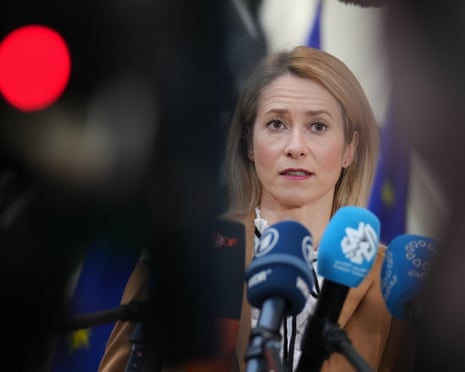
“It is clear that Russia does not want peace, and therefore we need to make Ukraine as strong as possible in order to them to be ready to stand up for themselves in this very, very difficult time,” she said.
Kallas added that “we heard yesterday that the talks in America were difficult but productive,” and she wanted to discuss the latest with EU and Ukrainian ministers.
She appeared frustrated by Europe’s exclusion from the key talks – conceding that “the Ukrainian are there alone” – but insisted the EU should continue pushing in key two areas, by “putting the pressure on Russia … on further sanctions, reparatoins loan that they are very much afraid of, and … by [giving] them military, financial and humanitarian support so they can last and outlast Russia.”
Zelenskyy faces 'mini-revolution' in governance system after shock Yermak resignation

Shaun Walker
Over the weekend, Ukraine’s Zelenskyy had to respond to the forced resignation of his closest and most senior advisor, Andriy Yermak, who stepped down on Friday after his apartment was searched as part of a widening anti-corruption probe.
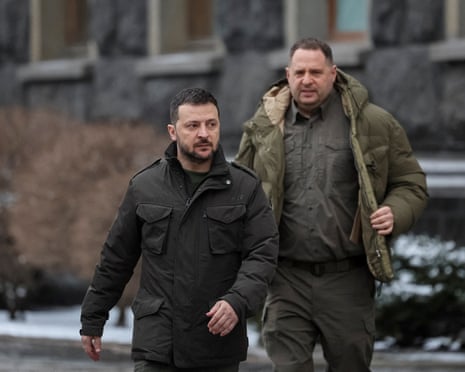
Here’s Shaun Walker’s take on the change:
Yermak’s resignation could have tremendous consequences for domestic governance, as well as for Ukraine’s negotiating position in talks over ending the war with Russia, where he had served as the head of Ukraine’s delegation to peace talks with the White House.
“It’s a mini-revolution in the political system and the governance system,” said Kyiv-based political analyst Volodymyr Fesenko. “Yermak was the key element in the system of power that Zelensky had built.”
Yermak, a former intellectual property lawyer, became a B-movie producer and then lawyer for Zelenskyy’s production company, back when Zelenskyy was still an actor. When his friend won victory in the 2019 presidential election, Yermak went with him into politics, first as a foreign policy adviser and then, a year later, as chief of staff.
Yermak appeared to become untouchable as he got ever closer to the president during the years of full-scale war. He ran the most sensitive tracks of Ukraine’s foreign policy, speaking regularly with national security advisers from allied countries and was in charge of the team working on peace negotiations.
He was also Zelenskyy’s chief political fixer, often giving orders to ministers, and was widely seen as the personification of the president’s will. It was Yermak who travelled to London to meet former army commander Valerii Zaluzhnyi, widely seen as the most threatening political challenger to Zelenskyy, and pitched Zaluzhnyi to join Zelenskyy’s team.
Few people in the Ukrainian elite liked Yermak, but many expressed grudging admiration for his work ethic and his ruthless scheming. Some felt that the level of control, unusual in a democracy, was justified by the wartime context. Additionally, his role as a hate figure often helped to protect Zelenskyy.
Even as Yermak’s apartment was searched on Friday, few expected it to push him out of office, as a broad understanding had developed that Zelenskyy was unlikely to sacrifice his most trusted aide at any cost.
Although Yermak has not been charged with anything at this point, the anti-corruption investigation threatened to dominate the news agenda and lead to a full-blown crisis, amid growing public discontent over corruption.
Morning opening: Zelenskyy visits Macron in Paris

Jakub Krupa
Ukrainian president Volodymyr Zelenskyy is expected to meet France’s president Emmanuel Macron in Paris in just under an hour as he kicks off another busy week of diplomacy amid growing pressure from the US to end the war with Ukraine.
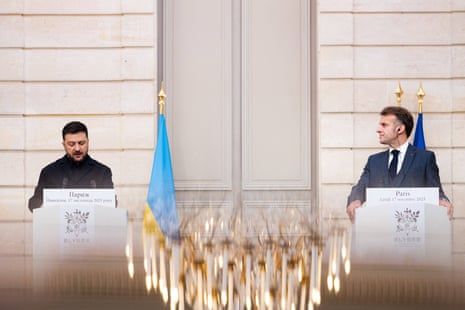
“Peace is within reach, if Vladimir Putin abandons his delusional hope of reconstituting the Soviet empire by first subjugating Ukraine,” the French foreign minister, Jean-Noël Barrot, told La Tribune Dimanche.
Well, that’s a big if.
Over the weekend, Ukrainian negotiators have met US officials in Florida to thrash out details of Washington’s proposed framework to end Russia’s war in Ukraine.
Diplomats focused on revisions to a proposed 28-point plan developed in negotiations between Washington and Moscow. That plan has been criticised as being too weighted toward Russian demands.
Meanwhile, EU ministers are meeting in Brussels for talks on foreign and defence issues, and US negotiators Steve Witkoff and Jared Kushner will head to Moscow ahead of planned talks with Russia’s Vladimir Putin. Lots for us to cover.
Elsewhere, German chancellor Friedrich Merz will host Poland’s Donald Tusk in Berlin for the latest round of intergovernmental consultations between the two countries.
Ukraine will no doubt top the agenda, but the meeting comes as positive sentiment towards Germany in Poland hits near record lows, prompting awkward questions about the relationship, as I try to explain it in this curtainraiser here.
I will bring you all the key updates throughout the day.
It’s Monday, 1 December 2025, it’s Jakub Krupa here, and this is Europe Live.
Good morning.