1 month ago
59
1 month ago
59
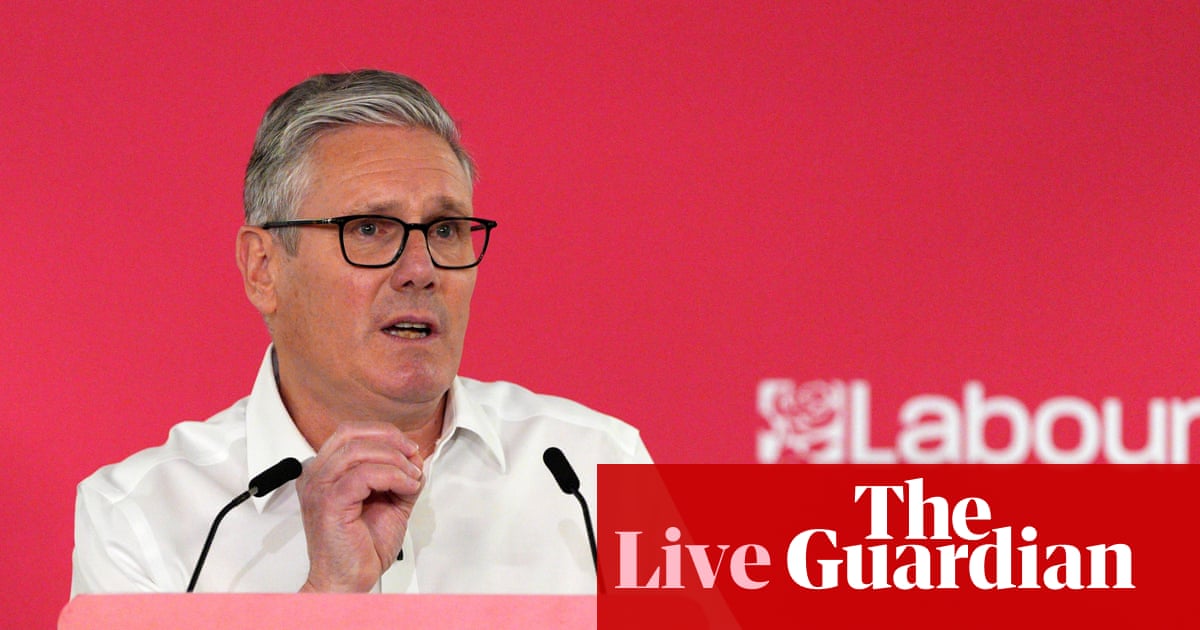
For me, it’s mostly sadness. Among others, the overriding emotion is fear. For some, it’s anger. It was certainly anger that was most vividly on display in Golders Green after the stabbing on Wednesday of two men, both Jews, in the broad daylight of a spring day – much of that fury directed at the government. When the prime minister came to visit, they shouted: “Keir Starmer, Jew harmer.”
I understand that fury, even if I think it’s aimed at the wrong address. British Jews are angry because this was just the latest in a spate of attacks that has included, among other incidents, the torching of ambulances belonging to a Jewish charity and the attempt to burn down not one but two synagogues, all in the course of a few weeks. Jews want those in charge, the government, to make it stop.
Ministers say the right things and pledge more money for the security measures that have been necessary at Jewish buildings for decades – the guards who stand outside Jewish schools and synagogues, the reinforced glass in our windows – and, of course, community organisations are grateful. But no one wants to live in a fortress. The solution cannot be to confine ourselves behind ever-higher walls.
There are some indications that these attacks could be orchestrated by Iran, paying local people with a history of violence or criminality to attack Jews. Hence the demand for the government to proscribe Iran’s Islamic Revolutionary Guard Corps (IRGC) as a terrorist organisation. It would be comforting to tell ourselves that this is all the work of foreign actors, that we have no homegrown problem of our own. But let’s say Tehran is involved: that it could recruit Britons so easily to the task of attacking Jews would tell its own story.
For those reasons, it’s not enhanced security or a ban on the IRGC that will placate those who heckled Starmer in London on Thursday. What they want is a crackdown on what they call the “hate marches”, the demonstrations against Israel that have been staged in London and elsewhere since the Hamas attacks that killed 1,200 Israelis on 7 October 2023 and the Israeli bombardment that followed, killing 70,000 Palestinians and leaving Gaza a ruin.
Those who attend such demonstrations insist that they are there purely to mourn the Palestinian dead and to oppose the state that is killing them. But Jews hear in some of the slogans and see in some of the placards – especially those that speak of a “Zionism” that controls the world through money and hidden power – a refrain that has been directed at Jews by antisemites for centuries, long before Israel ever existed. When they hear, chanted through a megaphone: “Say it loud, say it clear, Zionists not welcome here,” they hear an echo of those who persecuted and expelled them in the past – because they know that “Zionists” has long been the euphemism of choice for hardcore antisemites who really mean Jews.
Incidentally, it’s not only Jews who take this view. Jonathan Hall KC, the independent reviewer of terrorism legislation, who this week described the recent attacks on Jews as a “massive national security emergency”, has also said that talk of Jews and Israelis as “if they are demonic, as if they are the source of the world’s problems” has been “very present on the streets” and “it’s painting a target on Jews’ backs”. He has suggested a moratorium on the marches.
Still, I’m uneasy about a ban. Part of my objection arises, obviously, from a belief in free speech. It’s also clear from the Palestine Action precedent that it would never work: the marches would still happen, almost certainly bigger than before. But I confess that part of it is a weary knowledge that such a ban would only make life worse for British Jews: we will be blamed for censoring free expression, cast as the shadowy string-pullers who put a gag on everyone else.
But why is there even talk of a ban? The demonstrations would not need to be policed for hate speech if they were genuinely self-policed. Such a move should come naturally. It’s a good bet that every single person on those protests would call themselves a proud anti-racist. Indeed, they would say that’s a big part of why they’re there in the first place. Surely, then, they would want to be free of even the hint of racism. And yet organisers have never once approached mainstream Jewish groups, seeking guidance on how they might tackle this problem. (Doubtless, the march organisers will have talked to the “Jewish bloc” who go on these demonstrations, but getting a clean bill of health from those who already agree with you is not quite the same thing.)
So if the organisers won’t act, perhaps the wider anti-racist movement will. And this gets to the heart of the matter. Governments can’t eradicate racism; only society itself can do that. But where are those who should be leading that effort? Where are those who are usually so vocal in their opposition to racism, now that one of Britain’s oldest minorities is facing a violent, murderous threat on the streets?
Where are the actors and celebrities who ordinarily waste no time in declaring their solidarity with the oppressed, even those many thousands of miles away, now that British Jews are stabbed in London for no reason other than that they are visibly Jewish? The silence of those otherwise so noisy is remarkable – and we Jews hear it loud and clear.
Perhaps it’s because the likes of Nigel Farage and Kemi Badenoch have already seized on the issue – Farage declaring it’s now “open season on Jewish people in this country”, something he would know all about, given that he went to a school where it was allegedly open season on Jews when one N Farage was a pupil – trying to find a rare patch of moral high ground, and no one wants to be in their company. Or, as one reader who wrote to me this week suggested, people are “conflicted” because the likes of Benjamin Netanyahu regularly conflate criticism of Israel with antisemitism, and so, “by implication, supporting Jews implies support for Israel”. I credit that reader with honesty: I suspect many of those now silent are hushed by the fear that supporting Jews stabbed in Golders Green will somehow be read as backing the Israel Defense Forces in Gaza. Better to say nothing instead.
But since when did progressives take their lead on anything from Netanyahu? If you’re a supporter of the Palestinians and you don’t like the conflation of opposition to Israel with antisemitism, here’s a really easy way to reject that conflation: take a stand now against antisemitism and in support of British Jews.
It should have already happened. There should have been a call for a mass demonstration in London this very weekend, making clear that, whatever their different views on the Middle East, the people of this country reject and repudiate deadly attacks on an ethnic minority, isolating and ostracising those who would contemplate or defend such violence. That it has not is an indictment of all those who claim their animating mission is the fight against racism.
Hence the sadness I feel. Jews now are being asked, and asking each other, if they should consider leaving this country. For the record, my answer is: absolutely not. This is my home. This is where I belong. As Ed Miliband once said, contrasting himself with David Cameron, I may not have been sitting under the same oak tree for 500 years, but my family is rooted here. And yet the fact that this has even become a conversation is a terrible shock. Such things were meant to be in our distant past. If it shocks you too, then you need to say so. Right now.
-
Jonathan Freedland is a Guardian columnist
-
Do you have an opinion on the issues raised in this article? If you would like to submit a response of up to 300 words by email to be considered for publication in our letters section, please click here.