3 months ago
65
3 months ago
65
A thinktank at Columbia University is engaging in deceptive trade practices by hiding the extent of its financial ties to the fossil fuel industry, according to a first-of-its-kind administrative complaint filed by student activists and shared with the Guardian.
Columbia’s Center on Global Energy Policy (CGEP) describes itself as an independent organization producing research on energy policy. But that representation is “misleading”, alleges the complaint to the New York City consumer protection bureau, filed Monday by Columbia’s chapter of the youth-led environmental justice organization the Sunrise Movement.
Publicly disclosed donation documents and academic studies’ conflict-of-interest statements show that CGEP has accepted millions of dollars in funding from big oil companies, including ExxonMobil, Shell, BP, Occidental and Tellurian. By presenting its fossil fuel-funded work as neutral, CGEP is misleading the public, the students allege.
The institute’s branding is particularly concerning because its energy research informs climate policy at the state level and nationally, said Leel Dias, a third-year student at Columbia and organizer with the campus’s Sunrise chapter.
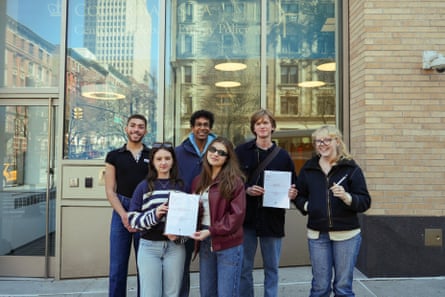
“They’re claiming to be a trusted source of information that policymakers can use,” Dias said. “But in reality, they’re laundering the reputation of the fossil fuel industry.”
In an emailed statement, a Columbia spokesperson said CGEP’s funding comes from “a wide variety of sources” that all “share our commitment to improving energy policy through rigorous, independent analysis and engaged dialogue on global climate and energy issues”. The thinktank currently accepts monies from a variety of oil companies, as well as tech companies such as Google and foundations such as the JPMorgan Chase Foundation, it says online.
“All of our funders are fully disclosed on our website, which makes accusations of deception absurd and unfounded,” said the spokesperson.
Though CGEP says it is “unbiased”, oil and gas interests do not view it as such, the complaint says, referencing internal industry documents revealed by a 2024 investigation by Senate and House Democrats. In a 2018 memo, for instance, BP identified CGEP as an “opinion leader” that could “illustrate BP’s energy transition narrative” and position the company as a “preferred partner”. A 2021 public relations brief from Shell also said that a CGEP panel featuring a company representative could help counter critiques of hydrogen, a fuel favored by the fossil fuel industry, in the face of critical studies.
“We don’t need to guess why Shell or BP are funding research at Columbia as they are literally telling us. It’s so that Columbia can greenwash their business models and extend their license to operate,” Dias said. “As climate catastrophe worsens, we cannot afford to allow any more disinformation from big oil to obstruct the clean energy transition.”
There is evidence that fossil fuel funding is skewing research results. A 2024 study found that polluting companies’ funding of universities’ climate-focused efforts is delaying the phaseout of oil and gas.
“Universities are established enablers of climate change obstruction by fossil fuel interests,” said Geoffrey Supran, a University of Miami professor who co-authored the study and has long studied oil and gas funding in academia.
A 2022 study led by Columbia researcher Douglas Almond also revealed that research centers across 26 universities that are heavily funded by the sector – including CGEP – show a statistically significant bias in favor of gas over renewable energy sources. Two CGEP professors authored a response to the Almond study, pushing back on its methodology and conclusions and saying its analysis “does not support the conclusion that CGEP’s research is influenced by its funding”.
Columbia in 2024 established a committee to “consider questions concerning funding for research from the fossil fuel industry”.
CGEP, founded in 2013, “has long been committed to independent and nonpartisan research that meets Columbia’s high standards of academic integrity”, the university spokesperson said.
“No outside organization or individual, including funders, influences the work of our scholars to determine policy recommendations or research outcomes,” the person added.
The students’ complaint boasts support from a Columbia University student worker union, as well as two faculty groups.
“I am very proud of our students in Sunrise Movement who are pushing back courageously, intelligently and peacefully through protest and legal action, including this case, to ensure that we do not have an energy policy center that is in any way compromised by fossil fuel influence,” said Jacqueline Klopp, who directs Columbia’s Center for Sustainable Urban Development. “Universities need to produce trusted research and guidance for the public, free of fossil fuel interests, and should strive for the highest standards of transparency and ethics.”
Steven Donziger, the former attorney who battled Chevron over pollution in the Ecuadorian rainforest and faced three years on house arrest, also backed and advised the students on the filing.
“The complaint uses verifiable evidence to document a disturbing lack of integrity in an academic center at Columbia that appears dedicated to protecting oil companies that are destroying the planet, in exchange for funding from those same companies,” said Donziger. “This complaint is a fabulous example of how students can be effective change agents in society.”
If the consumer protection bureau finds CGEP has committed the violations the students allege, it could require the thinktank to remove claims of “independence” and “unbiased” from its digital platforms – potentially until it dissociates from fossil fuel companies. It could also place fines on Columbia University.
At “the very least”, said Dias, the activists hope the complaint pushes CGEP to fully disclose its funding sources, something campus organizers have demanded for years but that university policy does not require.
Under the administration of Zohran Mamdani, the democratic socialist mayor, New York City’s consumer protection bureau should be “sympathetic” to concerns about corporate overstepping, said Dias, noting that the mayor’s department of consumer and worker protection recently secured a $1.5m settlement with a fast-food franchisee for violations of city labor law.
Green legal non-profit Climate Defense Project reviewed the students’ claims. “We encouraged the Columbia students to move forward because, in our view, the complaint has a solid legal basis and it’s just a matter of finding political institutions willing to enforce the law,” said Alex Marquardt, the group’s executive director.
The filing comes amid increasing public scrutiny of big oil’s relationship with universities, and as calls for academic institutions to “dissociate” from fossil fuel companies have ramped up on campuses across the country. In the past, Sunrise organizers at Columbia have engaged in direct action, staging protests and disruptions to demand an end to fossil fuel funding of research.
In the years since the 2024 Gaza solidarity encampment at Columbia, however, university officials have cracked down harder on public demonstrations, according to the campus’s Sunrise chapter. This inspired them to take up new methods of organizing, they say.
Supran expects that the complaint against CGEP is “just the beginning”.
“I expect we’ll see more and more universities being held legally, politically and publicly accountable for knowingly facilitating the spread and legitimization of fossil fuel industry propaganda,” he said.