3 months ago
84
3 months ago
84
Last year, as the major fall film festivals took place around the world, it was hard to make out the sound of audience applause. It wasn’t an attendance issue or that booing was heard instead (that’s solely a Cannes response), it was that, for many, hands were too busy wringing to find time to clap.
The trifecta of Venice, Telluride and Toronto was once seen as an inescapable fixture on a film’s road to the Oscars. Best picture winners such as 12 Years a Slave, Spotlight, Birdman, Moonlight, The Shape of Water and Green Book all rose within that circuit and cemented their reception at festivals and world premieres and often felt judged for awards potential over quality. But over the past few years, as the Academy has changed and diversified its voting body and as the industry has changed in so many other ways, something has shifted. Winning films have come from Cannes, Sundance, SXSW and, most shockingly, no festival at all …
This year saw a further swing away from the film festival to Oscar pipeline with the two most dominant films emerging the old-fashioned way: as wide studio releases without a festival stop. The films – Sinners and One Battle After Another – amassed 10 Oscars between them and both came from Warner Bros, a studio celebrating a banner year of betting big on auteurs taking risks. The discourse surrounding them had grown exhausting by the time Sunday’s ceremony arrived, not just because of how over-extended this season had been but because, for once, so many people had actually seen the films in question. It was a blessing and a curse but mostly, if one stayed away from Twitter, it was the former, a thrill to have people invested in the Oscars once again.
There was, after all, very little to invest in during last year’s dud-heavy fall festival season. New films from Kathryn Bigelow, Luca Guadagnino and Noah Baumbach and major awards plays from Dwayne Johnson, Colin Farrell and Brendan Fraser all fizzled. At the same time, there was an understandable smugness to critics who hadn’t forked out the thousands needed to get on a plane to see them, thanks to the fact that Paul Thomas Anderson’s new film was already screening back home to wild praise and would be released in cinemas just after the film festivals wrapped with its wise September release. One Battle and Sinners, which was released last Easter, were essentially given to audiences first and without the velvet rope of the festival, helped position them as grand spectacles for the people, and not guestlist-only events for the privileged few.
The festivals were not without their Oscar successes this year: Venice premiere Frankenstein picked up three craft awards last night while Telluride’s Hamnet gave Jessie Buckley her first Oscar. But there’s a creeping sense that the pipeline is not what it once was and the very idea of what an “Oscar movie” is has changed for the better. This year voters turned their back on traditional biopics (The Smashing Machine, Deliver Me From Nowhere and Christy stumbled) and welcomed in the more unusual alternatives (Marty Supreme and Hamnet were mostly fictionalised, Blue Moon was set in one night rather than across decades).
There was an unusual embrace of horror, a genre that had long been discounted (Weapons, Frankenstein and Sinners all scoring for witches, monsters and vampires while Bugonia also picked up nods for the aliens). There was a broad swath of prickly, hard-to-like, easy-to-hate characters in the acting categories (from winning villains played by Amy Madigan and Sean Penn to fascinatingly, maddeningly complex characters from Rose Byrne, Teyana Taylor, Ethan Hawke and Emma Stone) something the Academy hasn’t always embraced, especially with women. And even if international films couldn’t break through to any major wins this year, there was still sustained representation (Sentimental Value, The Secret Agent and It Was Just An Accident broke out with noms outside of the international feature category).
Predictions were all over the shop as a result, with steadfast rules feeling harder to rely on with a base that’s almost doubled over the last decade and adding more women, people of colour and international voters. Even if One Battle After Another ultimately made most sense as a best picture winner after scooping up the majority of precursors, it’s far from a stereotypical Oscar movie. It’s a curious stewpot of genres (shifting from comedy to action to satire to thriller) led by a shambolic stoner with scenes of fetishistic sex and sudden shocking violence which is both relevant to the time we’re in without being directly about it. Paul Thomas Anderson’s idiosyncrasies have been quietly accepted by the Academy over time but to finally win, he didn’t need to temper his oddities. As a result, the film feels bigger and more emotional than what we usually see from him, but not necessarily easier: its edges are still on show.
Similarly, Sinners with its four major trophies is also not a standard winner. It’s another swirl of genres, including horror which the Academy often disregards, with a majority Black cast, something they have also chosen to snub on many occasions, and also contains plentiful amounts of sex and violence.
The success of Moonlight in 2017 had ushered in an era of the micro-budget, the $1.5m drama becoming the smallest film to be named best picture. Since then, smaller picks like Coda ($10m), Parasite ($11m), Nomadland ($5m) and last year’s Anora ($6m) have reigned but this year it was all about a grander scale. One Battle cost a reported $130m and Sinners was around $90m while the next two biggest winners, Frankenstein and KPop: Demon Hunters, cost $120m and $100m respectively. The Academy has long been concerned about how out of touch the Oscars has become, as network TV and cinemagoing have dwindled in popularity with films very few had seen leading the pack. In 2009 the five best picture nominees were extended to 10, allowing in blockbusters such as Avatar, Up and District 9, while an “outstanding achievement in popular film” Oscar was announced in 2018 before being binned after backlash.
But the popularity of the films in this year’s race (globally, Sinners is at $369m, One Battle at $209m, F1 at $633m, Weapons at $269m, Hamnet just crossing $100m and then the record-breaking Netflix success of KPop: Demon Hunters) meant that the films could speak for themselves without any clumsy Academy coercion. Last year had already seen the Oscars reach a five-year viewership high even as a film as small as Anora was sweeping, no doubt buoyed by fans of the Wicked and Dune sagas.

A genuinely entertaining and well-orchestrated Oscars ceremony led by deserved success for critically acclaimed and commercially successful films does however arrive with a bittersweet addendum. The major wins for Warner Bros (with Amy Madigan’s Weapons victory added, the studio took home all but one of the above-the-line Oscars) comes as Paramount Skydance prepares for ownership, a stinging reminder that even a record-breaking year does not mean safety in Hollywood. It’s still unclear exactly how it’s all going to work (the promise of 30 theatrical films from both studios combined seems unlikely in this climate) and one need only look at what Disney did after it purchased Fox, now barely functioning, or take a look at the kind of lazy, IP-led dross Paramount mostly tends to release these days to feel concerned about the future.
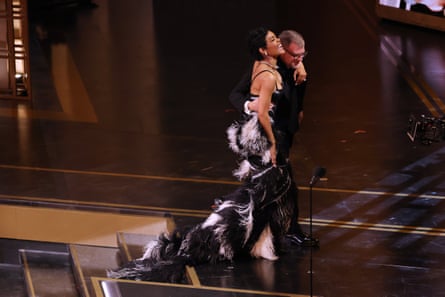
The slickly televised ceremony has also arrived soon after news that YouTube will be the official Oscars home from 2029, just after it celebrates its 100th anniversary. Host Conan O’Brien might have made multiple jabs about the scourge of big tech dumbing down art last night but it’s an unavoidable evolution for a show and an institution that seemed to have otherwise finally found a way to deftly move with the times. The Oscars may well have changed for the better but as the world around continues to change for the worse, it might not matter anyway.