2 months ago
72
2 months ago
72
Twenty minutes into the first grand slam final of her young career, it looked like Mirra Andreeva’s head was already in danger of exiting Court Philippe-Chatrier. Between the weight of the occasion, the windy conditions and a resourceful opponent seemingly built to cause her maximum anguish, Andreeva looked crippled by tension.
Her reaction to the pressure underlined the work Andreeva has put into addressing her emotional vulnerabilities. She maintained her composure, coolly problem-solving and then flourishing after a tense start as she ended the qualifier Maja Chwalinska’s historic run with a 6-3, 6-2 victory.
Ever since she arrived on tour as a 15-year-old, already beating some of the best players in the world, it seemed to be only a matter of time before Andreeva began to compete for major titles. The more pressing question was how long it would take. Not too long, it turns out. At 19, Andreeva is the youngest French Open champion since Monica Seles won her third consecutive title in 1992 and the third-youngest grand slam champion of the 21st century, behind Maria Sharapova and Emma Raducanu.
Most players would dream to face an opponent ranked No 114 in a final, but this was still potentially a hazardous encounter. Against Chwalinska, the second qualifier to reach a slam final after Raducanu, Andreeva entered her first slam final fully conscious of the fact that she was the heavy favourite and anything less than victory would be catastrophic.
In an era where teenage prodigies have largely vanished, Andreeva’s precociousness marks her as a dying breed. Her talent has never been in doubt, but over the past few years her biggest challenge has been managing her emotions and the pressure that comes with her status.
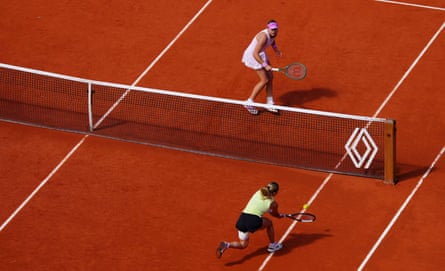
Polish fans at Roland Garros have been animated by the success enjoyed by Iga Swiatek over recent years. They may have had a different, less familiar face to cheer on in the final, but they came again in their thousands, lining the tournament grounds with their red and white flags. From the warm-up, chants of “Maja, Maja” echoed around the ground.
Chwalinska immediately got to work, unleashing her arsenal of shots. She threw everything at Andreeva: loopy topspin, low slices, drop shots, angles and random injections of pace on her lefty forehand. As she tried to inflict maximum uncertainty on Andreeva and goad her forehand into errors, she forced the Russian to generate pace on every ball.
Against such a difficult player to hit through, and in slow and extremely windy conditions that only made things more challenging, many of Andreeva’s bad habits resurfaced early on. She became passive and reactive, struggling to time her forehand and throwing up ample moonballs. Compared to the last two grand slam finals, which included some of the finest shotmaking talent to emerge this century in Aryna Sabalenka, Elena Rybakina and Amanda Anisimova, the tennis ball seemed to be moving at half speed on both sides of the net.
Down 2-3, after following up two double faults with an error-strewn return game, Andreeva steadied herself by finding first serves and securing her first hold of the match. This provided her with the confidence to force herself inside the baseline in the exchanges, taking the ball early off both wings, carefully redirecting it and controlling every point. Once she began to play on her own terms, the 106 ranking places between them were clear. From 2-3 in set one, Andreeva rolled through 10 consecutive games before confidently closing out the match.