3 months ago
79
3 months ago
79
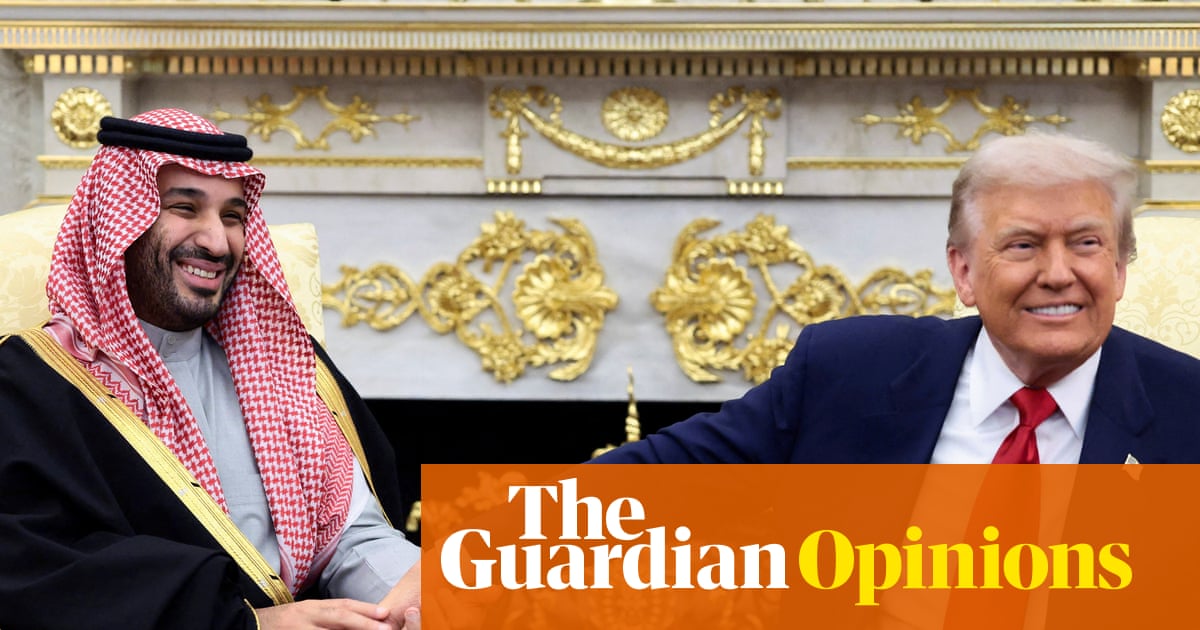
What’s the worst that could happen when King Charles visits Donald Trump in Washington at the end of this month? And what will be the best outcome from Keir Starmer’s point of view, since it is the prime minister who directed the visit to go ahead in the hope of improving our battered, supposedly special relationship? While the relationship is still apparently meaningful to Britain, to the US it appears to not mean so much – especially now.
The king goes where he is told, whether he would prefer to stay at home or not. This time to a land whose president denounces our aircraft carriers as toys and accuses us of cowardice, and whose defence secretary talks derisively of our Royal Navy. Perhaps Charles ought to wear his naval admiral’s uniform when he goes to the White House, medals and all.
But what Charles really takes to Washington is the monarchy’s greatest diplomatic asset: soft power. It’s an ability to charm, to convince foreign governments that he’s a good bloke and that Britain is worth taking seriously – in trade, culture or just tourism – and that we’re a reliable ally with whom to do business, or hold hands with across the sea. Unfortunately, the Trump administration despises most of that, except possibly our golf courses, some of which the president owns, so Charles faces the most ticklish and potentially most consequential excursion of his reign.
Such official overseas visits are carefully choreographed in advance, but it does take two to tango and Trump is notoriously difficult to keep on message, increasingly so these days. He doesn’t do protocol, so while we are unlikely to see Trump, surrounded by his grinning acolytes, tearing a strip or two off the king in the Oval Office like he did to Volodymyr Zelenskyy in February last year, Charles may well find himself listening to a rant about the shortcomings of the prime minister, or indeed about his plans for Canada, where it so happens Charles is also head of state. Trump has already breached protocol twice this week, albeit in minor matters, by describing Charles as prince and by giving away the dates of the visit – 27 to 30 April – which the palace tries to keep secret in advance for security reasons, not usually releasing until a week or so before the visit.
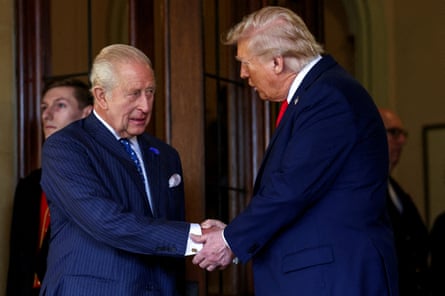
What does Charles do in those circumstances? Keep a dignified silence, or murmur gently that recollections may vary?
The two men are hardly intellectual or spiritual soulmates. Trump has no time for environmentalism, holistic medicine or architecture, unless it’s one of his own buildings. And the circumstances surrounding the meeting, with a war in progress, are hardly propitious – some advisers thought that would have been a good excuse to call the state visit off at least for now, though that would only have increased the president’s ire to no helpful purpose. Presumably the wrath of Trump was not thought worth provoking further.
Charles, of course, has been playing the diplomatic game for decades. He knows how soft words turn away wrath and, having met Trump several times on the president’s British visits, he also knows how to flatter him, which appears to be the way to his simple heart. Elizabeth II was a past mistress of distraction, remaining purse-lipped, or rooting about for something in her handbag if things were getting really sticky.
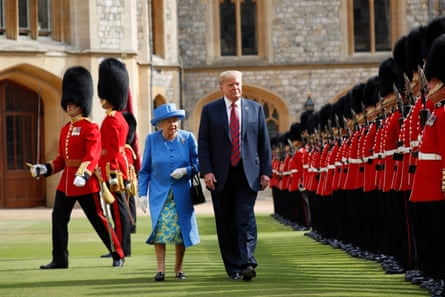
She was only once known, on any of her 266 foreign visits, to show visible irritation: in Morocco in 1980, when the capricious King Hassan II kept changing the visit’s itinerary and keeping her waiting for hours in boiling weather. She also put up with the Romanian dictator Nicolae Ceaușescu and his wife, Elena – who were both convicted of genocide and executed in 1989 – as guests at Buckingham Palace, and she did not complain when Trump barged past her while inspecting a guard of honour at Windsor Castle on his first state visit in 2019. He, naturally, believed he was her favourite president; she apparently just thought he was very rude.
Elizabeth II had an altogether smoother job during her six visits to the US, being generally welcomed obsequiously by the 14 presidents she met, from Truman to Trump (Lyndon B Johnson was the only person who served during her reign whom she did not meet). The days when American politicians reacted suspiciously to British monarchs petered out in the mid 19th century, with only occasional exceptions, such as Big Bill Thompson, the notoriously corrupt mayor of Chicago in the days of prohibition and Al Capone, who announced he would punch King George V “in the snoot” if he ever ventured into the Windy City. He presumably knew that the king, who did not like Americans much, was unlikely ever to visit (and never did), but Thompson believed it would play well with his Irish and German voters – and they duly re-elected him three times.
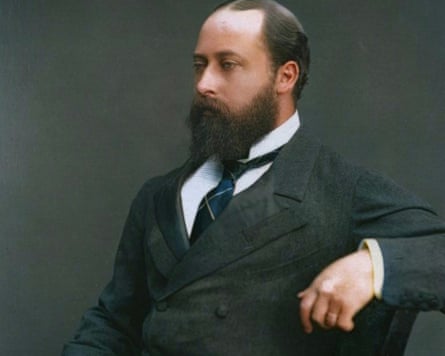
Otherwise royal visitors have usually been popular there, ever since a 19-year-old Bertie, Queen Victoria’s eldest son – and future Edward VII – ventured on a four-month tour to North America in 1860 to be greeted by cheering crowds in New York. An audience even stood to sing God Save the Queen when he attended an opera in Philadelphia. Sadly, the death of his father and the outbreak of the US civil war ended such jaunts.
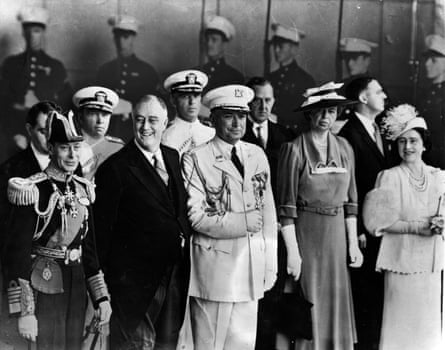
In 1939, the visit of George VI and his wife, Elizabeth, the future queen mother, three months before the start of the second world war was credited with greatly improving Anglo-American relations. He was the first reigning monarch to visit the US and went at the personal invitation of President Franklin Roosevelt, who – shades of this month’s visit – did not approve of the Chamberlain government’s appeasement policy. As Elliott, the president’s son put it: “Father wanted the welcome … to act as a symbol of American affinity for a country whose present political leadership he did not trust.”
For once, it was a visit that came at the behest of the American government rather than the British.
The trip was a triumph. King and queen were seen as unstuffy and approachable – “We ate things which I think are called hot dogs,” she wrote home to their 13-year-old daughter – and helped diminish American hostility after the abdication crisis, when Edward VIII gave up the throne to marry an American, and the earlier Irish independence struggle. “We like them. And we hope they like us,” wrote the New York World Telegram. It didn’t speed American military involvement in the war, however.
So will soft power triumph this time? What is mainly in the king’s favour is that Trump seems to feel he has an affinity with Britain, since his mother was a Scottish immigrant to the US. He says at the moment that he thinks the king is a great man and a great monarch, so on such slender threads are hopes raised. Charles will be genial and won’t provoke a change of heart. Will it change anything in Anglo-American relations? Perhaps for a few days, at least, before Trump returns to using Starmer as a convenient punch bag. The president is probably as ignorant of British constitutional proprieties as he seems to be of American ones.
No visit is entirely incident-free, and the palace has already said that the king will not meet a delegation of Epstein victims to discuss his brother’s behaviour nor hear their stories first-hand. He has a reasonable excuse while police inquiries into Andrew Mountbatten-Windsor are continuing in Britain, so there is not very much more he can say, having already expressed sympathy. That will not stop questions being raised, however.
The ostensible reason for the visit is the 250th anniversary of the declaration of independence from Britain. The late queen not only attended the bicentenary in 1976, but also reigned long enough to attend both the 350th anniversary of the founding of the English settlement of Jamestown in 1957 (conceived as a fence-mending visit after the previous year’s Suez debacle) but also the 400th anniversary in 2007.
Expect to see “No Kings” banners and demonstrators this time, but they will be aimed not at Charles, but at Trump’s apparently monarchical ambitions. George III, the king who lost America, remains a convenient figure of fun across the Atlantic: half comic madman, half tyrant. Largely forgotten is George’s greeting to the first American ambassador to the court of St James’s after the war, the future president John Adams, in 1785: “I was the last to consent to the separation but [it] having been made and having become inevitable, I have always said … that I would be the first to meet the friendship of the United States as an independent power.”
As one of the delegates to the peace conference told his opposite number, it did not matter because future Americans would be speaking English, not French. The ties really do run that long and go that deep. Charles can always console himself that his visit is to the US, not just to Trump – and the president is term-limited, while he, at least for now, is not.
-
Stephen Bates is a former Guardian royal correspondent.