2 months ago
66
2 months ago
66
To some it was the moment the mask slipped. Wearing an open-necked white shirt, Mohsen Rafighdoost, former minister of the Islamic Revolutionary Guard Corps (IRGC), was filmed last March fondly reminiscing with an interviewer from the Tehran-based Didban Iran news website about the assassinations he had organised around Europe.
There was Prince Shahriar Shafiq, the last Shah of Iran’s 34-year-old nephew, who was shot twice in the head outside his mother’s home in Paris in 1979.
Then there was the Shah’s final commander-in-chief, Gen Gholam Ali Oveissi, also shot dead in Paris, in 1984.
Rafighdoost explained with a chuckle that he had additionally ordered the murder of Shapour Bakhtiar, the final prime minister under the Shah, who was killed in his Parisian home in 1991; and the stabbing to death a year later of Fereydoun Farrokhzad, a dissident Iranian artist.
“Usually the Basque guys,” Rafighdoost said of the separatist terror group he commissioned to carry out the murders. “They were performing and no one was bothering them.”
It was all coordinated via intermediaries, Rafighdoost said, including an Egyptian cleric based in Germany. The cleric sorted out the payment, creating a handy distance that shielded Iranian officials from direct attribution.
The IRGC later denied the allegations. Rafighdoost’s office claimed he was confused after recently undergoing brain surgery.
Monday’s firebombing of four ambulances owned by a Jewish charity in Golders Green, north London, and the apparent claim of responsibility, yet to be verified, from a supposed new group said to have links to the Iranian regime, has brought a renewed focus on Iran’s use of terror against dissidents and Jewish communities.
With two British nationals arrested and then bailed, police continue to keep an open mind about the possibility that no state or international actor was behind the attack.
But based on its past modus operandi, experts do see the potential hallmarks of Iranian involvement in Golders Green. In comments to the Guardian, Kevan Jones, the Labour peer who chairs the intelligence and security committee (ISC) tasked with overseeing the UK’s spy agencies, described a growing trend: the use of hired hands to do the dirty work, whether it be violence, kidnappings, assassinations or surveillance.
“They are doing this through organised crime and through individuals by paying them and that’s what it is more likely to be here – if it is indeed linked to Iran,” Jones said.
The UK has seen a lot of Iranian activity in recent years. In October 2025, during his annual threat assessment, the MI5 director general, Ken McCallum, stated that “the MI5 has tracked more than 20 potentially lethal Iran-backed plots” in the past year alone.
Giving evidence to the ISC in the summer of 2023, the then home secretary, Suella Braverman, said Iran was using “very elusive, quite sophisticated, very brutal European-wide gangs” to carry out their work.
An unnamed MI5 official told the committee that Iran was “casting around for mercenaries and operatives to conduct activity … to build new alliances and relationships.”
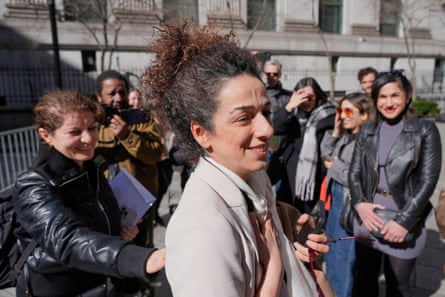
In the US, court records suggest Hells Angels biker gangs have been deployed by the Iranian regime. Two Russian mobsters, Rafat Amirov and Polad Omarov, were found guilty last year of plotting the murder of the Iranian American dissident Masih Alinejad. US prosecutors said in court that Iranian officials contracted the men to kill Alinejad at her Brooklyn home for $500,000. The ISC report named a heroin distribution syndicate led by an Iranian narco-trafficker, Naji Sharifizindashti, as doing Iran’s bidding in Europe. The regime is said to be seeking similar linkups in the UK. Two narco-gangs in Sweden were said by the authorities there to execute plots on Tehran’s command.
Matthew Levitt, a former deputy assistant secretary for intelligence and analysis at the US Department of the Treasury, now a senior fellow at the Washington Institute, said the use of proxies to carry out attacks was a longstanding tactic – but that Iran had decisively pivoted to use criminal gangs in 2018 after one of its diplomats was convicted of planning an attack on an Iranian opposition rally being staged in Paris.
“They realised at that point the utility of reasonable deniability and cut outs,” Levitt said. “With criminal proxies, as long as you are willing to pay the price, which is not so much money, you are also getting someone who is not squeamish about doing things that involve violence because that is what they do.”
Of the Golders Green attack, Levitt said that if it did emerge that Iran was involved, it was likely not a new terror group but rather the result of a “kind of criminal gig economy”.
Based on the open-source information available, the Washington Institute for Near East Policy’s Iranian External Operations dataset found that nine out of 41 Iranian external operations they had registered between 2025 and 2026 were based in the UK.
Why is there so much activity in the UK? The large Jewish community in the country and Britain’s historical alliance with the US, is part of the answer, said Levitt. “The Iranians are not intimidated by law enforcement and they will go where the targets are and where they have the resources,” he said.
Colin Clarke, the executive director at the Soufan centre, a US research NGO, said the Iranians had copied the Russian playbook.
“The Russians had moved to the use of what they call ‘disposable agents’,” he said. “It sends European services chasing their tails looking for a connection to a state that might not be there, or may be two or three steps removed.
“The downside is that these are often amateurish plots, and not particularly effective. But I do think that Iran potentially has sleeper cells, either IRGC or regime operatives, who are forward deployed, in case of an existential crisis: which is arguably where we are now. Is the US going in with ground forces the tripwire? We don’t know.”
In December 2023, Magomed-Husejn Dovtaev, a Chechen-born Austrian citizen, was convicted of conducting surveillance on the west London headquarters of the Iran International Persian-language TV station, declared a terrorist organisation by the Iranian regime.
Asked why he had taken an interest in the building and its surroundings, Dovtaev told the Old Bailey he “quite simply liked it” and was “in wonder at the architecture” of the Chiswick business park. Iran denied any involvement.
Adam Baillie, a former editor at Iran International and now its media spokesperson, said they had since moved their studios, but that the staff did not socialise for fear of an attack. “The worse it looks for the regime, the worse it is for us,” he said. “Proxies and use of rogue elements are a key worry for counter-terrorism and the police, with regard to us certainly.”
“The Met are in regular touch,” he added. “I was told by my security boss about three weeks ago that the Met had said that I had come to their attention as someone under increased Iranian attention for cyber hacking.”
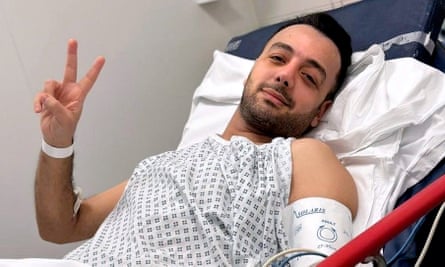
The station is at a state of heightened alert. Two Romanian citizens are due to go on trial next month charged with wounding and wounding with intent to cause grievous bodily harm after the stabbing of the Iran International journalist Pouria Zeraati in Wimbledon in 2024. They deny wrongdoing.
In the wake of the explosions in Golders Green, the Met commissioner Sir Mark Rowley announced that 264 extra police officers were being deployed to protect the Jewish community in London, alongside “additional highly visible firearms patrols”.
Dave Rich, the head of policy at Community Security Trust, which provides security advice to the Jewish community, said this should be seen as a warning ahead of the eight-day Passover festival and that the sub-contracting to criminals under the radar was a worry.
“When you’re deploying that many police officers and also extra visible armed patrols in Jewish community areas, you’re not just doing that for reassurance,” Rich said. “You’re doing that because you think there’s a real threat.
“People often say, what’s the biggest danger to the Jewish community at the moment? My answer is always the biggest danger is whichever type of terrorist turns up at a synagogue that morning.”