3 months ago
87
3 months ago
87
It’s not straightforward, trying to assess a book written by someone whose stature and reputation loom large over the text. I have not read any books by the American academic and anti-racist writer Ibram X Kendi before, but I had absorbed his ideas and interventions into American racial discourse over the years, as well as the controversies. And so I was curious about his latest – and his first since the “anti-woke” backlash.
I tried reading it as a stand-alone text, rather than another chapter in Kendi’s history. Every book deserves to be judged on its own terms. And Chain of Ideas is a huge piece of research that clearly builds on the many years Kendi has spent writing on racism and his experience as a public figure. But does it rise to the occasion? I attempt to answer this below.
A new chain of ideas

First, the background that is important to know, but also important to ignore. Kendi is one of the United States’ most prominent anti-racism writers and thinkers. Over the last decade, he has written several books and been awarded a series of prestigious accolades, such as the National Book Award for Non-Fiction and a MacArthur Foundation “genius” grant. His work has also become embroiled in America’s culture wars about race, and several of his books have been banned from schools for, according to conservative policymakers, introducing a view to children that America was inherently racist. His story so far – lauded anti-racism scholar, bestselling writer, and then traduced symbol of wokeness – is totemic. It symbolises the rise of and then backlash to anti-racism, particularly after the cultural breakthroughs and huge popularity of the Black Lives Matter protests after the murder of George Floyd.
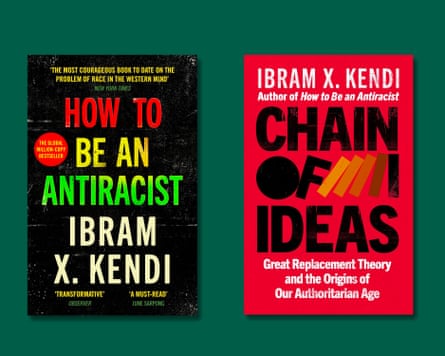
His new book, Chain of Ideas, lands in a very different moment to his bestselling 2019 hit, How to Be an Antiracist, in which he argued that there was no such thing as being a “non-racist” – one was either racist, or anti-racist – there was no space for neutrality in the middle, only complicity. And so it’s appropriately pitched at the macro-political and historical level, rather than the personal one that so dominated the early 2020s; one that focused on “allyship”, “doing the work”, and the responsibility of white people to undo racist programming.
In Chain of Ideas, as far as I have been able to gather, his argument is that modern rightwing politics is rooted in the theory of “the great replacement”, a belief that white people are being replaced by other races, on their way to becoming a minority dominated by people of colour. The “chain” is a series of ideas that make up the different parts of the great replacement theory that give it “reach and strength”. Kendi explains each component idea through the rhetoric and policies of rightwing politicians across history and geographies, from Donald Trump, to Marine Le Pen, Viktor Orbán and others across Europe and Latin America.
Connecting an ideology
Things start to fall apart pretty quickly. The ideas in the chain, such as “racism is interpersonal prejudice and interpersonal discrimination”, “stand in the legacy of antislavery, anti-colonialism”, and “fight for privileges provided by dictators instead of power provided by democracy, civil rights activism, and antifascism”, all kind of make sense on their own. But together they do not cohere into a “chain” that unites the theory, or can even be superimposed on to different nations. I understand, for example, that a rightwing dictator can make white people feel special and superior by saying that natives come first, and that this translates into less enthusiasm for more equitable and democratic systems. But I do not see how this is part of the practice of great replacement theory, rather than a political strategy. Or how it connects to legacies of anti-slavery, for example, in contexts in eastern Europe, where there isn’t a history of enslavement or colonialism analogous to the American or western European experience.
Each idea is an interesting foray into a particular history or event – for example, the media’s indulgent framing of France’s Le Pen under the “white people lose out as people of colour gain” – but broadly they don’t hang together.
A broader purpose

There is a valorous and appreciated attempt throughout the work to point out that great replacement theory as practised today (if you accept the premise that all these rightwing movements are joined together by the chain) has a broader purpose than just racial ideology. It also aims to distract less fortunate white people from the inequities they suffer from, by focusing on the people of colour coming for their native privileges. But it feels like there’s another book trying to poke its way into this book. In fact, there are at least two other books here – one about the racial politics of distraction, and another about the violent movements that are produced by racial hysteria. Kendi is trying to do too much, going down too many different avenues, without really bringing it back to his central thesis.
His voice is also rather strange for such an established and celebrated writer. When he comes into the text to talk about himself, or how he got here, or what role he wants to play in anti-racist discourse, he sounds simplistic, distant. Neither artful in prose nor powerful in statement. “I did not want my privilege to be my prison. I wanted to imprison my privilege to free my power”, he writes in one instance. In another, “I did not find the subject of this book. The subject of this book found me.”
The need for a political strategy
There are some richly informative passages in the book. I did learn a lot about the theoretical origins of the great replacement notion, and how it has crept into mainstream politics. And there are important, arresting accounts of far-right violence: its victims, and the derangement that racist politics triggers in people. But I was desperate for another book altogether. One that doesn’t become tangled in the backlash against racial justice movements by trying to explain it away as just another manifestation of how pervasive and sophisticated racism is. It’s just not edifying, nor does it answer bigger questions about how to change racist systems that are held hostage by not only the right, but liberals who have co-opted the language of anti-racism without the goals. Or address how to do so in western economies where more and more people are ravaged by recession, inflation and high costs of living, making them responsive to anti-immigration rhetoric. Or engages materially with strategy.
Chain of Ideas is a long, ambitious book, but it is strained by Kendi’s effort to coin a new theory and press gang the facts into it. What we need now is scholarship on the circumstances that give rise to such poisonous rightwing parties, and ideas on how to strategically connect these similar global experiences Kendi talks about, into not just an anti-racist movement, but a whole politics.
Chain of Ideas: Great Replacement Theory and the Origins of Our Authoritarian Age by Ibram X Kendi is published in the UK by The Bodley Head and available at the Guardian Bookshop.