1 month ago
52
1 month ago
52
Atop a gigantic wildlife bridge in California this week, butterflies filled the air. A red-tailed hawk sailed above as a slight breeze ruffled the 6,000 native plants, including poppies and purple sage. You’d never guess that below the quiet expanse of rocks and plants, a 10-lane freeway ferries 400,000 cars each day.
When the project broke ground four years ago, enthusiasm was high. The wildlife crossing in northern Los Angeles county would be the largest of its kind in the world, providing safe passage for mountain lions, bobcats and lizards.
But in recent weeks, the bridge has landed in the news for the wrong reasons. The Murdoch-owned California Post published an op-ed in March, penned by two writers from the conservative Manhattan Institute, that criticized the $114m project for going over budget, calling it a “jobs program for environmentalists” and a “multimillion-dollar bridge to nowhere”. Other conservative commentators piled on; from Fox News to Trump’s transportation secretary, Sean Duffy.
Beth Pratt, California regional executive director with the National Wildlife Federation and the public face of the crossing, said the backlash was swift. She began to receive messages painting her as a moron, a cat lady, and even threatening her physical safety. “The hate was really ugly,” she says. “We had to contact law enforcement.”
Despite the spate of rightwing hate, the wildlife crossing has found a finish line. The project will be officially “open for animal business” on 2 December, Pratt announced at an event for Earth Day this week.
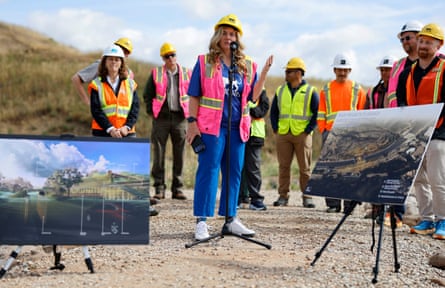
Pratt acknowledged not everything had gone to plan, due to environmental and economic factors. Initially, the project had a completion date of 2025, she says – but after breaking ground in 2022, there were two years of record rains and flooding. The group revised the construction schedule to factor in the impact of these disruptions and announced this delay with a new estimated completion date of 2026. “We have experienced no major delays since then,” Pratt says.
“I welcome hard questions,” she said of the Post’s coverage, and showed the Guardian a 10-page response she sent to their inquiries about the project. “This was not that. They ignored the facts and literally printed misinformation.” For example, she said, the bridge does indeed go somewhere – it is an active construction site that is connecting the Santa Monica mountains. And when citing the cost increase, the article neglected to break down the impact of inflation, she said.
As for the cost, Pratt points out the budget for almost every construction project has increased. The National Highway Construction Cost Index, a figure calculated by the Federal Highway Administration, has increased 67% since 2021 – and is slowing down the rate of builds across the country.
In the spring of 2025, as the wildlife crossing was collecting bids on the second stage of their project, inflation soared and “everything got more expensive overnight,” Pratt says. Costs ballooned by 23% from $93m to $114m – still less than the average increase in highway construction during this time, she points out.
Asked about Pratt’s criticism of the California Post story, Christopher Rufo, one of the authors, told the Guardian that “Beth Pratt seems like a quirky, well-meaning woman who has no business running a major infrastructure project”, and reiterated concerns about the project running behind schedule and over budget.
The National Wildlife Federation has now hired security and changed their protocols to keep Pratt and the other organizers safe at the crossing. “Not everyone agrees on conservation projects, and we have always been transparent in talking about cost and timing,” says Pratt. “But if bullies think they’re going to stop the work, they don’t know me. I’m from Boston.”
But atop the concrete colossus, none of the online acrimony was apparent. At the Earth Day event, the crossing was surprisingly peaceful, blending into the hillsides around it. It was easy to imagine how a lizard or a mountain lion might use it to move through the landscape.
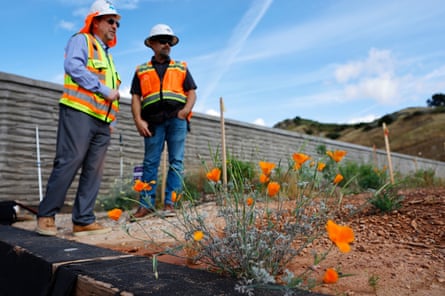
Already, butterflies and caterpillars have found their way to the plants, which is a welcome sign, says Jewlya Samaniego, who co-managed the Wallis Annenberg Wildlife Crossing Native Plant Nursery, where the thousands of native plants that cover the bridge were grown from seed, gathered by hand.
And it’s not just pollinators – a western fence lizard named Bob lives at the top of the stairs to the crossing, and a rattlesnake (thus far unnamed) lives at the bottom. The fact that they have made homes here, with the work still ongoing, is a testament to the project’s success at promoting biodiversity and coexistence. “I just hope everybody can see how much love that we put into this,” Samaniego says, looking out at the flora. “We really put our heart and soul into each plant that we grew.”
Aside from the freeway overpass, the construction continues. As we look out, workers are building a second large structure that will bridge a local road and connect the overpass with the surrounding steep hillsides. Once that’s completed over the summer, they will haul in 3m cubic feet of soil – enough to fill half of SoFi Stadium – to bridge the gap between the overpass and the surrounding landscapes. The construction teams will also build berms to block out noise and light, and add wildlife-proof fencing along the freeway.
Eventually, there will be more than 50 cameras on the crossing and the adjacent areas – ready to capture any creature that comes across, says Jeff Sikitch, with the National Park Service. He has been part of a two-year study of five target species that will benefit from the bridge. Researchers studied their movements and numbers before the crossing, and will do another study after it has opened, to compare. “The amount of available, protected habitat we do have in the Santa Monica Mountains is prime, great habitat for these species,” Sikitch says. “It’s even supporting our last remaining large carnivore, the mountain lion.”
Pratt says it’s an emotional moment to know that the project will soon be finished, despite the challenges and online hate. She teared up announcing the date. “This project that is decades in the making – open for business.”