3 months ago
88
3 months ago
88
Israeli warplanes have launched dozens of strikes across southern Lebanon despite a new agreement supposedly brokered by Donald Trump aiming to bolster the tattered ceasefire in Lebanon.
The US president said on Monday that he had stopped an imminent Israeli strike on Beirut and that he had spoken to Israel’s prime minister, Benjamin Netanyahu, and representatives of Hezbollah and both agreed that “all shooting will stop”.
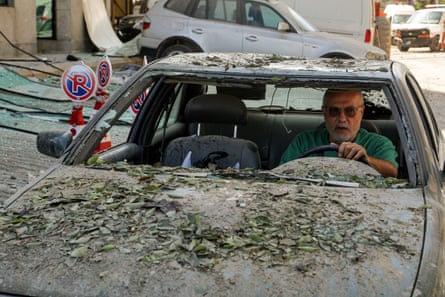
But on Tuesday, Lebanon’s state-run National News Agency reported 30 Israeli strikes across the south. Near the city of Sidon, rescuers recovered the bodies of six members of the same family, including two children and a woman, after an Israeli strike.
The Israeli military also issued a new evacuation warning for the southern city of Nabatiyeh before new strikes, accusing the “Hezbollah terror organisation” of violating the ceasefire.
A deal to reduce or stop levels of violence between Israel and Hezbollah, a militant Islamist movement with close links to Tehran, would support Washington’s efforts to reach a new ceasefire agreement with Iran.
Trump on Tuesday denied reports from semi-official news agencies in Iran that Tehran had paused negotiations until Israel stopped its offensive in Lebanon.
“The conversations between us have been going on continuously, including four days ago, three days ago, two days ago, one day ago, and today,” he said in a social media post.
Hezbollah has not claimed any recent strikes in Israel, saying instead it attacked Israeli troops who have pushed into Lebanon to establish a security zone between 5 and 10 kilometres wide.
The Israeli military said on Tuesday it intercepted two projectiles fired overnight from Lebanon towards the northern city of Safed, while a drone struck a military position in western Galilee, close to the border with Lebanon, the Times of Israel newspaper reported. No injuries were reported.
This most recent round of conflict in Lebanon began when Hezbollah fired rockets at Israel on 2 March in retaliation for its killing of Iran’s supreme leader, Ayatollah Ali Khamenei, in a wave of airstrikes carried out on the first day of the US-Israeli offensive against Iran.
In recent days there has been a dramatic intensification in fighting and bombardment.
Over the weekend, Israeli troops raised their flag over Beaufort Castle, marking their deepest incursion into southern Lebanon since the end of the 1982 to 2000 occupation. Hezbollah responded with even deeper rocket attacks into northern Israel.
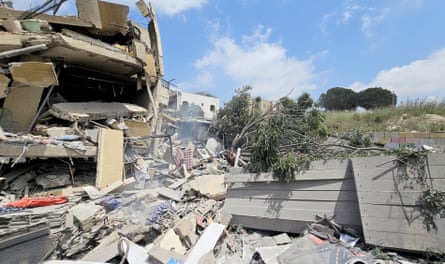
Citing what he called Hezbollah’s “repeated violations” of a ceasefire officially in place since 17 April but never respected by either side, Netanyahu had ordered strikes on Beirut’s southern suburbs, a densely populated Hezbollah stronghold.
According to the US news outlet Axios, however, Trump called Netanyahu “fucking crazy” and accused him of putting peace talks with Iran at risk.
Channel 12, a prominent independent Israeli news network, contested the details of the call. Amit Segal, the network’s chief political analyst who is close to Netanyahu’s political circles, said Trump had not attacked the Israeli prime minister personally and that the two had come to an agreement that Netanyahu would refrain from attacking the Beirut suburbs if Hezbollah ceased its attacks on Israel.
Netanyahu and his defence minister, Israel Katz, said they had given instructions to strike “terrorist targets” in the southern suburbs for what they described as “repeated and ongoing violations of the ceasefire by Hezbollah”.
The bombing order marked the most serious escalation of Israel’s war in Lebanon since the supposed ceasefire and was followed by Iran’s political leadership calling off all further negotiations, maintaining that a ceasefire in Lebanon was a precondition for a broader truce with the US.
Katz said Washington “endorsed” the principle that his country would strike Beirut’s southern suburbs if Hezbollah launched any further attacks on Israel. “If Israeli towns continue to be attacked, we will evacuate and strike the Shia Dahiyeh quarter in Beirut, Hezbollah’s stronghold,” Katz said.
In the southern suburbs of the Lebanese capital, which many residents had fled the day before, many shops were closed on Tuesday, while a military drone flew over the area at low altitude, according to an Agence France-Presse journalist.
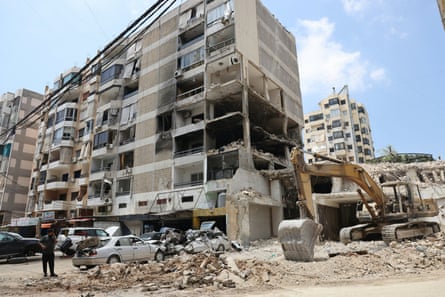
Layla Shehab, 35, decided to return as “we found the situation has calmed down a bit”.
Lebanese and Israeli delegations have begun a new round of talks in Washington, the fourth between the two countries, which have no diplomatic relations, since the start of the war.
Mahmoud Qmati, a senior Hezbollah official, told AFP on Tuesday that the group “will not accept a partial ceasefire”.
“The Zionist enemy should know that any aggression against the [southern] suburbs [of Beirut] could lead to a deeper and stronger response” from the group, he added.
Since mid-March, Trump has repeatedly said he is close to a deal with Tehran, which would postpone the most difficult and sensitive issues including the future of Iran’s nuclear programme. A priority for Trump is to reopen the strait of Hormuz, the critical waterway whose closure caused oil prices to spike, inflicting economic pain far beyond the region.