3 months ago
115
3 months ago
115
Dimmed lights and the honey-like vocals of R&B singers greeted guests at Sost, a restaurant in Washington DC, in late December. Though they entered as strangers, the 11 Black women attendees hugged each other before taking their seats. The ambiance was intimate and soulful, with a sparse table setting in a private room that boasted deep red walls. Crystle Johnson, the founder of Kinory, a dining community for Black women, led the group in a moment of silent meditation.
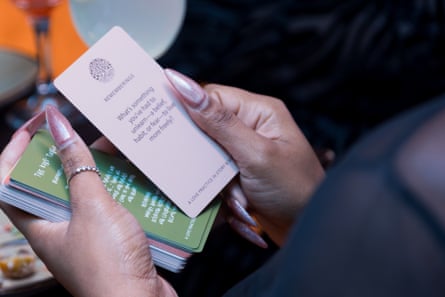
As an icebreaker, everyone shared who they were without talking about their profession. They laughed at each other’s responses over bowls of jollof rice and chicken, a black eyed peas salad and sweet potato fritters. Johnson posed questions that she pulled from a deck of cards during the three courses. One of the cards read: “What’s something you’ve had to unlearn – a belief, habit, or fear – to live more freely?”
The Austin, Texas-based Kinory dinners, launched in June 2025, allow participants the space to think about themselves. Johnson, along with other Black women across the country, are part of a cohort of people launching dinner parties to encourage respite and joy among their peers. It’s an opportunity for them to unplug from their daily responsibilities of work and family and to foster new friendships. Alongside DC, Johnson has also held dinners in Austin, and Houston, Texas. And central Florida-based Black Women Dinner Society founder, Tabrisha Ruby, has hosted meals in Tampa, Orlando, St Petersburg, and Clearwater, Florida.
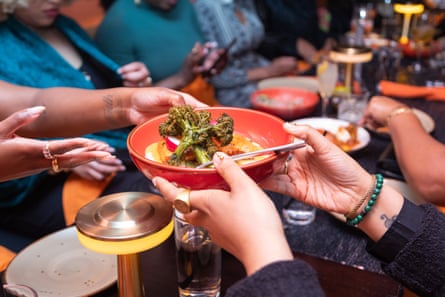
“They have no idea who the person sitting next to them is going to be,” Johnson told the Guardian. “And when they leave the dinner, they leave with friends; they leave with sisters.”
Black people have long gathered over dinners to resist, organize and collaborate. A dinner in 1924 at New York’s Civic Club – a space where Black and white intellectuals socialized in the 1920s – helped spearhead the Harlem Renaissance, with Black writers publishing dozens of works in the following years. Black activists and artists have also convened over meals to discuss the evolution of Black identity, said Christopher Allen Varlack, an associate professor in English at Pennsylvania’s Arcadia University.
“Dinner spaces are a place in which the food itself is celebratory of the culture,” Varlack, who specializes in literature from the Harlem Renaissance, told the Guardian. “It speaks to the resilience and persistence of the culture by gathering together and passing down stories.”
Hundreds of women from 25 to 60 years old have met at more than 30 Black Women Dinner Society gatherings where they’ve fostered lasting friendships. Ruby has made some of her best friends at the events and was recently a maid of honor for someone she met through the club. Others travel the world together. The group has also inspired new business ventures: one attendee began her own food club where she hosts day trips to a different state for brunch.
Such opportunities have become all the more important as the unemployment rate for Black women climbed from 5.4% in January 2025 to its highest point in four years at 7.3% last December. Ruby has hired several of the women who she’s hosted through Black Women Dinner Society to cater or serve as chefs at some of her other events, including afternoon yacht excursions.
Making a “connection with someone who you actually click and bond with so when you’re going through hard times and you need someone to talk to at 1 in the morning you can give them a call”, Ruby said. “That’s something that’s unique.”
Kinory’s origins evolved from a need for longlasting sisterhood. Johnson already hosted international retreats for Black women, but craved a more consistent community where members could develop relationships over time. She envisioned a space for Black women where “you don’t have to explain who you are, why you are, how you are, the things you’ve experienced; you’re just able to come into the space and just be who you are.”
A combination of the words kindred, memory and story, Kinory kicked off with a dinner during the AfroTech conference for Black tech professionals in Houston last October. Dinners at Kinory are membership-only, with an initial one-time $500 fee that includes a first dinner and priority access to other gatherings that Johnson hosts. Each dinner is hosted in a private room at a Black-owned restaurant and costs $225.
To join the group, potential members fill out a questionnaire through the Kinory website and Johnson selects applicants who prioritize self improvement. Then, she interviews the women and uses AI to connect them with others they’d be compatible with for each dinner. Johnson hosts up to 12 people per dinner, with guests ranging from 30 to 45 years old.
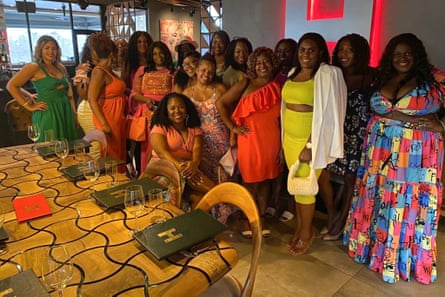
Gathering with other Black women over dinner, said Johnson, allows women to tend to their own internal landscape in a hostile sociopolitical environment. “Black women gathering for joy and fellowship is the balm that we need right now with everything feeling like it is on fire literally and figuratively around us,” Johnson said. “We need people who understand us, who aren’t there to judge us, who aren’t there to tell us what we should be doing, but who are just there to listen and to hold you.”
‘Collective work and responsibility’
The dinner at downtown Manhattan’s Civic Club marked a shift in public discussions about Black people from that of oppression to Black joy. On 21 March 1924, more than 100 publishers, authors, writers, artists and community members attended the interracial dinner. It was originally meant to celebrate the publication of Black writer, Jessie Redmon Fauset’s novel, There is Confusion. But attendees soon began discussing how Black art was no longer focused on slave narratives, but on celebrating jazz, cabarets and southern vernacular.
“It was a great opportunity to unveil some of the fundamental changes that were taking place in Black, artistic expression,” said Varlack.
Black writers including Zora Neale Hurston also hosted literary salons and dinner parties where their discussions about Black culture, music and books helped fuel the Harlem Renaissance. A’Lelia Walker, a socialite, also hosted lavish dinner parties for Black and queer artists at her residences throughout New York, which served as a respite for people on the margins of society.
Modern-day dinner gatherings are a way to honor the past and celebrate Blackness, said Varlack. When Black women convene over a meal, he said, they are practicing Ujima, the third principle of Kwanzaa, an African American celebration, that means “collective work and responsibility” in Swahili.
“It takes collective work in order to solve the problems affecting that community and to preserve the community as a whole. The work that the African American community has to engage in can’t just be about responding to racism, oppression and violence,” Varlack said. “It also has to include that element of Black joy, of celebration of the culture. It’s one of the ways in which members of the Black community build up resilience so that they can continue to do the work that’s necessary to usher in transformation for the Black community, and other marginalized and minoritized communities.”
‘There is nothing like the love of a Black woman’
Kinory and Black Women Dinner Society’s gatherings continue the legacy of honoring Black culture by gathering women to discuss their lives and interests.
Ruby created Black Women Dinner Society in January 2022 for women to meet each other at fine dining restaurants around Tampa and eventually throughout central Florida. She chooses a different fine dining restaurant every month, charges a $25 fee per dinner and then people pay for their individual dishes. Attendees secure their seats on Eventbrite or by messaging Ruby on Instagram or Facebook. There are no requirements to join, though she usually caps each dinner at a dozen people.
Discussion topics range from career changes to the details of their divorces, or their dating experiences. “The conversations get really deep,” Ruby said, “but they’re also very comical too at times.”
Though the group has since expanded to include out-of-town gatherings, food remains at the center of its mission. From 9 to 12 April, Black Women Dinner Society will host a weekend trip in New York City, where they will dine throughout the city. In July, the group will visit restaurants in the Caribbean.
More than anything, gathering with other Black women has helped Kinory attendees embrace a much-needed slowness in life. “We have been on the hamster wheel for so long, we’re addicted to that, to just the chaos and the hustle,” Johnson said. “But once you’re able to slow down, there is nothing like the love of a Black woman.”