3 months ago
80
3 months ago
80
“It was hot in ’94,” thundered Alexi Lalas, the former USA defender turned Fox Sports analyst, who starred for his country when they were the sole World Cup hosts that year. “And guess what? It’s going to be hot again this time.”
Lalas’s booming address came last December at the draw in Washington DC for this summer’s tournament and, to digress slightly, it was difficult not to fixate on his sheer vocality. Lalas is loud and confident, outspoken and there was the moment when he considered England’s chances at the finals. Notoriously, they failed to qualify 32 years ago.
To sum up, Lalas made it plain that England were coming to his turf with the express intention of making off with the trophy, bringing it home and so on and he, for one, was absolutely not OK with that. What does he have against England? It was unclear. Anyway …
Lalas’s main point about the heat and humidity was that he was in no mood to hear any moaning about it and the message appeared to be directed at the European heavyweights, including England. Just deal with it, lads. It is the same for everybody.
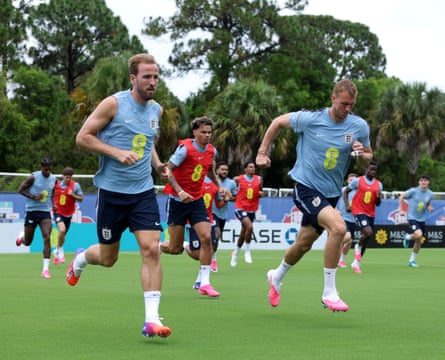
England are dealing with it. There is a reason why Thomas Tuchel wanted to oversee his first training session of the summer in West Palm Beach on Tuesday – 15 days before England kick-off the mission to add a second star to the shirt against Croatia in Dallas. The manager has been keen for his players to acclimatise as early as possible and there is no more testing environment than Florida. Some of Tuchel’s squad came over to the Sunshine State in the final week of May, partly for a holiday but also to begin the process of getting used to the conditions.

It was 32C and 79% humidity in West Palm Beach for Tuesday’s session, and the stadium in Miami is the tournament’s highest-risk venue in terms of heat. The one in Kansas City, the area in which England will base themselves for the duration of the finals, is second on the list. If England win their group and progress, they would play their quarter-final in Miami. Before that, they would have a last-16 tie in Mexico City and the high altitude which can affect breathing would be an additional challenge.
England play their opening warm-up game against New Zealand on Saturday at 4pm local time (9pm BST) in Tampa, roughly four hours by road from West Palm Beach. The temperature at kick-off is forecast to be 32C, albeit with less humidity than in West Palm Beach, and it talks to the buzz phrase that has done the rounds at the Football Association. They want the players to be “comfortable being uncomfortable”.
There is no doubt that extreme heat does not make for great football. The hotter it is, the less players run – at all speeds. The data from the Club World Cup in the US last summer showed this. Tuchel’s assistant, Anthony Barry, is on record as saying “the environments [in North America] do not facilitate world-class football. You’re not going to see the best team playing the best football. The team that wins the World Cup will be one of moments.”
Every England fan worries that the conditions will be one of the greatest obstacles, with almost all of Tuchel’s players coming off a physically draining Premier League season. Some are carrying injury niggles. The FA is clear that this World Cup will be the most challenging ever – the hottest since 1994; the biggest with the expansion to 48 nations; the most logistically demanding across not only the US but Mexico and Canada, the other hosts. From east to west, there are four time zones.
The team that win will be the one that cope best with the variables and from an England point of view the “heat-proof game model” – which takes in selections, rotations and substitutions – and recovery strategies are key.
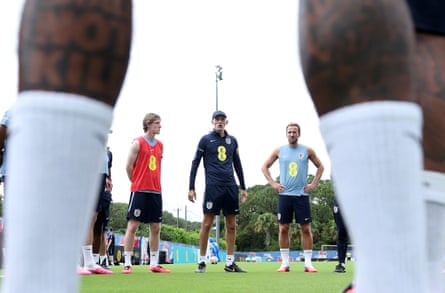
The FA has invested a significant amount of planning and infrastructure into working out how they get the players to and through the tournament in the best possible physical state. Most of the acclimatisation is taking place in Florida – England have a second friendly against Costa Rica in Orlando on Wednesday – but the groundwork began last June, when Tuchel took the squad to Girona for a week of warm-weather training.
The sessions were punishing. The players were asked, for example, to cycle for 45 minutes at a consistent level inside a tent heated to a minimum of 35C. And sports science was to the fore. Before players got on the bikes, they swallowed a biometric tablet which helped to monitor their core body temperatures under stress. Some of the players have invested in hyperbaric oxygen chambers, red-light saunas and ice baths at home to improve recovery.
The data is everything. How it is collected and extrapolated is dizzying. There are the external loads, such as distances covered and number of high-intensity runs, tracked via GPS technology. And the internal loads, such as heart-rate variability, measured by wearable devices. The players have used health bands in training this week.
The FA has benefited from cooperation with the players’ clubs, who have shared data on them from training sessions. Tuchel has said his decision to select John Stones, who barely played for Manchester City over the second half of the season, was influenced by his positive data from club training. The idea is for Tuchel and his staff to understand every detail about a player’s condition so they can best calibrate their loads in training and matches.
The obsession with recovery extends to what the players will eat on the plane back to Kansas City after matches and how they will sleep. The FA has wanted to get them used to the Bermuda grass in North America, which is different from the surfaces in England – it is slightly more compact – and have made sure it is of a high quality at their training pitches.
The Kansas City base camp has been picked because of its location in the centre of the US; there will not be any flights of more than three-and-a-half hours, which may not be the case for teams who venue-hop in the knockout rounds. The FA believes there is an advantage to having a fixed home with the associated comforts; it is happy with the hotel in Kansas City – the four-star, 54-room Inn at Meadowbrook, which it will take over from next Saturday. Tuchel has described it as private and intimate.
And so to the first small step – the New Zealand game at the Raymond James Stadium, home of the Glazer family-owned NFL franchise, the Tampa Bay Buccaneers. The warm-up matches were not supposed to be here or in Orlando, rather in Miami, which is closer to West Palm Beach. Something went wrong at some point there.
England have been designated as the home team against New Zealand and the tunnels in all four corners of the ground have been decorated with FA livery. Towards the top of one of the main stands is the Bucs’ ring of honour, featuring the names of their greatest players. There is also room for one Malcolm Glazer, the late owner.
The venue, where the grass surface feels a little hard compared with those in the Premier League, is best known for the replica pirate ship behind the seats at one end. When the Bucs score a touchdown, it fires its canons, loud bangs and fake smoke a part of the scene. It is unclear whether that will happen if England find the net. The starting gun for their summer will sound.