3 months ago
112
3 months ago
112
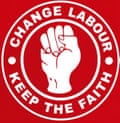
First came Andy Burnham’s Makerfield byelection campaign launch video, with the Greater Manchester mayor stomping down red-brick streets soundtracked by homegrown stars Oasis, Elbow and James. Then came the eye-catching, northern soul-influenced campaign logo: Change Labour, Keep the Faith. And this week, it is not just pubs and clubs but music venues that would be part of Burnham’s proposed business rates cut.
As he looks to return to Westminster then make a bid for party leadership, music is part of Brand Burnham in a way that is unusual for a mainstream politician, in a campaign where he has pitched “Manchesterism” as the solution to Britain’s woes. But it is a policy platform that can be as vague and vibes-based as a Noel Gallagher verse. How does the Mayor’s love affair with Manchester’s music industry shine a light not just on “Manchesterism”, but the man behind it?
“Ordinarily, we wouldn’t ally ourselves with a politician,” says Elbow’s Guy Garvey of his band’s decision to approve One Day Like This for Burnham’s video. “But these aren’t ordinary times and Andy isn’t an ordinary man.”
Burnham’s mayoralty began with a tragic music event. The 2017 Manchester Arena bombing took place just 17 days after his election, and the new mayor recognised that music would be important in the city’s healing – be it advocating for the unusually prompt One Love Manchester fundraiser show or joining the 1975 on stage at Parklife festival in a “moment of noise” for the victims.
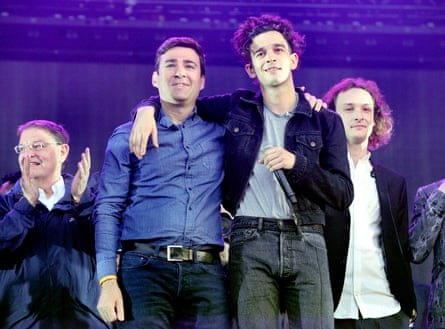
“Andy’s greatest skill is the ability to understand that soft power is as important as formal policy,” argues Rose Marley, co-founder of the city’s Beyond the Music industry festival and an adviser to Burnham. Marley remembers Burnham pointing to the Madchester era he remembered from his teens. “He asked: why did it go away? And what could I do to enable that ecosystem?” Marley sees Factory Records founder Tony Wilson as influential on Burnham and music policy in general: “Tony’s whole view on the role of civic leadership in culture was to create the conditions for it to thrive.”
To do that today, Burnham has collaborated with the sector on big swings. He was “a massive, massive reason why we brought the Brits and the Mobos in,” says Guy Dunstan, senior vice-president at Manchester’s Co-op Live arena, referring to the UK’s two biggest music award ceremonies. Brit award organisers, he says, wanted the city of Manchester to “leave nobody in any uncertain terms that the Brits were happening there”, and Burnham’s tub-thumping support could ensure that. Beyond that, the mayor’s sincere music fandom helps. “Doves are my favourite band, and Andy told me they’re one of his favourite bands,” says Dunstan. “You can chat to him about football. That connection you don’t necessarily get with a lot of leaders.”
The Greater Manchester mayor has no formal powers or budget over culture, which makes his involvement all the more striking. In 2021 following his election the Greater Manchester Music Commission was established, a body he leads that unites the city’s broad music offer from the Hallé Orchestra to indie venue Band on the Wall. When the Beyond the Music festival planned their 2023 launch, he was alongside them at SXSW in Austin, Texas, pitching the city to global investors. The involvement of his teenage favourites might have helped. “It was a bit of a dream come true for Andy to be on stage with New Order,” remembers Marley. When Beyond the Music arrived that October, visitors were treated Oasis’s singer reading the MetroLink tram announcements: Burnham had pulled in a personal favour from Liam Gallagher.
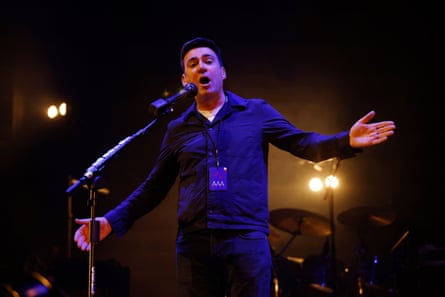
Watch one of Burnham’s charity DJ battles against Liverpool mayor Steve Rotheram and his tastes are that of any nostalgic Hacienda Dad – spicing up his Inspiral Carpets and Stone Roses with a little LCD Soundsystem and Gorillaz – but he has used his mayoralty to push a more modern line of Manchester music. “I’m a Black, gay female rapper,” says OneDa, who Burnham flew out to join his delegation at SXSW in 2024. “It’s totally the opposite to what Manchester music usually represents.” OneDa remembers Burnham adopting her “Manny on the rise” tag when he took to the stage in the US. “He was saying: I’m going to get this tattooed!”
For all that he’s well liked by many, and his business-friendly, “good growth” approach has become the earworm chorus of his Manchesterism tune, some musicians, artists and workers in the night-time economy might wonder exactly how they have benefited from the city’s property-led boom which has led to some of the most sharply rising rents in the UK.
A more specific controversy dates back to 2018, when Burnham appointed Sacha Lord – the Warehouse Project and Parklife entrepreneur – as the city’s unpaid Night Time Economy Adviser. “It was as much a PR exercise for Andy as it was for Sacha,” suggests Jack Dulhanty, a journalist for Manchester publication The Mill. “To be associated with a guy at the centre of Manchester music makes Andy look not like a managerial and boring leader.”
But Lord resigned in January 2025 after the Arts Council said that his company misled them in applying for a £400,000 Covid support grant, though Lord denies any wrongdoing. “Burnham backed him to the end,” says Dulhanty, who broke the story. After Lord’s resignation in January, and with the Arts Council seeking to recover the funds, Burnham said: “I believe him when he says there was no intention to mislead,” and added: “It is not clear to me why the Arts Council has now reached this decision.” Dulhanty argues that “there was a personal element” to Burnham’s support of Lord, “in that they were friends”. (Burnham did not respond to a request for comment on these points after being contacted by the Guardian.)
During his mayoralty, Burnham’s public appearance has regenerated from slick Westminster functionary to his current everyman era: an Adidas-wearing archetype lifted directly from the city’s music heritage. Speaking to me earlier this year, Burnham summarised the appeal of Liam Fray, frontman of local heroes the Courteeners: “I’m up here,” he said of Fray, “but it could be any of you.”
As polls close on Thursday 18 June, the British music industry might do well to watch closely whether Burnham’s high-stakes gamble has paid off: they might just have their strongest advocate yet in No 10. “I’m one of many people I know that hope he’s going to help all the arts in the UK stand up to big business in a fair and constructive way,” says Garvey. “In the next general election, I hope all proudly progressive voters rally behind the Labour party whoever is at its head. But I really hope it’s Andy Burnham.”