3 months ago
73
3 months ago
73
The rustle of a notepad. The click of a pen lid. On a floral-patterned sofa sits Dustin Hoffman with long hair, big collar and a lean and hungry look. Opposite is Jane Alexander, wearing a blue button-down dress, cornered and nervous in the glow of a table lamp. In this taut, claustrophobic acting masterclass, no detail is too small.
“The makeup artists ran in because the sweat was pouring off Dustin’s face,” Alexander recalls with a laugh. “Gordon [Willis, cinematographer] said, ‘Don’t touch that, I’m lighting off his sweat!’ I love that.”
This was a pivotal scene in All the President’s Men, dubbed “the granddaddy of all journalism movies”, which premiered at the John F Kennedy Center for the Performing Arts 50 years ago on Saturday. The film was based on the 1974 book of the same name by the Washington Post reporters Bob Woodward and Carl Bernstein about their investigation into the Watergate imbroglio that brought down President Richard Nixon.
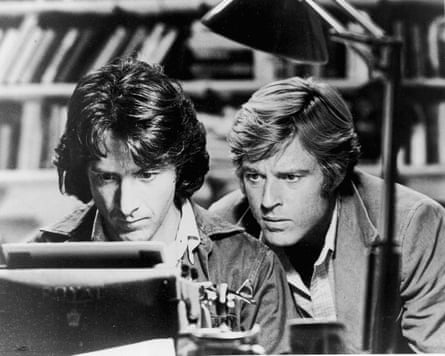
Flawlessly directed by Alan Pakula, and starring Robert Redford as Woodward and Dustin Hoffman as Bernstein, All the President’s Men was a box-office hit and nominated for eight Oscars, winning four including best adapted screenplay for William Goldman and best supporting actor for Jason Robards as the Post editor, Ben Bradlee.
There was also a best supporting actress nomination for Alexander in the role of Judy Hoback, who in the screenplay is referred to as “the Bookkeeper” of the Committee to Re-elect the President. She had only five minutes and nine seconds of screen time but, half a century later, looks back on it as one of the highlights of her career.
Alexander had appeared on stage and in film in The Great White Hope opposite James Earl Jones. She went straight from performing a matinee of Noel Coward’s Present Laughter with Douglas Fairbanks Jr at the Kennedy Center, a short walk from the Watergate complex, to filming her brief scenes in All the President’s Men inside a tiny house on a hot summer’s afternoon.
“I remember walking in and thinking I was a little bit late,” Alexander, 86, says via Zoom from Purchase, New York, with her pet dog Romeo listening in. “We went right to the set, and Alan Pakula looked at me and he said, ‘Oh God, you look great, let’s go, we’re gonna shoot it now!’ I said, ‘No, I haven’t gone to makeup and hair yet.’ He said, ‘I love what you look like – just like that.’ I said, ‘I don’t have my costume.’ He said, ‘I love that, what you got.’ I said, ‘That’s just my summer shmatte, a little blue thing.’ He said, ‘Perfect.’
“We went right into the house and rehearsed in that small, small room. Alan set it up so brilliantly. I don’t think you could have failed in that scene because he put me right in the corner with that light so it was very claustrophobic. It was a hot day and it was hotter inside the house.
“Dustin was leaning forward from the couch. There was a Panavision camera, humongous, the size of a Volkswagen car. Gordon Willis is sitting up there operating above us and he’s crowding. I remember it all being like, ahhhhrrrrrgh! I couldn’t see anybody but Gordon, the camera, Dustin. I couldn’t see where Alan was. It was set up for causing great tension.”
The scene is a study in gimlet-like persistence and the psychological toll of whistleblowing. The relentless Bernstein keeps pushing the bookkeeper, who is caught between conscience and fear but will become the first source within the Committee to Re-elect the President to confirm the existence of a secret slush fund.
Alexander remembers it all vividly. “It’s probably one of the favourite scenes I’ve ever done in my life,” she says. “I always felt that Alan directed it so beautifully and I’m told by a number of acting teachers that they use that scene in classes for people to learn and watch very carefully.
“Essentially, it looks like it’s in one take; of course, it’s not. There’s a lot of cutting but it’s just the two of us and he only uses two angles for both of us. Dustin was always leaning forward. It was tight, it was tense. Now, why did I even let him in the room? Because I need to tell somebody this story. With Bernstein like that, so upfront, I don’t know if I can do it and I don’t know if this is the right person. Woodward would probably have been easier to divulge everything to.”
Alexander makes a briefer, second appearance later in the film when Woodward and Bernstein return to her house and find her sitting on her porch. “When you have Bob come into it outside, I’m more ready and we never hear what I fully say but I’m going to spill all the beans.”
When she first saw the film at the Kennedy Center premiere, before an audience of 1,100 people, Alexander was awed. “It was incredible. I still think it’s one of the great films of all time. It’s the only one I watch every two years that I’ve been in. It holds up.”
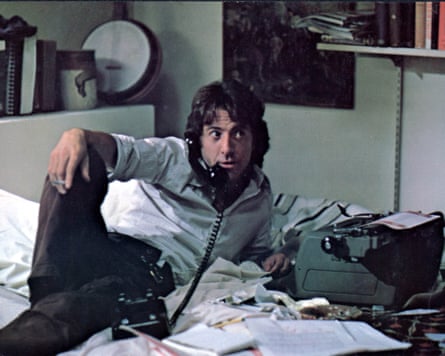
All the President’s Men ranks alongside His Girl Friday, Citizen Kane, Ace in the Hole, Sweet Smell of Success, The Killing Fields, The Paper and Spotlight as one of the best films about newspaper journalists plying their trade. It is the definitive procedural account of reporters joining the dots between a break-in at the Democratic National Committee headquarters at the Watergate building, Nixon’s reelection campaign and the White House.
Redford’s curiosity had been piqued when, weeks after the break-in, the topic came up with reporters during a publicity tour for his film The Candidate. He devoured the Washington Post’s industry-leading reports on the Watergate story. When he read a profile of the paper’s odd couple – Bernstein, a liberal Jew who wore his hair long, and Woodward, a Waspy Republican who served in the navy – he saw their cinematic potential.
Years later Redford told the Washington Post: “I thought that was a real great character study. Two guys that couldn’t be more different. Different religions, different politics, different everything. And yet they had to work together, and they didn’t like each other very much. I said, ‘Boy, that feels like a good, interesting little black-and-white film to me.’”
But when Redford approached Woodward about a possible film, he was rebuffed. Speaking by phone this week, Woodward, now 83, recalls: “Carl and I were in the middle of covering the story and focused on that and so the idea of a movie, and the idea it focusing on the relationship between Carl and myself, just seemed impossible.
“It didn’t make sense. We were busy and Redford kept calling and insisting, ‘This is the way to tell this story’. Carl and I both thought, yeah, maybe from his end it’s the way to tell the story but we did not see it initially.”
However, like the tenacious men he was seeking to portray, Redford persisted and, when he learned that Woodward and Bernstein were contracted to write a book about their Watergate investigation, duly bought the film rights for $450,000, a hefty sum at that time.
Goldman’s first screenplay, however, did not go down well. It was full of Hollywood liberties including descriptions of women as “delicious looking”, “leggy” and owning “the best boobs in Virginia”. Woodward scribbled “No!” or “Wrong” in the margins numerous times. Woodward says: “The first draft had lots of jokes and as Carl said, it was kind of Butch Cassidy and the Sundance Bernstein Take on the President.”
Bernstein and his then partner Nora Ephron had a go at writing a screenplay but could not resist overdoing Bernstein’s own heroism. Goldman was offended and later described the intervention as “a gutless betrayal”. But Pakula came on board and, along with Redford, kept honing the screenplay, excising the back stories of Woodward and Bernstein’s personal lives to make something leaner and sparer.
Woodward recounts: “Pakula and Redford came to Washington, stayed at the Madison Hotel across from the Post and we talked to them regularly to answer the questions of what happened. We had some notes, we had drafts of stories and so they sucked it up out of us like reporters.
“It was a good experience for us to see somebody come and kind of take over your story, which is what they were doing and what they did and it worked because it was, quite frankly, honest. It was not a mistake-free endeavor and we laid out the mistakes and the tension between us and how Bradlee and other editors at the Post responded.”
He adds: “In reporting you are always asking the question, what’s the next story? What’s the next level and driving to that. That was the whole spirit of the making of this movie that was adopted by Pakula, all of the people who worked on this.”
Nixon himself only appears on TV screens. But there is a dramatisation of Woodward’s late-night meetings in car park with a secret source known as Deep Throat who urges: “Follow the money.” Woodward says: “They really got it and they got the lump in your stomach atmosphere exactly right.”
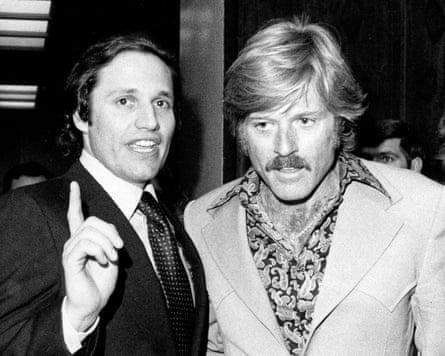
Redford and Hoffman learned each other’s lines so they could interrupt each other in character and give their joint interviews extra authenticity. They were also diligent in their research. Hoffman spent nearly four months in the Post office, speaking to reporters about their jobs, sitting in on meetings and listening in on their phone conversations as well as spending time with Bernstein socially.
Redford, who had just appeared opposite Barbra Streisand in The Way We Were, was arguably Hollywood’s hottest sex symbol. But for Woodward, that was not quite the blessing it might have seemed. He says: “When the movie came out, I remember, I was unmarried and I would meet women, or somebody would say you ought to take so and so out, and so I’d call on the phone and identify myself and say, how about a date Friday night? ‘Oh yeah, that’d be great.’ ‘I’ll pick you up at seven o’clock, eight o’ clock.’
“I go there to the house or apartment and I remember this twice at least: I’d knock at the door and the woman would open the door and look at me and you could realise subconscious levers in the subterranean world of expectation that thought it was Robert Redford but it was me. The door would open with a real smile and then she’d look at me, realise it’s not Redford and it would go from this high expectation to bargain basement low expectation. I’ve seen disappointment a number of times.”
Woodward considered the casting of Robards as Bradlee a masterstroke – “Separated at birth. They’re so alike” – and remembers when a Saturday morning when a rough cut of the film was first shown to Post staff, who were anxious about what they would see. “There were a lot of tight sphincters about that.
“Bradlee told the story: he’s sitting there in this theatre watching and had his arms behind his head, which is something he did and, in the movie that’s on the screen, Robards puts his hands behind his head. Ben’s sitting there watching it. It was a jolt. He’d kind of been caught.”
Producer Walter Coblenz’s commitment to specificity in the look of the film was no less remarkable. At one point he visited Woodward at his home. “He said, I want to have somebody come and take pictures of your apartment. We want to know what it’s like for the movie. Then I was sitting in a chair and he said, ‘Even better, how about if I buy some of your furniture?
“I said, OK. He said, the chair you’re sitting in, I’ll give you $150. He bought that, bought some table, bought some lamp, God knows what else he bought. But I remember I thought this was a kind of realism on steroids and it reflected Redford’s, Hoffman’s, Pakula’s quest for realism.”
This forensic approach extended to the Washington Post’s office, which was painstakingly duplicated on a sound stage in in Burbank, California. Leonard Downie, who worked on Watergate as deputy metro editor, recalls that Pakula’s production team took 1,000 photos in the newsroom along with meticulous notes.
In his memoir, All About the Story, Downie writes: “Copies of the same works of art hung in the soundstage newsroom, along with 1972 calendars displaying the correct date for each scene. The movie newsroom contained the same two hundred desks, plus the same wastebaskets, Teletype, Telex, fax and photo machines, typewriters, telephones and other equipment, and even books.
“The phones had the correct extension numbers on them, and 1972 phone directories were on the desks. All the equipment and technology worked. Unseen actors played the appropriate people on the other end of the line for Woodward and Bernstein’s telephone calls.”
There was more: “The Post sent packing crates of used paper, unopened mail, old galley proofs, and other trash from our newsroom to scatter on the desks on the movie set. It also reprinted the front pages of seventeen different editions of the Post for placement on the desks on days depicted in the movie.”
In a phone interview, Downie, 83, who was executive editor of the Post from 1991 to 2008, says he was impressed by the accuracy of the portrayal. “Woodward is hard to depict because he’s not a colorful person. Redford was fine as Woodward. Dustin Hoffman was Carl Bernstein. He was amazing.”
And Robards’ performance struck a chord with Bradlee, Downie recalls. “He’s either talked to Bob and Carl about a story not being ready late at night and then he goes off towards the elevators, and as he’s moving through the newsroom, he kind of reaches out and taps the desk. We never saw Ben do that until the movie and we always saw Ben doing that after the movie.”
Downie worked as a script as a consultant for Steven Spielberg’s 2017 film The Post, which was a prequel of sorts, dramatising the Washington Post’s publication of the 1971 Pentagon papers and, unlike All the President’s Men, includes publisher Katharine Graham (Meryl Streep) among its characters.
In Pakula’s film, Graham only appears by name when the attorney general, John Mitchell, threatens over the phone: “You tell your publisher, tell Katie Graham she’s gonna get her tit caught in a big wringer if that’s published.” Goldman’s screenplay did in fact include a four-page scene in which Graham, to be played by Geraldine Page, questions Redford about Deep Throat but it did not make the final cut.
Graham had initially been sceptical about the project and Redford’s decision to use the Washington Post’s name. Woodward says: “She initially was, ‘Oh great, I’m glad I’m not in it, ‘and then when she saw the movie she did an about face and said, ‘Why am I not in the movie?”
Graham’s family still regret the omission. Her son Don Graham, who joined the Post in 1971 and later became publisher himself, says by phone from his home in Washington: “The one missing character in All the President’s Men is Katharine Graham. That newspaper does not have a publisher and that was an outrage, righted later by Steven Spielberg and Meryl Streep.”
Graham, who is now 80 and runs a scholarship fund for undocumented immigrant students, adds: “She told me Redford came to her and told her she would not be in the movie. She said, I’m really hurt by that. She is a pretty meaningful character in the book: Bob and Carl are not guilty of failing to understand Katherine Graham’s importance in this but movies are movies and they aren’t documentaries and they don’t depict everything.”
Still, Katherine Graham and Pakula became fast friends, and Don Graham hugely admired the film when he first saw it at the Kennedy Center on 4 April 1976. He says: “I thought, this is an unbelievably accurate description of how much of the reporting worked. I thought, I’m not sure it isn’t too accurate, I think that most viewers will find this too slow. But that wasn’t the reaction of most viewers. The tension built up.
“I admired how Pakula stayed true to how the reporting went, the calling people at night, the checks that don’t work out, the mistake they made, the slow step-by-step, story-by story, interview-by interview pace of it. That was impressive to me and I came away feeling yeah, they got it right.”
Woodward’s then six year-old daughter was less awed, however. He says: “I said, what did you think, Diana? She said, ‘Boring, boring, boring.’ Redford came for dinner one night. He came in the hallway and Diana was there and I introduced her to Redford. He looked down and she said, ‘I know who you are. I saw you on television pretending to be my dad.’”
The timing of Saturday’s anniversary is acute. Redford died last year aged 89. Donald Trump has added his name to the Kennedy Center and announced it will close for two years. The media is under attack and the Washington Post, sold by the Graham family after 80 years to the tech billionaire Jeff Bezos, recently slashed a third of its staff. Woodward remains an associate editor.
Bradlee’s speech at the end of All the President’s Men resonates anew: “You know the results of the latest Gallup poll? Half the country never even heard of the word Watergate. Nobody gives a shit. You guys are probably pretty tired, right? Well, you should be. Go on home, get a nice hot bath. Rest up … 15 minutes. Then get your asses back in gear.
“We’re under a lot of pressure, you know, and you put us there. Nothing’s riding on this except the, uh, first amendment to the constitution, freedom of the press, and maybe the future of the country. Not that any of that matters, but if you guys fuck up again, I’m going to get mad. Goodnight.”