3 months ago
88
3 months ago
88
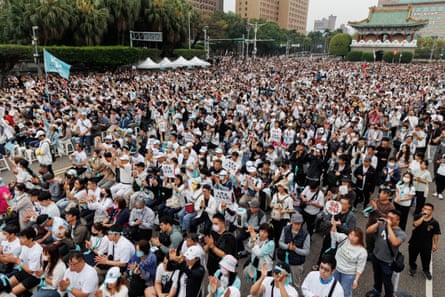
Opposition figure Ko Wen-je put on a defiant display in front of tens of thousands of supporters outside Taiwan’s Presidential Office, two days after being handed a 17-year prison sentence on corruption charges.
“I will not yield! I will not surrender!” Ko shouted on Sunday in Taipei, as he turned towards the grand, red-brick Japanese colonial-era building in order to directly address President Lai Ching-te.
“We want Lai Ching-te to understand that even if you try to eliminate Ko Wen-je, there are still tens of thousands of supporters behind him,” he told the reportedly 80,000-strong crowd.
Ko’s Taiwan People’s party (TPP) called on its supporters to gather to “fight for judicial justice” immediately after the ruling on Thursday last week by the Taipei district court, which saw the 66-year-old convicted of charges including bribery, breach of trust and misappropriation of political donations.
It’s a message that resonated with those at Sunday’s rally, with several attendees telling the Guardian of their fears that Taiwan’s judiciary is being manipulated. “The judiciary – one of the most fundamental red lines in our society – has been undermined,” says one 49-year-old, who gives his name as Mr Wang.
Within Taiwan, perceptions of Ko remain starkly divided: he’s either an unprincipled populist who succumbed to greed, or a maverick reshaping Taiwan’s political landscape who has been cut down by the ruling Democratic Progressive party (DPP). What’s certain is that Ko’s conviction has widened the chasm in Taiwan’s already fractured political landscape, as it struggles to bridge the divide that exists between its main political forces on how to handle the existential threat posed by China.
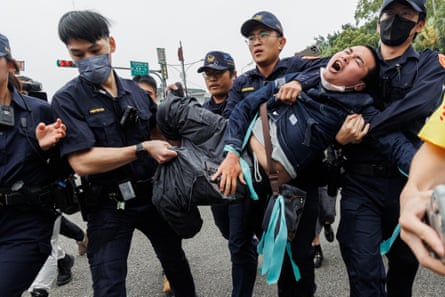
The Chinese Communist party (CCP), which claims Taiwan as part of China despite never having ruled the island democracy, has seized the opportunity to sow discord, accusing President Lai of manipulating the judiciary to “suppress political opponents”.
Ko, a former surgeon and two-term Taipei mayor, founded the TPP in 2019, positioning the party as a third way between the pro-sovereignty ruling Democratic Progressive party (DPP) and the Beijing-friendly opposition Kuomintang (KMT). One of three frontrunners in Taiwan’s 2024 presidential election, 26.46% of voters backed Ko in a race won by the DPP’s Lai with 40.05% of the vote.
Authorities arrested Ko just seven months later, accusing him of accepting a NT$2.1m (around $66,000) bribe to approve the illegal expansion of a Taipei mall when mayor in 2020. Ko has denied all charges.
The TPP claims that the ruling party wants to suppress Ko’s burgeoning populist movement and pressured prosecutors to fabricate the charges.
Taiwan’s Presidential Office told the Guardian it does not comment on individual cases, but said it: “Respects judicial independence”.
Growing perception case is ‘politically motivated’
Despite Taiwan consistently ranking as one of Asia’s most free and vibrant democracies, with high trust in public institutions, support for the TPP’s claims of political persecution appears strong and growing among sections of society.
Polling conducted by non-partisan thinktank the Taiwanese Public Opinion Foundation (TPOF) in September 2024, a month after Ko’s arrest, showed only 28.6% of respondents believed the case against him was politically motivated. A year later, that number was 41.7%.
“That’s something like a million more people that now believe the case is politically motivated,” TPOF research fellow Paul Huang says.
Brian Hioe, a Taiwanese political analyst and founder of publication New Bloom, said that while “there’s quite a lot of proof of Ko’s guilt”, the TPP has been “very good at trying to convince the public there’s zero evidence against him”.
Tsao Yao-chun, an assistant professor who specialises in anti-corruption research at Taiwan’s Cheng Shiu University, said: “The evidence and legal arguments in this case were exceptionally thorough ... The prosecutors and judges, acting in the interest of social justice and given the significant impact of this case, have already set a powerful anti-corruption benchmark for the public.”
One of the TPP’s most effective points has been to claim that the severity of Ko’s punishment is evidence of ruling party interference. Hioe says harsh initial sentences for corruption are common in Taiwan, but they are often significantly reduced upon appeal. Ko may “serve a few years in jail”, Hioe said, and there’s a chance “he may even serve no jail time”.
Hioe also noted that graft cases are being pursued against several DPP figures, most notably former vice-president and Taoyuan city mayor Cheng Wen-tsan, a case that opened the same month as Ko’s.
Galvanised or hobbled
At Sunday’s rally, Ko told the animated crowd his prosecution was intended to “undermine the development of this new politics in Taiwan”. Yet to be seen is whether the case against its founding father will prove a galvanising force for the TPP, or if it will hobble the party.
Barring a successful appeal, Ko will be disqualified from the 2028 presidential election under legislation restricting individuals convicted of corruption or facing a sentence of 10 years or more from running for Taiwan’s highest office.
Recognising his party’s need for support, TPP chairman Huang reiterated his desire to form a coalition government with the KMT, advocating for deeper cooperation ahead of November’s local elections. Despite key differences, the parties have already teamed up to block the DPP’s proposed NT$1.25tn ($40bn) defence spending package, creating a months-long deadlock in parliament.
If there was a solution to the impasse in Taiwanese politics, it appears further away than ever following Ko’s conviction. “The verdict,” Huang says, “has only strengthened our conviction that Lai Ching-te must be voted out of office.”
Additional research by Lillian Yang