3 months ago
60
3 months ago
60
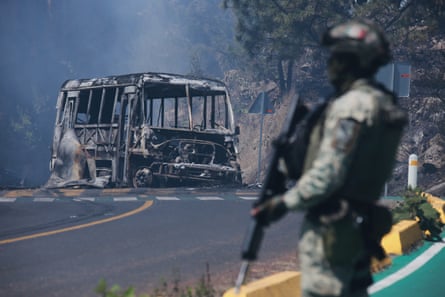
Mexico was rocked this week by a wave of brutal violence after the capture of the drug lord Nemesio Rubén Oseguera Cervantes, AKA “El Mencho”, as members of his powerful Jalisco New Generation Cartel blew up trucks, fired on police stations and engaged in gun battles with Mexican security forces.
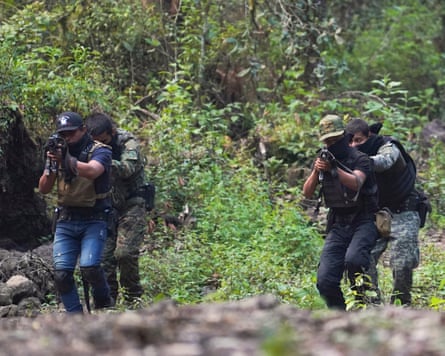
The chaos eventually calmed but not before 62 people had been killed, including a pregnant woman caught in the cross fire. The scale of the carnage, as well as the arsenal involved, has underscored a key element of Mexico’s struggle against organised crime: cartels are armed to the teeth, and most of their weapons are trafficked from the US.
As the smoke from the burning blockades cleared, Mexico’s defence minister, Ricardo Trevilla Trejo, said the vast majority of weapons seized after El Mencho’s capture – including a Barrett rifle, a rocket launcher, grenades and mortar rounds – had come from across the border. Since the start of the administration of President Claudia Sheinbaum, Trejo said, Mexican authorities had seized 23,000 weapons, of which 80% came from the US.
“The ability of criminal groups to exercise this type of power and exercise this type of violence is closely linked to firearms trafficking,” said Cecilia Farfán-Méndez, an expert on Mexican organised crime. “If we want to see less violence in Mexico, this is a very important conversation.”
Mexico has extremely strict gun ownership laws: the country only has two gun stores, both run by the Mexican military, which enforces strict regulation on the purchase of weapons. But in the US, loose gun legislation and a national obsession with firearms mean guns are readily available to buy and traffic south of the border.
“Our country’s lax gun laws have created a deadly, vicious cycle of firearms trafficking that’s riddled with violence and chaos,” said the Democratic senator Dick Durbin last year as he announced a bill to tackle arms smuggling. “Our gun laws and gun industry practices fuel an iron river of firearms trafficking that supplies Mexican drug cartels.”
Durbin’s bill, introduced with the Democratic congressman Joaquín Castro, has yet to come up for a vote.
Conservative estimates suggest 135,000 guns are trafficked into Mexico annually, though some studies suggest as many as 730,000 American firearms are smuggled into Mexico every year. That would mean 2,000 US guns crossing the border every day.
While large gun stores are important suppliers of firearms that end up in Mexico, 83%of these weapons come from independent gun dealers in border states such as Arizona, Texas, New Mexico and California. The most powerful guns also come from these smaller stores, including .50-caliber sniper rifles and 7.62mm assault-style weapons.
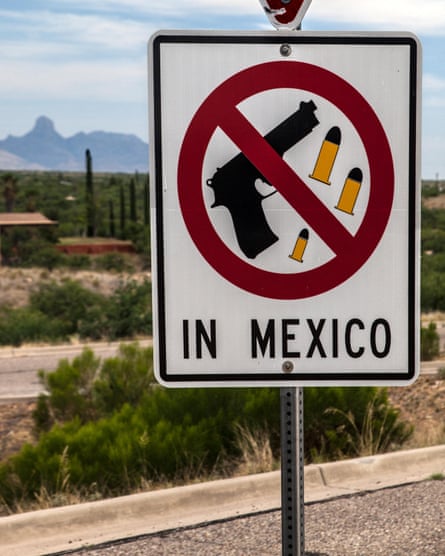
At times, these powerful weapons are smuggled across the border en masse: last year, US authorities arrested a father and son in Texas who together were attempting to smuggle “300 rifles and pistols as well as various caliber ammunition and magazines” into Mexico.
But the vast majority of weapons are trafficked into Mexico piecemeal, with guns and ammunition divided up among multiple smugglers, making it difficult for authorities on either side of the border to find and seize the weapons.
“It is very easy to hide a gun in a vehicle without being detected and it is very difficult to stop every single car and every single truck,” said Ieva Jusionyte, a professor at Brown University who has studied arms trafficking to Mexico. “It’s like trying to find a needle in a haystack.”
Still, analysts say the main problem is not at the border: it is in Washington, where a well-funded gun lobby has halted progress on any meaningful regulation for years.
“Certainly, Mexico and Mexican customs need to do much more to prevent those guns from coming into Mexican territory,” said Arturo Sarukhán, a former Mexican ambassador to Washington. “But at the end of the day it’s the loopholes in how you can buy guns in gun shows and gun shops in the US that are allowing proxy purchases of firearms that are then illegally trafficked over international borders.”
Mexico is keenly aware of the problem: Sheinbaum has repeatedly called on the US to do more to halt the southbound flow of weapons. “The topic always comes up in meetings, and I’ve brought it up in phone conversations with President Trump,” she said earlier this month. “The issue of weapons entering Mexico from the United States.”
In 2021, the Mexican government filed a lawsuit against eight gun manufacturers, accusing them of “negligent marketing, distribution and sales”. The US supreme court ruled unanimously last year to reject the suit, based on a 2005 law that shields gunmakers from liability if their weapons are misused.
Still, the Trump administration appears to be stepping up its efforts to stop the weapons from entering Mexico.
Last week, the US Bureau of Alcohol, Tobacco, Firearms and Explosives (ATF) said it had seized 4,359 guns and 648,975 rounds of ammunition “bound for Mexico” since January last year. But even by conservative estimates, that means US authorities seized just 3% of the guns being trafficked across the border.
“It is a minuscule amount,” said Jusionyte. “The technologies are evolving, both how the guns are being hidden in vehicles as well as the scanners that can detect them, but it’s a cat and mouse game that is stacked against [the authorities] because of how profitable it is to smuggle guns into Mexico.”