3 months ago
84
3 months ago
84
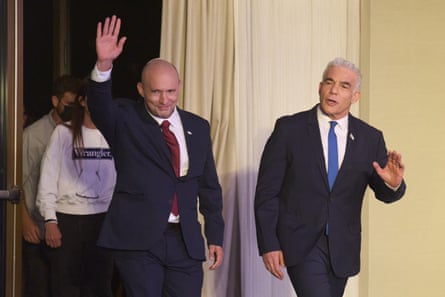
The Israeli prime minister, Benjamin Netanyahu, is facing the prospect of running against a rightwing-centrist super coalition in elections later this year after two of his most formidable political rivals combined forces in an attempt to oust him, inviting a third party leader to join them.
In a move that some analysts compared to the centre-right coalition that removed Viktor Orbán from power in Hungary, the former prime ministers – rightwing Naftali Bennett and centrist Yair Lapid – issued statements announcing the merger of their parties, Bennett 2026 and Yesh Atid (There is a Future).
The move came as Netanyahu disclosed he had recently had a malignant tumour removed from his prostate, leading to questions about the timing of a disclosure that was vague on details and his wider health, with the latter now likely to be an election issue.
“We are standing here together for the sake of our children. The state of Israel must change direction,” Lapid said standing alongside Bennett at a joint news conference on Sunday.
Bennett said the new party would be called Together and that he would be its leader. “After 30 years, it is time to part with Netanyahu and open a new chapter for Israel,” he said.
Bennet also invited Gadi Eisenkot, a former Israel Defense Forces chief of staff and leader of the Yashar party to join them. Polls suggest that a combination of the three parties would create the largest grouping in the Knesset. On Monday, Eisenkot asked Bennett to coordinate any future moves with him.
Although Eisenkot has not formally announced whether he will join the coalition, he quickly welcomed the new grouping.
“The goal of winning the critical elections ahead of us is a shared one,” Eisenkot wrote, calling Bennett and Lapid “partners” and pledging to continue acting “responsibly and wisely” to achieve “the victory and change required for the state of Israel”.
Giving an indication of the scale of the challenge to Netanyahu, a recent poll for the Maariv newspaper showed Bennett’s party tied with Netanyahu’s Likud on 24 Knesset seats, while Lapid’s Yesh Atid would receive seven and Eisenkot’s Yashar 12.
The nature of Israel’s coalition politics, however, would probably see Bennett lose some support in any partnership with Lapid, losing disaffected Likud voters strongly opposed to Lapid.
Since his first term in the 1990s, Netanyahu has become a polarising figure at home and abroad. Bennett and Lapid have joined forces before, putting an end to Netanyahu’s successive 12-year tenure in a 2021 election, only to form a coalition government that, with a thin majority and deeply divided over issues such as the Israeli-Palestinian conflict, survived barely 18 months.
Their coalition included for the first time in Israel’s history a party drawn from the country’s Arab minority – Palestinian by heritage, Israeli by citizenship – the United Arab List (UAL). Prior to that the duo muscled their way into his 2013 coalition government in a move that left out Netanyahu’s traditional ultra-Orthodox Jewish allies.
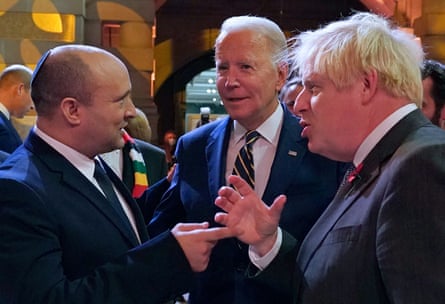
Netanyahu, Israel’s longest-serving prime minister, made a comeback when he won the November 2022 election and formed the most rightwing government in Israel’s history.
But Hamas’s 2023 attack on southern Israel, which plunged the Middle East into turmoil, with Israel fighting on multiple fronts, left Netanyahu’s security credentials in tatters and polls since then have predicted that he will lose the next election, due by the end of October.
Netanyahu, the most dominant Israeli politician of his generation, has shown remarkable political survival skills in the past, however. On Sunday, he posted a 2021 photo of Bennett and Lapid with the UAL leader, Mansour Abbas. “They did it once, they’ll do it again,” Netanyahu’s Telegram post said, an apparent swipe at their short-lived 2021 coalition that included UAL.
Bennett said that he would not seek a coalition with Arab parties again and ruled out ceding any land to enemies, an apparent reference to the Palestinians’ goal of establishing an independent state in territories occupied by Israel.
Bennett, 54, a pugnacious former army commando turned tech millionaire, has been trailing Netanyahu in election polls. A 23 April survey by Israel’s N12 News found Bennett securing 21 of the Knesset’s 120 seats, against 25 seats for Netanyahu’s Likud.
The survey matched previous polls by academic institutions and Israeli media, which have put Bennett as the top contender against Netanyahu, though the political map could still shift and change.
Lapid, 62, a telegenic former TV news anchor who writes pop songs and thrillers, speaks as the voice of Israel’s secular middle class, which has become increasingly incensed by what it sees as an unfair tax and military service burden.
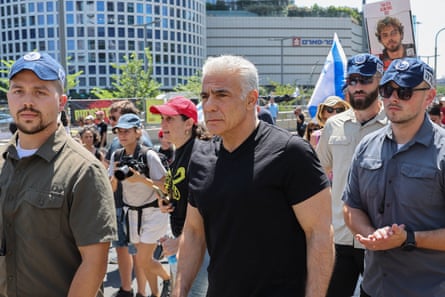
Netanyahu’s ultra-religious political allies have been seeking an exemption for their communities – who have low employment and many state benefits – from the conscript military.
It is a hot-button issue in Israel that has become all the more pressing since the military has warned of being over stretched and with the last two years exacting the highest military death toll in decades.
Both Lapid and Bennett have made it a central issue for their campaign. They have also criticised Netanyahu for failing to leverage military gains into strategic wins over Iran and the groups it supports in Lebanon and Gaza – Hezbollah and Hamas.
Reuters contributed to this article