3 months ago
114
3 months ago
114
She is the little-known Australian who now has the tennis world talking, with the power to go toe-to-toe with the biggest hitters in the game.
Talia Gibson became the youngest player in seven years to reach a quarter-final in her debut at one of the not-quite-grand-slam tournaments – known as WTA 1000s – last month, as part of an eye-catching run during which she beat five top 20-ranked players.
Despite her coaches spending years reminding her of her immense potential, the admittedly shy 21-year-old agrees she is only now beginning to believe.
“Something that I’ve reflected on the most was how much more belief I think I should have had in myself,” she says, speaking from her hometown of Perth before the Billie Jean King Cup tie in Melbourne against Great Britain which starts on Friday.
At Indian Wells at the start of March, she won through qualifying then reeled off victories against Ekaterina Alexandrova (ranked 11), Clara Tauson (17) and Jasmine Paolini (7) before losing against world No 14 Linda Noskova in three sets.
Gibson immediately proved that run was no fluke, the following week in Miami. Again she won through the qualifiers, and defeated 15th-ranked Naomi Osaka and world No 17 Iva Jovic before losing to Australian Open champion and world No 2, Elena Rybakina, in the round of 16.
Though Gibson didn’t win either tournament, she had put the tennis world on notice. Before March, the WTA website had not even uploaded a profile photo of her. Now, she is on the verge of the top 50. “It was a sort of pinch me moment when I was getting those wins,” Gibson says. “It just made me realise that I was capable.”
“Me being able to actually see that happen, it was a bit of an eye-opener for me,” she says. “I thought, before it happened, I’ll kind of ‘believe it when I see it’, really. And I think that’s probably one thing, on reflection, that I could have done better.”
Suddenly, she is Australia’s second-highest ranked player (after another new arrival in 19-year-old Maya Joint), even if Gibson has been well-known in local tennis circles for years. At 15 she was awarded the female junior athlete of the year at the 2019 Australian Tennis Awards. Three years later, at 18, she won it again.
But in a sport where the world’s top 10 often features teenagers, such as today’s formidable young duo Victoria Mboko and Mirra Andreeva, Gibson was no prodigy. Indeed, there has been more media attention given to Emerson Jones, the 17-year-old who is also in Australia’s team for this week’s Billie Jean King Cup tie.
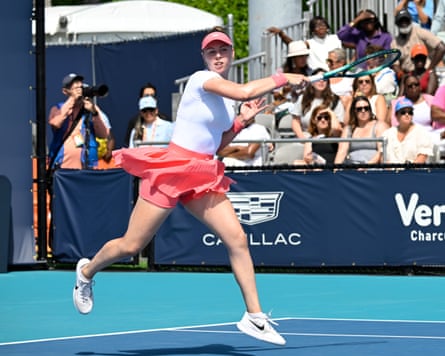
That was, until last month. Gibson’s run at Indian Wells was described by Sports Illustrated as “a week to remember”. By the time she reached Miami, one Tennis Channel commentator described Gibson as “a train that cannot be stopped”, and a player with top 10 potential.
Tumaini Carayol, the Guardian’s UK-based tennis writer, was in the US and saw the Australian’s run first-hand. “Gibson had been under the radar for a while, even after winning various titles on the ITF circuit, but by beating five top 20 opponents in two of the biggest tournaments on the circuit, she has made her progress impossible to ignore,” he says. “There will be many more eyes on her now.”
Gibson is starting to understand that the spotlight is part of life of as a top professional. “It’s a big step going from nobody really knowing who you are,” she says. “When you kind of start to have that success, there’s a lot of people that want to get your thoughts on all of it. Sometimes it can be overwhelming.”
Fortunately, she feels she has the support to succeed even if she was surprised by its sheer volume. “It was a little bit shocking to me to see how many people are actually keeping track of how I’m doing and the success that I’m having,” she says.
Gibson describes herself as a “pretty ordinary” woman from Perth, who likes going to the beach and spending time with friends. But unlike most of us, she spends most of her time travelling on a tennis tour with extraordinary physical and mental demands, where every moment is captured and scrutinised.
“I’m more of a shy, kind of quiet person,” Gibson says. “So I think when it comes to doing stuff like interviews and meeting new people and doing media, and stuff where you’re interacting with people – you know, the public and everything – it’s forced me to step outside my comfort zone.”
On the court, she looks increasingly comfortable. This year she has won more than three out of every four service games, a ratio that is among the top 20 in the world despite her challenging opposition. A return game is developing, but the forehand she hit on match point against Paolini in Indian Wells for the biggest win of her career underlined her growing reputation as one of the tour’s gunslingers.
“A lot of people would say I’m probably one of the most aggressive players out there, and I wouldn’t disagree with that,” she says. “But I hope that one day, they’re able to add a few more adjectives to it.”