3 months ago
79
3 months ago
79
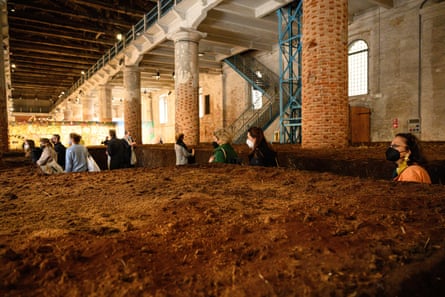
The earth’s cool breath is the first thing that hits me. Scented with clove and cinnamon, it catches my senses by surprise in the dim, while a vast soil sculpture emerges around me as if from a dream, just as the artist intended. I’m contained within its mammoth, terraced walls of reddish soil and struck by the silence, the peace felt in being held by nothing but earth. Another visitor lies on the ground nearby, contemplating the circular, 12-metre-high structure towering above us. I resist the temptation to stroke it, instead smelling and observing the work, feeling a mixture of curiosity, fear and solace.
I’m in Mexico City, inside The Womb Space, a cavernous earthwork by Delcy Morelos. Now in its ninth and final month, the show has been a word-of-mouth sensation, drawing more than 60,000 visitors. Its draw lies in an often nostalgic appeal to the senses – a woman in her 70s enters and whispers: “It smells like my ranch! Like playing in the dirt as a child.” Remarkably, it turns out the sculpture’s soil was actually sourced from the region the woman is from. Together, we take in the earthwork’s cascading plant matter, its humidity and the uncanny aliveness emanating from within. It’s almost like standing inside a mountain: you feel humbled and somehow more primal, the response more visceral than cerebral.
The Womb Space offers a similar experience to Morelos’ latest earthwork, Origo, meaning Origin – a multisensory installation about to open to the public in the Sculpture Court of the Barbican in London. Both immersive artworks are part of her 14-year inquiry into our relationship with the material that, she says, “sustains all life but is most humble”: soil. Exhibited globally – including maze-like creation Earthly Paradise at the 2022 Venice Biennale – her earthworks are majestic, providing an encounter between ourselves and what she calls “our origin self – like that first dark, humid place we all come from”.
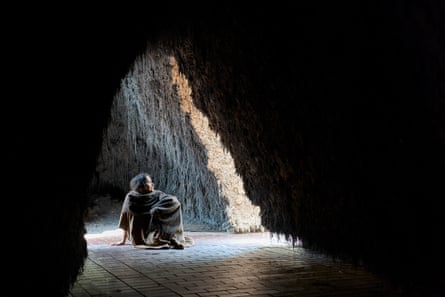
Origo is a 24-metre-wide outdoor, ovular pavilion with cave-like passages for visitors to explore. There is also a patio at its centre for rest, in which meditative activities will take place, such as tai chi. “I’ve thought about what a Londoner might need,” she says. “What I can bring from what I am, where I come from.” With organic materials and an egg-like form, Morelos’ work will be in active dialogue with the Barbican’s angular, concrete edifice which, she reminds me, is also derived from the earth.
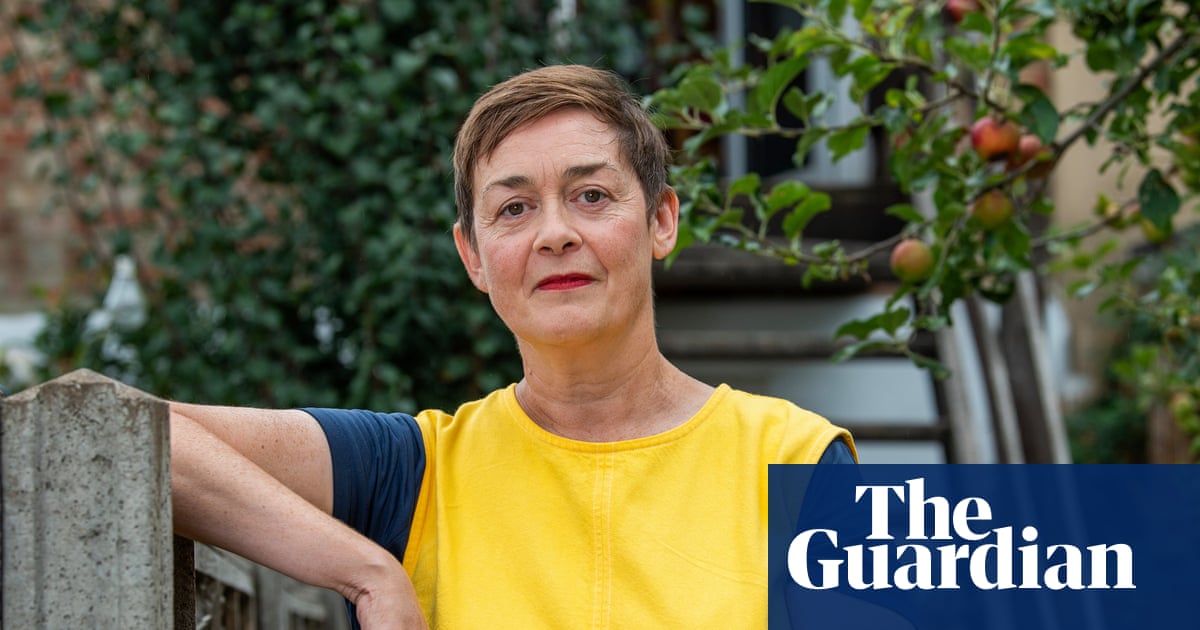
We meet in Casa Pestalozzi del Valle, a cafe in the leafy, middle-class neighbourhood of Colonia del Valle in Mexico City. Petite and bright-eyed, wearing a handwoven indigo poncho, she calls her soil art “a mission, a vocation even”, saying it has given her more vigour than ever. “I want to create experiences,” she says, “where people discover answers to questions they didn’t know they had.”
We discuss lots of things: the loss of the sacred and our fear of death – the event that marks our return to the land that has so nourished us. “I work with earth so you realise you’re made of earth, too,” Morelos says. “There’s no separation. If you hurt her, you hurt me, you hurt yourself.”
This way of thinking stems from the Andean cosmovision her work is rooted in: a worldview in which mountains, seas and the like are perceived as sentient beings rather than resources to be exploited. Morelos says that for her Amazonian teacher, Isaías Román, “the universe is a tejido, a woven fabric – everything matters”. She sums it up excitedly: “It’s absurd to think that a river is not alive – when she sustains the lives of everything that feeds from her!”
Morelos, 58, grew up in a small town in Colombia called Tierralta. She remembers polishing the house’s earthen floor by hand with her grandmother each day to reduce dust. After attending art school, Morelos produced mainly works in blood-red, a way of addressing the prolific violence she’d seen around her as paramilitary groups fought over coca-rich territory. These conflicts eventually led her attention to the earth itself – something that should be “cared for, not possessed”.
The artist’s subsequent installations are a mix of land art, arte povera, minimalism and both pre-Hispanic and modern architecture. Morelos wants them to dismantle the belief that soil is just dirt underfoot, matter to be mined for gold and oil. Writing of her work, Oaxacan activist Yásnaya Aguilar notes that the Adam and Eve creation myth positions humans at the pinnacle of existence, having “dominion ... over every living thing”, according to the Bible. This eclipsed European pagan belief systems, Morelos says, and helped justify our extractivist culture. Aguilar goes on to describe how even “the idea of earth as property came with colonisation”, a concept that differs hugely from indigenous notions of collective territory.
Responding to this, Morelos’ elevation of earth is radical, suggesting that soil is an equal to be met eye to eye. “Horizontal relationships are much more interesting,” she says. “Because there’s an element of care, of listening. A Colombian phrase used when someone isn’t listening is ‘pon me cuidado’, meaning ‘put your care on me’. When you listen to someone, you’re looking after them.”
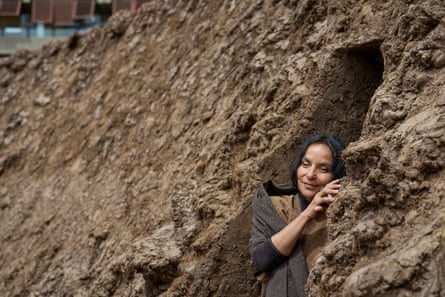
So that’s what she does. “I listen to the space, the materials it’s made of, the memory of what was there. That’s where the care starts.” She sees this care as something that’s mutual, extending between us and everything else, from lakes to stones to ants. “Care is what means our species exists.”
Origo will be free to enter, something that pleases Morelos. “It means people can visit multiple times, seeing it evolve through weather and time.” It has taken an extraordinary amount of manpower – 30 tonnes of soil passed through Morelos and her team’s hands – but Origo will be taken down come August. “There’s a fetish, almost, that artworks should be preserved for ever,” she says. “But I like the idea of impermanence.” She draws a comparison to the English countryside passing through seasons: new buds appear, flowers bloom, leaves fall. “This work will only exist in the memories of those who lived the experience.”
Finally, our conversation turns to the role of mystery and magic in her work. “How do I say it?” she says, faltering, then bursting into laughter. “Magic has always been here. If there wasn’t magic in the world, I wouldn’t want to be alive.” I get a sense of this in The Womb Space, detecting some unknowable force as I look into the shadowed earth, feeling that my gaze is somehow being returned. One woman clutches her daughter’s hand before the looming soil mass, red-eyed.
“It makes me feel like the earth and I aren’t strangers,” she says quietly. This, Morelos has said, is her hope. “I want to create a space where you can be with her. Here, the earth will hold you. I want Origo to move people, to help them realise we don’t need so much to live. The earth is so abundant.”