3 months ago
45
3 months ago
45
The first track on Kevin Morby’s eighth album is called Badlands. It refers to the unforgiving terrain of the American midwest and also comes freighted with pop cultural references: the title of Terrence Malick’s bleak 1973 neo-noir movie loosely based on the spree killings of Charles Starkweather; the ferocious track from Bruce Springsteen’s 1978 album Darkness on the Edge of Town that depicts the lot of a frustrated blue-collar worker “smashing in my guts” in a nowhere town. Unforgiving terrain, violence fuelled by nihilistic rage, frustration: the listener is thus primed for a song on which Morby, who was raised between the farmland of Missouri and the suburbs of Kansas City, paints a stark picture of the America from which he hails. But Badlands isn’t so straightforward. It’s driven by big, punchy, slightly distorted drums, but the music that plays over them is strangely laid back: a clean, clear guitar plays a gently addictive riff, Morby’s vocal has a conversational tone, there are sweet vocal harmonies. On the one hand, the lyrics talk about “the big disaster we call home”, but on the other suggest that “heaven is a place on Earth beneath the golden sky”. He concludes, with a shrug, “I can’t tell if I’m in heaven or the badlands.”
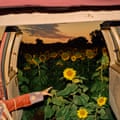
It sets the tone for an album that, in the best way, can’t quite work out what it thinks, conjuring a series of grey areas. Morby is particularly acute on the weird push and pull exerted by one’s home town, comforting familiarity and nostalgia (“home smells like cinnamon and the sad passing of time”) and doing battle with the sense that you never quite fit in: “Where no one ever makes a sound except me on this guitar,” as Morby puts it, a bluesy acoustic lick suddenly disrupting the austere sound of Cowtown for emphasis. But a sense of equivocation seeps into everything. On Natural Disaster, Morby can’t decide whether his swings in mood are something that should be dealt with via medication or meditation or just a natural occurrence, like landslides or hurricanes, that he furthermore needs as songwriting fuel. Die Young looks back on youthful hedonism with a shudder (“thank God we didn’t die young”) that can’t fully undercut how fondly he relates a succession of on-the-road touring scrapes.
Musically, Morby deals primarily in introspection and understatement. His back catalogue has occasionally touched on soul (2022’s This Is a Photograph) and jazz (there’s a surprising amount of sax improvisation on 2019’s Oh My God), but its foundation remains well-crafted Americana that draws on Bob Dylan, Lou Reed, Tom Petty and Leonard Cohen. He’s never sold vast quantities of albums, or written a breakout song that’s crossed over from the realm of glowing Pitchfork reviews to mainstream success, but the genesis of Little Wide Open gives an insight into how well respected he is. The National’s Aaron Dessner, not a man you imagine wants for offers of high-profile production work – his recent CV features hugely successful albums for Noah Kahan, Taylor Swift, Gracie Abrams and Ed Sheeran – apparently asked to work with him and said he has shared Morby’s music “with everyone I’ve ever worked with”.
The supporting cast includes Justin Vernon of Bon Iver imitating a tornado siren with his voice and alt-country star Lucinda Williams delivering a monologue inspired by Springsteen’s spoken-word contribution to Lou Reed’s Street Hassle on Natural Disaster, as well as sundry members of Muna, Sylvan Esso, Florence + the Machine and Perfume Genius. Their collective efforts return Morby to what you might call the bedrock of his sound. There are a couple of moments that leap out – 100,000 builds to a climactic maelstrom of noisy guitar – but for the most part, Little Wide Open’s main currency is subtle pleasures: the lovely melancholy exhalation of the title track’s chorus, the way the banjo-assisted closer Field Guide for the Butterflies gradually builds from fragility to something tougher, the beautiful little piano and clarinet motif that runs through Junebug. Filled with songs that take their time to unspool – the title track and Natural Disaster both last more than seven minutes – this is music that eschews flash and instead encourages the listener to sit with it, which fits with its lyrical uncertainties, its sense of someone working out their feelings in real time.
Morby has called Little Wide Open his “most personal and vulnerable album”. Certainly, it’s identifiable as the work of someone age 38, on the cusp of fatherhood – with his partner Katie Crutchfield of Waxahatchee – and powered by the kind of doubts that might assail you at that point in life: “Am I a has-been?” wonders Javelin. “Am I a husband?” But its emotional tone feels more universal than that: in a climate that tends to extremes, it’s a welcome safe space for admitting you’re not sure; that things are complicated.
This week Alexis listened to
Jordan Rakei – It Never Ends (ft Femi Koleoso)
Written and recorded in a day while Rakei was Abbey Road’s first artist in residence, his collaboration with Ezra Collective’s Koleoso is delightfully spacey, sweet but beat-driven soul.