3 months ago
88
3 months ago
88
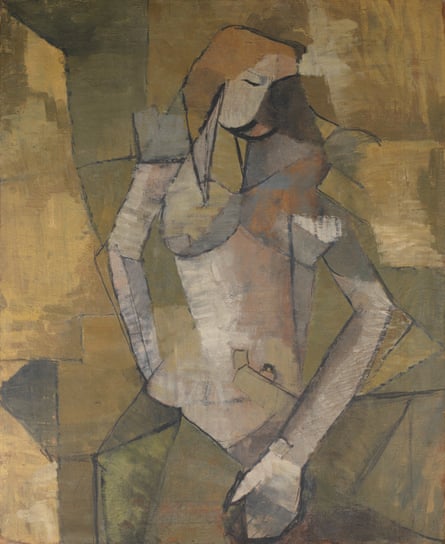
Last November, a work titled Potiphar’s Wife by British painter Euan Uglow appeared in a private sale by Christie’s in London. “We were all so excited,” says art historian and curator Catherine Lampert. “I had tried many times to find out where that picture was.” It depicts a woman lying on the ground against a blue wall, legs crossed and arms stretched out behind her to, it seems, stop a man in a T-shirt from leaving. Both cling to a beautifully draped length of orange cloth.
This is the last painting Uglow talked to Lampert about as he lay dying of cancer in August 2000. She had known him since her early 20s, had organised his first big show in 1974 and in those final months of his life, she was working on the catalogue raisonné of his paintings – an annotated list of Uglow’s complete works.
“Euan was quite cryptic,” she says. “But in the last months, he let me record him in anticipation of this book and then he would be quite” – she taps the table decisively with her hand – “‘This is what this picture is about.’ The last time I went to see him in hospital, he said, ‘Let’s get to work.’” Lampert only recorded a few minutes that day. But the details she gleaned – about the vertical yellow band that anchors the whole composition being “satiny and still” and the way the drapery “moves” – she treasured like gold dust.
Lampert is sitting at an aged square table that has been in her London home for 50 years, as has she. The many people who have sat around it (Uglow and Frank Auerbach among them), not to mention the art (Alison Turnbull) and photography (David Hockney in Lucian Freud’s studio; Auerbach and Leon Kossoff at a dinner) on the walls, speak to her status as a quiet giant of contemporary art.
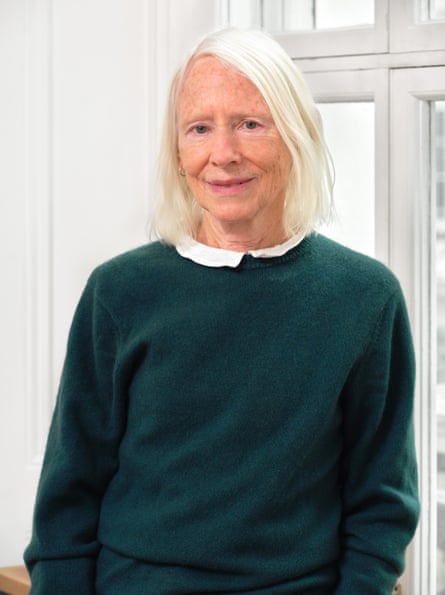
In the past 12 months alone, she has co-authored the catalogue raisonné of Freud’s paintings; curated an Auerbach retrospective; written essays for Hurvin Anderson’s recent show in New York and the National Portrait Gallery’s current Freud exhibition; and last week, she opened Euan Uglow: An Arc from the Eye, at MK Gallery in Milton Keynes, the artist’s first big show in 20 years.
It’s a lot of work for someone pushing 80. “Yes,” she says, “I never seem to want to stop working. It’s just so distracting to be thinking about art – and seeing it too.”
Lampert was born in Washington DC in 1946 and came to London as a 20-year-old exchange student to study sculpture at the Slade. She mostly did her own thing. “I didn’t want to be in the class of Reg Butler” – then head of the sculpture department, she says. “I didn’t connect. So when I was trying to make something, I would go to Camden Art Centre. The lower floor was run by a distinguished Sudanese potter called Mohammed Abdalla [also known as Mo Abbaro], and he would let people just come and use the clay.”
She also made connections. After postgraduate studies in the US and Rome she worked at the Arts Council, then at the Hayward Gallery, and, from 1988, as director of the Whitechapel Gallery, both in London. She left in 2001, the year the Whitechapel turned 100.
“I’ve been persistent,” she says, “and I have pushed.” She describes getting Freud to convince head of exhibitions Norman Rosenthal to show Auerbach at the Royal Academy after a long period of obscurity. So too, the 2019 show of Paula Rego’s paintings she curated (also at MK Gallery), at a moment when “there was no manifest interest in her work.” Rego has been in high demand ever since; Uglow could be poised for a similar comeback.
“Obviously a good relationship with artists is the first thing,” says Lampert. “Also, that you find their work thrilling and you want to do something to widen the view on it.” With delight, she describes recently buying a work by Charles Avery (“We’re going to collect it from the framers this afternoon, and he’s going to eat with us on Friday. I can’t wait to have it.”) and attending Brian Eno’s stint DJing at Peter Doig’s exhibition at the Serpentine: “It’s very good to be able to sit for two hours and have a painting right next to you. It doesn’t happen very often – and listening to music, too.”
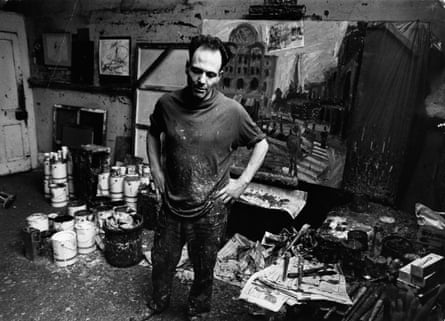
Lampert is the person who sat for Auerbach the longest, after his wife: weekly two-hour sessions from 1978 until his death in November 2024. “It’s a very particular way of your life being, for 46 years. Frank and his work and the privilege of being in his studio, that was life-changing. He affected me so emotionally.”
In 2013, while preparing the Daumier exhibition she curated at the RA, she took a trip to Berlin. “I said, ‘Frank, where did you live?’ And he told me the address. So I was the first person to go to that building and see the Stolperstein on the ground.” These are small concrete cubes with brass plates commemorating those killed in the Holocaust; both Auerbach’s parents were murdered at Auschwitz after he escaped to Britain aged eight.
“If you’re not just bursting in to get a story, this kind of little detail begins to mean something,” Lampert says. “You can imagine Frank in the courtyard. Your emotional attachment to art and to the artists means they’re not just professional colleagues. I don’t mean that you have an intimate relationship, I mean that you just care an enormous amount.”
She fetches a framed photograph taken at his 93rd birthday, in April 2024. “He was feeling really uncomfortable. So at one point I got up and gave him a shoulder massage. And [The Wolseley founder] Jeremy King is looking kind of a bit surprised, like, ‘Why is she doing that?’ But I felt it was what he needed. He was in quite a frail condition.
“I’m really, really, really missing him,” she continues. “It’s very hard to adjust. I miss his voice and the rhythm of things.” She spent several months after his death documenting the books in his studio, noting the images on the pages he’d left open on the floor. For the Freud catalogue raisonné, she and co-author Toby Treves compiled a list of all the names in his daily appointment books, working out who was who: the secret names he had for his children, his models’ nicknames (“AR” for “Arborio”, for a woman who once made him rice for dinner).
Compiling such a catalogue is the most exacting of art historical tasks. Some can be tedious to read. Freud’s, though, is like delving into John Rewald’s account of Cézanne’s oeuvre: the immersion is so complete, the written detail so vivid and enlivening, at times you forget to look at the pictures.
Lampert met Freud a few years after Auerbach, in 1981. At first she saw him weekly. One of Freud’s models, Sophie de Stempel, has told her he would sometimes send a postcard saying, “Haven’t seen you. Come for a dance,” which Lampert euphemistically explains might mean “embrace and so forth” but also was a summons to be spontaneous. “It’s just the way he related to lots of people. It was his spirit, his humour, his directness,” she says. “Lucian was so charming. He could just touch somebody’s shoulder, and there was nobody else, you know?”
Leafing through the Freud archive at the National Portrait Gallery, Lampert has found postcards she’d sent him throughout the years that he’d kept, “of a Courbet or something,” she says. “And I’d think I’m glad I sent that. Sometimes, it would go unanswered, sometimes he’d say, “Come see this picture’. And that continued right to the end of his life.
“Lucian said that he would have asked me to sit,” she adds. “When you’re just sitting, you can ramble on, like somebody next to you in a car. That would have been a really great experience too. But you have to have a lot of time in your day.”
And she was already quite committed to another artist, I venture. “And a husband,” she says. “And a job. A lot of his sitters were very young, working in a club or waitressing; they didn’t have responsibilities.”
Hockney likes to point out that his portrait by Freud took 120 hours. Others, including Uglow, turned Freud down. “He said, ‘I can’t give up that time’. As it happens, Euan died young, in his 60s, so he was probably right not to give it up.”
With Auerbach, she says, it mattered so much that his sitters arrived on time. “And that was true of Uglow and Freud and Kossoff. They couldn’t cope if there was any uncertainty about whether somebody would come.”
What did Lampert get out of sitting for so long? “Everything,” she says instantly, “Everything. I always came out in a really good mood. It never failed.”