3 months ago
79
3 months ago
79
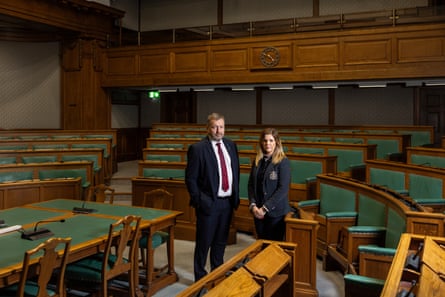
As night descends on the grand offices of Lincolnshire county council, everything appears orderly and calm. Paintings of long-forgotten councillors and dignitaries stare out into an empty drawing room. The council chamber is silent and dark. Bored receptionists glance at their phones while a handful of admin staff hunch over glowing screens. But a rebellion is brewing in the office of the council leader, Sean Matthews, who took charge last May, when Reform replaced the Conservative old guard. The affable former royal protection officer is plotting an apparently radical campaign of civil disobedience against a series of giant solar farms planned for Lincolnshire.
Despite a quarter of a century in the Metropolitan police, Matthews is willing to break the law to stop solar developers. He is planning to lie down in front of the bulldozers. “They can arrest me – I’ve arrested plenty of people,” he says, leaning forward on a sofa. “It’s much bigger than me and my criminal record. For goodness sake, it’s the future of the county, it’s the future of our land. I am passionate about that and I will do what I can.”
He is not the only Lincolnshire cabinet member willing to spend a night or two in the cells. Natalie Oliver, a local business owner who became a Reform councillor last year, is also prepared to defy the police. “I would do anything for my residents … we are 100% committed,” says Oliver, sitting opposite Matthews. “Getting arrested would be a new experience for me, but if that’s what it takes, that’s what it takes.”
This is the frontline in a fierce political battle over the rollout of mega solar farms, which could shape the future of the UK’s energy transition. On one side is the energy secretary, Ed Miliband, who has pledged to take on the “blockers” to get large-scale renewable projects through the planning system. On the other side is a varied collection of grassroots campaigners and Nigel Farage’s anti-net zero disruptors, who increasingly dominate the politics of Lincolnshire.
Miliband has given the green light to more large-scale solar farms in Lincolnshire than anywhere else in the country. Four other local authorities, including Yorkshire and Cambridgeshire, each have just one approved solar project capable of producing more than 100 megawatts (MW) of power, whereas Lincolnshire has six. These include Tillbridge Solar and Mallard Pass solar farm. A further four Lincolnshire solar schemes are going through the national planning process.
For supporters of renewables, this is a tantalising prospect. Miliband has pledged to turn Britain into a “clean energy superpower” by almost tripling solar power, doubling onshore wind and quadrupling offshore wind capacity by the end of the decade, to create a virtually carbon-free electricity system.
Yet for many people living nearby, the solar revolution is upending centuries of settled rural life, despoiling landscapes and gobbling up food-producing land. They also question the wisdom of placing solar panels on an often cloudy island and believe private developers, rather than the public, will benefit.
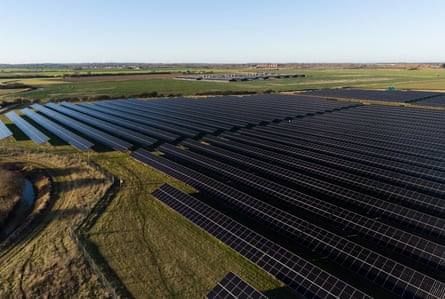
The countryside around the Lincolnshire market town of Gainsborough is a focal point for solar developers and their adversaries. It is set to be transformed by a cluster of four large-scale solar plants. The area is attractive because solar farms can easily plug into the National Grid at the site of the former Cottam coal power station, which operated here for half a century. One of the new plants being built in this area, Tillbridge, is the largest solar development to be granted planning permission so far. The project will cover approximately 1,400 hectares (3,460 acres), equivalent to 2,000 football pitches.
In the pretty village of Glentworth, frustration is hardening into resentment. Dorne Johnson, who helps run the 7000 Acres group, which represents residents from more than 30 villages opposed to the four solar farms, has lost faith in the national planning process, which handles major infrastructure projects. “We feel we are being dumped on. We feel we don’t have a voice,” says Johnson, as she walks her two cockapoos down a muddy lane that will one day overlook Tillbridge.
The site will have thousands of 3.5 metre-high tracking solar panels, which pivot towards the sun to maximise electricity production. The entire development will be fenced off to protect passersby and stop theft of cables for the lifespan of the scheme, which is 40 to 60 years. “I won’t be living in a rural village any more – I’ll be living in a power plant,” says Johnson, who retired to the county with her husband in 2021. “Why is Lincolnshire the sacrificial lamb? If we need solar farms, which I don’t think we do because there are better options, why are they all coming here?”
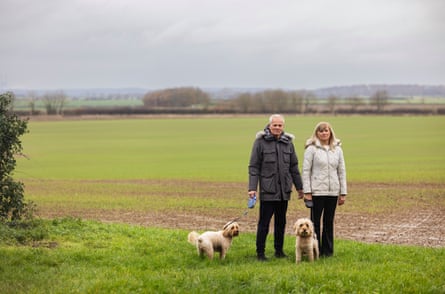
The group are keen not to be portrayed as nimbys. Johnson insists she wouldn’t mind other energy plants, such as modular nuclear reactors, as they have a smaller footprint. “Solar is taking away all this land that produces food, when you can go and build a Sizewell C with less impact,” she says.
They are also careful not to come across as climate change deniers. But their criticism strays into that territory. Johnson questions if there is a climate emergency, even though the world’s scientists have called for rapid and deep cuts in emissions. “We don’t believe there is an emergency,” she says. “We are against the rush … we should be doing it more thoughtfully and more slowly.”
Later, cold rain seeps from the leaden sky on to an isolated farm worker’s cottage on the far outskirts of Glentworth. The cottage is surrounded by a patchwork of ploughed fields and soggy winter crops, interrupted only by the odd agricultural shed. Apart from the splash of raindrops, there is barely a sound. This is the tranquillity that attracted Alison Wood and Nick Mapstone to Lincolnshire in 2000. They were desperate to escape the frantic pace of south-east England and find a sanctuary to care for their autistic daughter, who has learning disabilities and is distressed by noise.
“I had just given up work to look after her. It seemed like the perfect solution to bring her and our other daughter here, out in the wilds, with no one to bother us,” says Wood, as water streams down the cottage’s conservatory roof. “It was our little rural idyll for years until the solar farm landed on us.”
Their cottage backs on to fields that will one day become Tillbridge Solar. The development has been hanging over them since 2022, when Mapstone, a retired health auditor, came across a surveyor wandering down their lane. “They wanted contact details to include us in the so-called consultation,” Mapstone says, with more than a hint of bitterness.
The site will undoubtedly change the couple’s lives. One of two substations will be situated little more than 500 metres from their home, with three battery units less than 900 metres away. They fear their daughter, who is 33, will be affected by the drone of these systems, which could stop her going out in the garden or even opening a window. “We’ve spent our lives protecting her from anything that will hurt her, and now we can’t do anything about this,” says Wood. “We are totally impotent.”
The worry has been draining. Mapstone lets Wood, a former university psychology lecturer, do most of the talking, but his weary expression and the lines under his eyes suggest restless nights. He says the experience has taken a toll on his health. “This has caused depression and anxiety. I was perfectly all right before. And I’m sure it’s not just me; a lot of people in the village have been affected,” he says. “It is the constant worry and the lack of control ... It is the inevitability; it is going to happen.”
The family’s concerns generated 22 pages of technical notes during the planning process. Tillbridge Solar told the Planning Inspectorate it had revised its plans to reduce the noise heard in the cottage. It also pledged to carry out spot checks once the farm was built. A spokesperson for the company tells me it recognises that large infrastructure projects can feel imposing, but they argue that completed solar farms produce electricity quietly, without combustion, emissions or regular vehicle movements. While they understand the concerns of Wood and Mapstone, they add that operational noise levels at the nearest homes will remain well below recognised thresholds.
Wood and Mapstone are not reassured; they worry their daughter’s medication will have to be increased so she can cope with the noise. “We feel awful – we don’t want to do it,” Wood says.
It is not just Tillbridge Solar’s closest neighbours who are upset. The planned route of underground cables linking the scheme and the other solar farms around Gainsborough to the National Grid has also sparked determined opposition.
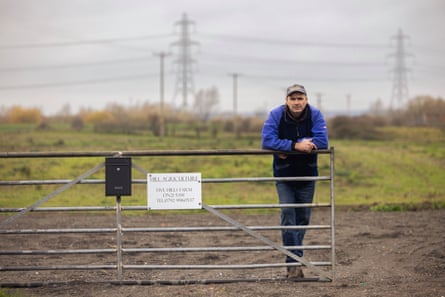
On the windswept fields south of Gainsborough, Nick Hill, a steely eyed potato farmer, is trudging over soil earmarked for the cables. “There are four solar farms within a six-mile vicinity, and all the cables are coming directly through here and going there,” says Hill, pointing towards the distant grey chimneys of the defunct Cottam coal power station.
This directly affects Hill: he will not be allowed to build more sheds to store crops and farm machinery on top of the cables. But he is more concerned about the loss of food-growing land. “In the second world war, if the boats didn’t come across, we had days before running out of food. We’ve got more people in this country now, so we’ve got less time if anything goes wrong,” he says. “It’s very shortsighted.”
This fear is at the heart of the battle over solar in Lincolnshire. While less than 1% of the UK’s land area could produce enough solar energy for the country to reach net zero by 2050, the sites are not spread evenly throughout the UK. Local farmers are divided: many have leased their land to solar farms, whereas others have become ardent anti-solar campaigners. Hill, whose family go back five generations in Lincolnshire, is scathing about farmers leasing their land to solar companies. “I know them,” he says. “It is all down to money and greed.”
The developers are often viewed in the same way. All the approved large-scale projects in Lincolnshire are privately owned. Tillbridge will be built by the international solar company Canadian Solar, which has a Chinese solar manufacturing subsidiary, and a UK renewable company, Tribus Clean Energy. Hill is furious that Miliband has enabled private companies such as these to hoover up so much of the county: “These companies are in it for profit. It is wrong.”
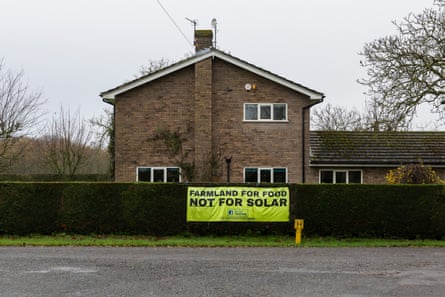
Hill’s farm hosted a 100-strong protest organised by Lincolnshire MP and Reform deputy leader Richard Tice, which was broadcast by GB News and ITV. Local people and councillors held placards with slogans such as “Save rural Lincolnshire” and “Fields 4 food not solar farms”. At the front of the crowd, Tice issued a familiar threat: “We are going to rip up all of these new contracts … whether it’s for windfarms, whether it’s solar farms or battery storage, they are on notice. We don’t view them as valid. They will be null and void … If you invest in solar and wind, you are probably going to lose your money.”
The issue has politicised Hill. He peppers his answers with Tice’s catchphrase “net zero stupid”. He didn’t bother voting in recent general elections, but next time he goes to the polls he is certain: “I’m voting Reform.”
Hill is far from an outlier. A recent YouGov poll suggests Farage’s anti-net zero populists are on course to take all but one of the parliamentary seats in the county. They have already notched up some major local victories: as well as controlling the county council, the party’s candidate, Andrea Jenkyns, won the race to become the first mayor of Greater Lincolnshire in May 2025. Back in the county council offices in Lincoln, Matthews and Oliver are keen to stand in the next general election, which has to be held by 2029. “I would put myself forward – I want to do as much as I can,” Oliver says. A smiling Matthews chips in: “I can’t imagine being on those green benches without her.”
In the meantime, they are going to try other ways to stop big solar coming to Lincolnshire. Matthews denies his approach can be likened to Just Stop Oil campaigners clambering on gantries on the M25 or Britain’s most famous anti-roads protester. “Swampy was against road building. I understand the principle, but the road has got a use … Solar farms are not proven to be of any use.”
Matthews believes Miliband is indifferent to the popular mood in the county. “I genuinely believe that Labour don’t care because they’re never going to win here, so they’ll just chuck everything in Lincolnshire, turning what is a beautiful county into an industrial, electrified wasteland.”
The Reform leader, however, does back other types of industrial energy production in Lincolnshire. Matthews even supports modular nuclear reactors and fracking because they use less land than solar. This is more than a pipe dream: Jenkyns has been courting a US fracking company. “If you want extra energy, let’s look at shale gas. Let’s look at tapping into that fantastic resource that we’ve got in Lincolnshire,” says Matthews, with unbridled enthusiasm. “It works really well in America; they get huge amounts out of the ground.”
The Conservative government banned fracking in 2019 due to “unacceptable impacts on the local community”, with an official report warning it was impossible to predict the magnitude of earthquakes the process might trigger. Fracking sites have prompted long-running protests, but Matthews is convinced he could persuade local people: “We’d win them around.”
Like the 7000 Acres group, Matthews doesn’t want to be described as a climate change denier, but he openly questions the contribution of humans to global heating: “My view is that our influence on the climate of the planet is minute.” The UN’s Intergovernmental Panel on Climate Change, which examines all available climate research in regular cycles, found that human activities have “unequivocally caused global warming”, harming people and nature across the globe. But Matthews is having none of it: “Don’t give me that nonsense. That’s 30 years old made-up stuff. That’s crazy. It’s not true. It’s scientists who have been paid for by people who want to make a lot of money out of new green energies.”
The Tillbridge Solar spokesperson tells me that the project avoids the highest-grade agricultural land wherever possible, and that any change in land use is temporary and reversible at the end of the project’s operational life. They say the independent planning inspectors examining the project concluded that the scale of land used would have no “material impact” on UK food security.
It is hard to find prominent figures willing to defend solar publicly in Lincolnshire. One environmentalist pulls out of my interview because he is worried it could undermine his campaigning. Neil Murray, a veteran former Labour councillor who now sits as an independent on the planning committee, says solar supporters sometimes speak in “hushed tones” in local shops in case they are overheard. “What you notice living around here is that people who are supportive of solar are keeping their heads down,” he says in the living room of his rural bungalow, with his two spaniels at his feet.
But Murray is unafraid of ruffling a few feathers. He claims renewable projects are frequently obstructed by the council: “It’s nothing to do with looking after the land. They think the climate crisis is a conspiracy. They don’t articulate it like that, but that is what is behind it.”
Murray, whose family moved from Glasgow to Lincoln in the 1960s for work, stresses that the vast majority of Lincolnshire will remain untouched after the solar farms are built. “Anti-solar campaigners need to get things in proportion. If we want electricity and we don’t want to be beholden to dictators, we need to have clean, renewable energy from sources like the sun, wind and waves, which do not run out,” he says.
He concedes that some might be adversely affected by the changes under way. “Most of these solar farms are not located near where people live,” he says. “I feel sorry for affected families, but they are isolated cases.”
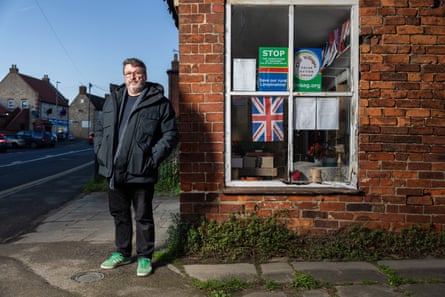
The village where Murray lives with his partner is on a limestone ridge running from the south of the county towards the Humber estuary in the north. Plans to build a battery energy storage facility and a National Grid substation to serve nearby solar farms have led to a grassroots campaign and a protest march. The development could see 232 van-sized batteries placed on two fields outside the village. He acknowledges that many people are against what they see as the industrialisation of Lincolnshire. “It has become a culture war,” he says. “They don’t like change.”
Few trust private developers, but the next four years could see more communities building their own renewable schemes. Great British Energy, which was set up by the government last May, is planning to generate power from publicly owned renewable plants and spend up to £1bn supporting more than 1,000 community-owned energy projects by 2030. Surveys suggest projects such as these provoke far less opposition, but this does not extend to the diehard opponents in Lincolnshire county council. “It’s not about who owns it – it is about covering huge swathes of arable land in ugly eyesores,” Matthews says.
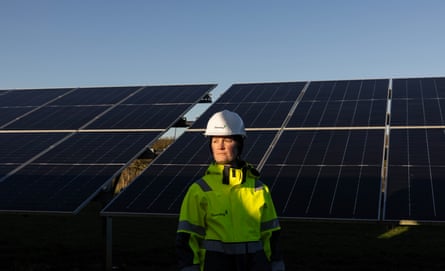
There are plenty of apocalyptic warnings about the impact of solar farms on rural landscapes, but what do they actually look like? The 52-hectare Whitecross solar farm is barely visible from a quiet tree-lined country road on the outskirts of the Lincolnshire town of Sleaford. Yet a rough track through a wood leads to six fields full of more than 63,500 dark solar panels, which shimmer in the winter sunshine.
“I think this is beautiful,” says Saffron Hooper-Kay, who manages Whitecross for the investment management firm Downing. “Green electricity is being produced here and that is beautiful to me. Every panel has a 250-watt peak, four panels together boil a kettle.”
Whitecross is nowhere near the size of Tillbridge, which will be 23 times bigger. But it still produces enough electricity for 10,300 typical homes every year. If the same power were generated by fossil fuels, it would produce 6,954 tonnes of greenhouse gases annually. “That is equivalent to removing 1,620 cars from the road every year or planting 116,000 trees for 10 years,” Hooper-Kay says. Although if you account for the manufacturing and shipping of the panels from overseas, Whitecross could take up to two years to reach carbon positive.
Hooper-Kay started out working on rigs in the North Sea, where Reform plan to increase drilling if they win the next election. “I used to work in oil and gas,” she says as she wanders through the solar arrays. “I didn’t want to pull more oil out of the ground, so I retrained.”
The farmer who leases the land is also delighted. “It is very heavy land. It is classified as grade 3b, which means poor arable production,” says Andrew Darley, gesturing to the fields his family has farmed for three generations. The income from the lease has roughly quadrupled the money he was making from growing oilseed rape and wheat. “We would have been struggling without the solar farm,” he says. “It’s made a big difference.” But he is also pleased to be contributing toward the net zero target and giving the land a rest for the duration of the scheme. “We were having to use quite a lot of herbicides,” he says. “Now we’re all green.”
A hare darts between the arrays as Darley is talking. “I’ve been surprised by the amount of wildlife that has become established here. There are brown hares, partridge, skylarks, buzzards and red kites,” he says proudly. This is not unusual. Research by the RSPB and Cambridge University found that solar sites managed for nature on the East Anglian Fens contained nearly three times as many birds as surrounding farmland.
However, Darley is less enthusiastic about building solar on good-quality growing land. Mallard Pass solar farm, which has been approved by Miliband, will be partly located on higher-quality agricultural land. “I feel that there still ought to be a land classification if possible, so solar farms are not taking good arable land out of production,” Darley adds.
Whitecross generates power throughout the year. On a bright winter’s day, it is producing just under half its capacity. Vassilis Thomas, who maintains the site, checks an app on his phone: “At the moment, it is 133 kilowatts (kW), and the capacity is 320kW, so we’re talking about 40% ... If there are clouds, this can drop down to 15% or 20%.” Some anti-solar campaigns suggest the UK is too far north for solar power to be worthwhile. But other northern European countries have similar levels of sunlight; the Netherlands produces 20.5% of its electricity from solar power. In the UK, solar’s share reached more than 6% last year, which was the sunniest on record.
The British solar industry is expanding fast. Downing is developing four sites in Lincolnshire, including a large-scale project.
But Tice, whose Boston and Skegness constituency is little more than 20 miles away from Whitecross, is doing his best to undermine market confidence: in July he warned investors that a Reform government would cancel “contracts for difference”, which guarantee prices for renewable energy and nuclear generators. Price agreements such as these are essential in a privatised energy market because most of the costs are upfront. Many investors are prepared to pump in the capital necessary to install new solar farms only if they know the schemes will be profitable.
Hooper-Kay is troubled by Reform’s threats: “It is very shortsighted. It’s a ‘just keep barrelling out the water and hope we don’t sink’ vibe.”
As the sun slides below the horizon, Murray takes his dogs for a walk. He pauses by a poster warning that solar farms are industrialising Lincolnshire. “Did the people in Lincolnshire complain when much of Yorkshire and Scotland were covered in coalfields? Of course not,” he says, with typical directness. “It’s time for Lincolnshire to do its part.”