3 months ago
70
3 months ago
70
Just south of Santiago, the tiny rural town of Paine is a quiet grid of painted abode facades, shaded squares and shuttered shop fronts as the summer holidays draw to a close.
But the white-knuckle fear of crime that propelled its most famous son, José Antonio Kast, to a resounding victory in December’s presidential election is as present in sleepy Paine as it is the length of Chile.
“We have so much crime here – robberies, guns, drugs, you name it,” said María Elena Balcázar at a table in her roadside cafe opposite the Parroquia Santa María Virgen de Paine, the church where the Kast family would attend mass.
“Past eight o’clock nobody goes out anymore, everyone is scared,” she said. “People voted for José Antonio Kast because he promised strong, drastic changes.”
Kast, 60, whose career on the most extreme rightwing fringes of Chilean politics has often courted controversy, was elected president at the third attempt when he won 58% of the vote.
Chileans voted for iron-fisted solutions to increased violence and illegal immigration – the tenets of Kast’s campaign which he repeated time and again to baying crowds on nationwide tours.

Violent crime has ticked up in Chile over the last few years with the arrival of international gangs, part of a wave of illegal migration across the country’s long and porous borders.
But the perception of the problem has far outstripped reality.
Although three times what it was in 2015, Chile’s murder rate of six homicides per 100,000 people in 2023 places it nowhere near the most dangerous countries in Latin America, let alone the world.

Ecuador recorded 46 murders per 100,000 people in 2023, Haiti 41 and Mexico and Colombia 25. In Latin America, only Argentina and Bolivia had lower murder rates than Chile.
Yet a 2024 Gallup security report ranked Chile sixth out of 144 countries worldwide where people most fear walking in their neighbourhood at night.
Rolling news replaying footage of violent assaults has contributed to the perception that the country has become ungovernably violent under the outgoing leftist president Gabriel Boric, who beat Kast in 2021.
On the night of December’s runoff vote, Kast announced that he would install an emergency government to wrest back public order.
But that night and throughout the campaign he avoided all mention of the hardline, ultra-conservative moral code on which he has built his political career.

Kast has publicly supported Augusto Pinochet’s dictatorship, under which more than 3,200 people were murdered and 1,469 forcibly disappeared. Thousands more were detained, tortured or forced into exile.
While running for the presidency in 2021, Kast said that the former dictator, who died in 2006 without ever facing justice, would have supported his candidacy.
He used his three terms in congress to oppose abortion and the morning after pill, and to promote traditional family values.
“They simply figured out that, in order to win the presidency, [Kast’s team] needed to move away from [Boric’s] agenda and say that their priorities are first, public safety, and second, economic growth,” said Claudio Fuentes, a political scientist at Diego Portales University in Santiago.
Kast was born in Santiago on 18 January 1966, the youngest of the German immigrants Michael Kast and Olga Rist’s 10 children.
His father was a member of the Nazi party, and during the second world war was conscripted into the Wehrmacht where he rose to lieutenant, fighting on the eastern front and in Italy, France and Crimea.
The couple were devotees of the hardline Catholic Schoenstatt movement and instilled a strict work ethic in their children, opening a meat processing factory in Paine and a Bavarian restaurant on the dusty verge of the pan-American highway.

It has grown into a successful nationwide chain of more than 50 restaurants.
Balcázar’s father worked at the factory and spoke fondly of Michael Kast. She remembers him handing out sandwiches to children in the square.
The family has long been influential in Chile’s rightwing politics. Miguel Kast, José Antonio’s brother, was a key ideologue of the Pinochet regime as one of the “Chicago Boys”, a group of economists that imposed a neoliberal model during the dictatorship.
José Antonio Kast studied law at the Universidad Católica, where he became involved in student politics under the watchful gaze of Jaime Guzmán, a fiercely conservative lawyer and architect of the constitution devised under Pinochet.
A youthful Kast appeared in campaign adverts espousing the continuation of the dictatorship before a pivotal 1988 plebiscite.
He worked briefly as a lawyer upon graduating, but gravitated toward politics. He became a councillor for the conservative Independent Democratic Union party (UDI) in 1996 before being elected to congress in 2002 and serving three consecutive terms.
“Kast has always been on the most conservative fringe of Chilean politics in cultural and neoliberal economic terms,” said Felipe González Mac-Conell, a historian who co-authored a book about the president and Chilean far right.
“He always maintained his beliefs and never wavered. He hasn’t changed his way of thinking nor have any of those around him, who have thought the same as him all along.”
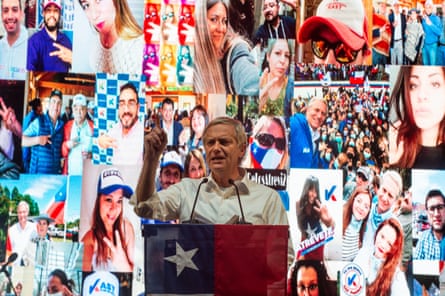
After 20 years in the party and two unsuccessful leadership bids, Kast resigned from the UDI saying that it had strayed too far from its founding principles as it modernised – and liberalised – with Chilean society.
He ran for the presidency for the first time as an independent in 2017, winning 8% of the vote, before founding the Republican party in 2019 on the basis of the “defence of human life since conception,” family values and the market economy.
He has already begun shaping Chile’s future. He drew criticism over the weekend for attending the gaudy launch of Donald Trump’s Shield of the Americas security alliance.
He spoke at a summit of the Conservative Political Action Conference in Hungary last year, and met El Salvador’s security minister during the country’s heavy-handed crackdown on gangs.
Back on the outskirts of Paine beside a noisy highway is a memorial to the 70 men who were disappeared by the Pinochet regime – more than in any other municipality in Chile.
“Truth and justice are on the line,” said Flor Lazo, whose father and two brothers were kidnapped from their home in the fraught days after Pinochet’s 1973 coup.
No trace of them has ever been found.
“We are on a war footing. Let me be clear. We will be watching closely everything the new president does. We will take our fight to La Moneda [presidential palace] if necessary.”