3 months ago
112
3 months ago
112
Yann Martel’s writing studio, where he sits while we talk over Zoom, is a mere 10ft by 12ft; beyond his treadmill desk lie the drifts of snow that separate him from the house he shares with his wife, writer Alice Kuipers, and their four children. Martel was born in Spain, but his father’s academic work took the family to places including Portugal, France, Costa Rica and Alaska; perhaps it’s no surprise that, after all that travelling, he’s been settled in Saskatoon, Canada, for many years. But his novels couldn’t be any less rooted, in time or place: from the sea-tossed raft of the Booker prize-winning Life of Pi to the Dante-inspired Beatrice and Virgil and the era-shifting triptych of The High Mountains of Portugal, Martel is clearly possessed of an itinerant imagination.
Now comes Son of Nobody, for which Martel has written what the novel’s dismissive professor would term “pseudo-Homerica”; a version of the Trojan war seen from the perspective of an unknown soldier, Psoas, and discovered by an eager researcher in present-day Oxford, Harlow Donne. The poem appears in full, with Harlow’s story – including the breakdown of his marriage and his relationship with his young daughter, Helen – presented via digressive footnotes, at times scholarly but just as often humorous and domestic.
The catalyst was Homer’s Iliad itself, in Stephen Mitchell’s translation, which Kuipers recommended to her husband. Realising he had got to his 50s without reading one of the foundational works of world literature, Martel picked it up, expecting it to be “venerable and kind of boring … a bit of a book for old farts”. Instead, he was gripped by the intensity of the action and by the depth of the poem’s exploration of life and death.
“And I just started getting ideas. Many things struck me: one was that the Iliad is just about rich people. It’s the Bill Gateses and the Jeffrey Epsteins of the world, ruling things and squabbling because they have nothing better to do, frankly, whereas what about the common man? What about the cannon fodder? What about his opinions? What about the poor schlub stuck in the trenches?” Wrath, he points out, is key to the poem’s emotional tenor – it is, he says, “basically a book about the failure of anger management”.
He began to imagine creating responses from a different perspective: “So that’s why I have Psoas as a commoner, because I have no sympathy with the elites of this world particularly, and I just started getting into it. And then it was really fun.” Creating the poem itself, he found himself liberated by the limitations of rhythm and metre, aiming for something controlled and yet expansive: “I didn’t quite want minimalism, but nor did I want maximalism.”
But if Martel’s imagination is fired by the literature of the distant past, he doesn’t see it as a way of shutting out the present day – rather as a means of locating ourselves in a wider historical context. “Right now,” he explains, “we live in a Trumpian world where there’s Putin and the Chinese and it kind of sucks. And I know that, because I’m living it as a citizen, every day. So I don’t necessarily want fiction that directly reflects that: I’m not interested in parodies of Trump, because he’s there already, right in my face. I much prefer going to older stuff, because it’s a different time. And the fact is, we’ve been there before: so to people who are in despair over Trump, I’d say, ‘Well, imagine you’re in 1915 and the war is grinding on, and hundreds of thousands of young men are dying at alarming rates. And yet we survived.’”
Martel’s interest in the largest questions of existence derives in part from when he studied philosophy at college, and found himself “exhilarated” by ideas of what constituted beauty, justice and reality. By contrast, the books he encountered on his literature course often seemed like simple entertainment – or not even that. “When I read Percy Bysshe Shelley talking about a flower,” he grimaces, “I thought, I don’t care about the beauty of a flower, that’s so lame. It just seemed inconsequential compared with this idea of God is perfect, therefore he must exist, and so why am I not religious? I found that really interesting, but ultimately, I wanted to express it through art.”
He adds that, of course, he discovered authors he admired more than Shelley, among them “Joseph Conrad and Virginia Woolf and Willa Cather, and all these other writers who weren’t just talking about flowers. I said, ‘Wow, there’s so much you can do with the written word. There’s so much you can do with stories.’ Stories are all-encompassing; philosophy is more narrow. So how do we combine the two? Hence, my interest in asking big questions – it makes the art worth it.”
Prior to Life of Pi, Martel had published two books, the short stories The Facts Behind the Helsinki Roccamatios and the more concisely titled Self, both of which had, as he points out, good reviews but small sales. He didn’t imagine the story of a shipwrecked boy’s relationship with a Bengal tiger called Richard Parker would change his fortunes: “I was thinking, this is a book about religion, and it’s not dripping in sarcasm and irony. It’s not about the patriarchy. And it’s also about animals, and usually you find animals in children’s books, not adult books. Even worse than that, I defend zoos, and many people think of zoos as being jails for animals. They’re not usually popular with your standard urban-dwelling novel reader. So I’m taking all these things that secular readers don’t like. This book is going to sink.”
Not only did it float, but readers found it spoke to them about relationships and connection. Martel remembers a reading at which a woman observed that “Pi looks after the tiger, feeds the tiger, cleans up after the tiger, and then leaves without saying goodbye. Is this a metaphor for marriage?” (He doesn’t say it is, but he doesn’t say it isn’t, either.)
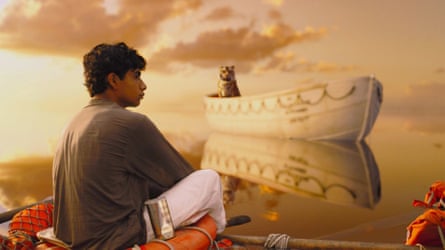
Twenty-five years later, Martel is still in demand to talk about the novel to readers and students across the world. And although he thinks Ang Lee’s film lost something by being too concerned with the special effects – whereas, he insists, it’s essentially “a bourgeois drama in a lifeboat between two people coexisting uneasily” – he was more impressed by Lolita Chakrabarti’s puppet-centred stage adaptation.
As we talk, the conversation repeatedly turns to Martel’s interest in remembrance, from the immortality that great artists achieve through their work to the way the most rank-and-file soldier might be commemorated. When I ask what he’s working on next, he shows me a small box containing 52 booklets, some as short as a page, some longer stories, which he wrote in a tumble of creative and emotional energy over the six weeks he was waiting for his editor to read Son of Nobody.
The pieces are about his mother, who has Alzheimer’s and now lives in a care facility, where she feels a terrible loneliness because she’s unable to recall her friends and family or forge new relationships. Struck by the losses she has endured – of Martel’s father, her siblings and now many of her memories – he sets about capturing something of her and her life. “Usually, I don’t do more than one project at a time. I’m a one-trick pony – I work on something doggedly until it’s done. So this book came as a surprise to me.”
Perhaps it’s a more natural progression than it seems, considering all that time spent in the bloodthirsty world of the ancient Greeks and in Son of Nobody’s contemporary story, which explores with immense tenderness and poignancy the bond between parent and child. As for what might emerge after his book-in-a-box, Martel is sure something will fill his appetite for what he calls the magical thinking of writing fiction: “You become a small god when you’re an artist, like a chef, putting food together from disparate elements. You create something. And that’s really exciting.”