3 months ago
92
3 months ago
92
Driving down the palm-lined strip of Wilshire Boulevard in Los Angeles, a striking new crossing heaves into view. A ribbon of glass leaps over the road, sandwiched between two gigantic planes of concrete. As you get closer, the bridge swells out in sinuous arcs, swooping back on itself to inscribe an amoebic, shape-shifting blob, spreading out like an inkblot. From some angles it has a retro-futuristic air, recalling a Jetsons airport terminal, or one of California’s “Googie” style gas stations. From others, the curving roof looks like a great big tongue, flaring out to give the neighbours a raspy lick.
This concrete colossus is home to the new David Geffen Galleries of the Los Angeles County Museum of Art (Lacma), a $724m mothership designed by the fabled Swiss architect Peter Zumthor. It is less a museum than a mighty piece of infrastructure, a 110,000 sq ft warehouse-cum-bridge, jacked up nine metres in the air and looming above the street with a brooding, muscular heft. Two decades in the making, and subject to tortuous years of delays, controversies and cost escalations – building on a tar swamp in a seismic zone is not straightforward – it finally opens this weekend.
The Fitzcarraldian feat is the brainchild of Michael Govan, who became Lacma’s director in 2006 with an ambition to build a museum like no other, using the promise of a dazzling structure to lure donations of artworks and dollars ($125m came from LA county, the rest was fundraised). Govan cut his teeth at the Guggenheim, and on Frank Gehry’s Bilbao outpost, where he clearly got a taste for the transformative fairy dust of signature architecture. He later moved to Dia:Beacon, in New York’s Hudson Valley, where he commissioned Zumthor for a project that was ultimately unrealised. At Lacma, he was determined to make a monument for posterity, at any cost.
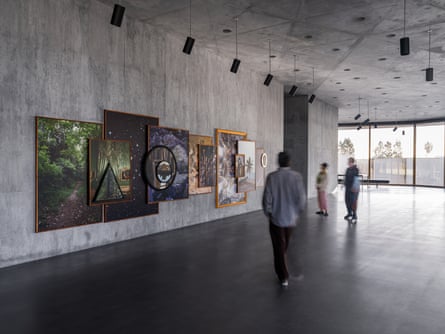
“My brief to the architect was to have everything on one floor,” says Govan. “And I wanted transparency, no hierarchy, no facade.” He is standing in the lofty gallery, surrounded by an open field of disparate objects, framed by concrete overhead, polished concrete underfoot, and concrete-walled rooms all around us. “I also asked for concrete,” he adds. “People say concrete is not the most environmentally friendly medium, but if it lasts 500 years it’s very friendly!” He chuckles with a winning smile, showing the easy charisma of someone used to extracting large sums from billionaires.
Eschewing the usual design competition, Govan turned straight to Zumthor, architecture’s most venerated sculptor of liquid stone. The reclusive Pritzker prize-winning 82-year-old has transformed the humble mix of cement and sand into everything from a bewitching charred chapel in a field in Germany – made by pouring it over a pyramidal pyre, before setting the woody innards alight – to a cave-like holiday home in Devon, built by ramming crumbly concrete in sedimentary layers. But Zumthor’s small mountain atelier had never done anything remotely on the scale of Lacma. Even though he was aided by executive architects SOM, it was like asking a dinghy-maker to build an aircraft carrier.
In some ways, it shows. Arriving at Lacma’s park-like campus – which, sadly, is segregated from the sidewalk by an off-putting steel palisade fence – visitors are greeted by a barren concrete plaza. They are ushered up a long outdoor staircase, or into an elevator, housed in one of the eight pavilions that hold the building up, like the chunky legs of a concrete elephant. This public space currently feels like loitering beneath a highway overpass, but there is hope it will be activated by throngs of tourists and events. A very LA touch of public life is provided in one leg by a branch of Erewhon, a high-end grocery store and byword for bougie, known for its $20 smoothies. Govan promises a “special Lacma mix” is in the works – a concrete-hued charcoal blend with black sesame granola aggregate, perhaps?
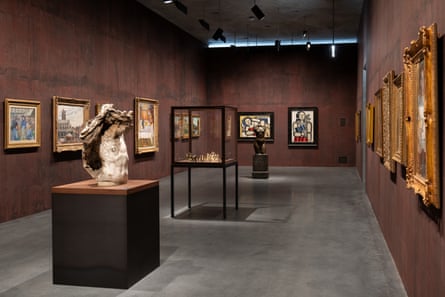
Once you have made the ascent upstairs, things improve. Drifting around the galleries, which vary in size, mood and colour, is a delight. Some are tiny, chapel-like spaces, reserved for a single item – such as a Qing dynasty court robe, dramatically spotlit against inky blue walls. Others are larger and feature furniture and old masters set against walls stained a rusty red, like Corten steel. Sometimes the moody theatrics get a bit much. It might work for a mountain spa, like Zumthor’s famous Therme Vals, but with all the dark walls and dim lighting, there is a tendency for the galleries to feel a bit sepulchral, a shadowy columbarium for 6,000 years of dead stuff.
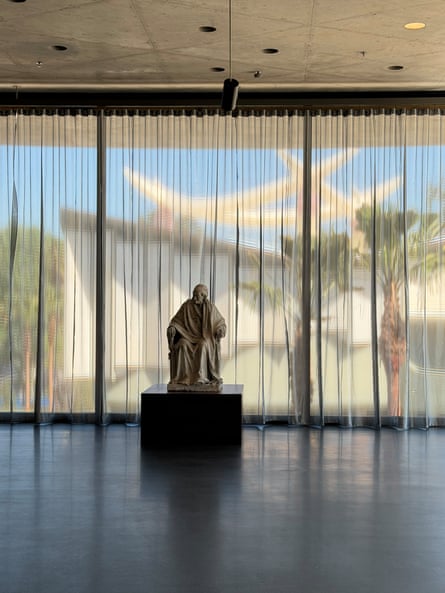
In between the concrete tombs, sunny respite is brought by panoramic views back outside, to the lush park and busy street, veiled by shimmering metallic curtains. It’s a treat to sit and watch the world go by from this elevated perch, and Bruce Goff’s eccentric pavilion for Japanese art has never looked so wondrously life-giving next to all the grey concrete. The curtains, by textile designer Reiko Sudo, help to filter the LA sunshine, and they bring an unusually domestic air.
Along with the comfy leather benches, the drapes can make it feel as if you are exploring the gargantuan villa of a movie-mogul art collector in the Hollywood Hills. There are distinct echoes of John Lautner’s midcentury homes in the curved concrete slabs and seamless expanses of glazing, and you sense that Zumthor’s underlying ambition was to build a supersized Case Study house. Raised aloft, safely sequestered behind the tall fence, the whole place oozes exclusive compound vibes (a sense amplified in the gift shop, where $150 tote bags, made from the shiny curtain fabric, are for sale alongside $215 Lacma-branded sweaters.
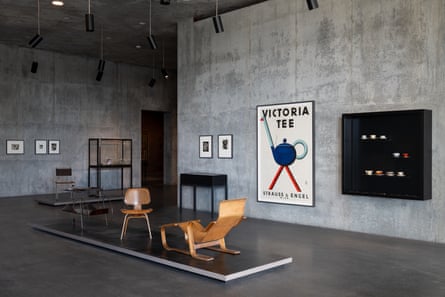
Govan has come under fire for his decision to ditch the usual chronological hang in favour of thematic clusters, but for the most part it works. One moment you are marvelling at Do Ho Suh’s gossamer recreation of a palace in Seoul, the next you are confronted by Hindu deities and Islamic textiles, or a room about plastic in art. It somehow feels very LA, where Koreatown jostles with Little Armenia, Historic Filipinotown, Little Ethiopia and Tehrangeles in an endless sprawling suburb.
The open areas in between the rooms also make for good day-lit display spaces, including one zone fittingly devoted to car culture. You can admire the fibreglass body of Raymond Loewy’s sleek 1961 Studebaker Avanti, while looking out on its bloated gas-guzzling descendants growling along Wilshire down below. Zumthor says he wanted the visitor experience to “feel like walking through a forest”, with open clearings and sheltered bowers – and, just like a forest, it can be disorienting. I found myself doing circuitous laps of the concrete maze to ensure I had seen everything. Bringing a ball of wool may be advisable.
Back in the gift shop, there’s a poignant reminder of what once stood here. A $5 postcard of Ed Ruscha’s painting Los Angeles County Museum of Art on Fire, 1965-68, depicts the original complex that was crushed to make way for Zumthor’s Goliath. Designed in the 1960s by William Pereira, architect of the space-age theme building at LAX airport, and later expanded, it was a handsome hotchpotch, but one that Govan claims was beyond repair. “People called it ‘Leakma’,” he says. “I had so many people who would not donate their collections to the old buildings, because they were in such bad condition.” Nor, he thinks, would patrons have been quite so eager to lavish their largesse on a renovation project (philanthropy needs to catch up).
Zumthor’s daring building might have brought in the collections and the funds, but it comes with an unspoken cost. Lifting the whole thing off the ground and spanning the road – a piece of structural theatrics more than a necessity – required 15,000 tonnes of steel reinforcement, twice as much as all the metal in the entire Eiffel Tower. The concrete bill is equally eye-watering. For every sq metre of floor area in Zumthor’s building, there are two cubic metres of solid concrete supporting it – compared to an average of 0.3 to 0.6 cubic metres for a typical large concrete building. In total, 65,000 cubic metres of concrete were poured, almost double the amount in LA’s Sixth Street Viaduct , a huge bridge that stretches for more than a kilometre across roads, railways and a river. Perhaps the carbon footprint is fitting, given whose name is on the building. In a 2021 ranking by The Conversation, the project’s lead donor, David Geffen, was listed as the most polluting individual American, due to his use of yachts and private jets.
I put the carbon question to Zumthor. Do the ends justify the means? Was it worth the extraordinary environmental impact to create this audacious structure, which ultimately has less gallery floor space than the buildings it replaces? “The horizon of ‘concrete uses too much carbon’,” he says, putting on a whiny complaining voice, “this is a very small horizon. This building will still be there when people are talking about other things.”
The window behind him frames a view of La Brea Tar Pits , an archaeological research park where the fossils of ice age animals have been discovered, preserved in bubbling pools of tar. Below Zumthor’s flaring concrete cantilevers, a model of a woolly mammoth drowns in a lake of crude oil, as a mother and baby mammoth look on helplessly.