2 months ago
79
2 months ago
79
I was not hungry when I arrived at Taix on Thursday night, Los Angeles’s venerable, soon-to-close French restaurant and de facto museum of a long-gone era of fine dining. I’m rarely hungry when I go to Taix. Not because I don’t thoroughly enjoy their french onion soup, the mussels, or the decadent hamburger. I’m not hungry because it’s never my first stop of the night. Taix isn’t a destination. It’s a nexus point for LA.
No one in Los Angeles ever thought it would be gone, until it was. Sunday will be the last service for a restaurant that has anchored the neighborhood of Echo Park for the past 64 years, before it is torn down to make way for a large-scale luxury apartment development. The impending closure has sparked an end-of-an-era frenzy, with lines down the street, packed tables and loyal fans pinching menus and other memorabilia for their personal collection.
As the city’s cost-of-living crisis continues to grow, and as other historical meeting places like Cole’s French Dip close after decades, the loss of Taix (prounounced “Tex”) stands out as a symbol of the city’s grief. From civic leaders to artists and writers, people from all corners of LA have sat at Taix’s bar or luxuriated in its massive dining rooms. Losing it is significant for so many Angelenos, but especially the residents of Echo Park, which has been roiled by gentrification for a number of years.
Taix, though, is a symbol of the old Echo Park: a place for communion with the spirits of the past, a chance to chat with good friends or new friends. It can be a launching pad for a rollicking night out or a soft landing spot at the end of one. It has long been an ornate, crumbling, cavernous playground of possibilities. It’s a contradiction in terms: a safe space for the gay arts community of the city, but also a symbol of the city’s traditions. The restaurant will reopen on the ground floor of the new apartment complex, but can it possibly be the same?
When I arrived at the restaurant for a final visit this week, a line to enter threatened to stretch on to the sidewalk in front of its sprawling parking lot and valet stand. On weekends, that parking lot is full of vintage shoppers perusing an outdoor market, but usually it’s empty. Taix first opened in 1927 and has been in its current location since 1962, when it moved from its original spot downtown. In the 60s, Los Angeles was full of restaurants with grand entrances covered by an awning, welcoming automobiles in this car-centric city.
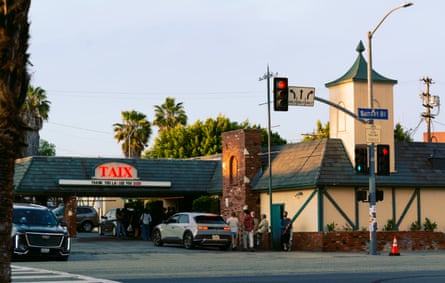
LA still loves its cars, but the idea of a restaurant occupying that much valuable real estate and having its own parking lot is becoming antiquated in the days of ride-sharing. But during the last few days of Taix in this iteration, the lot was a godsend. It allowed those of us brave enough to attempt to grab a table to valet, to mingle, and to trade stories about why we love this place.
The line to get in was moving at what can best be described as a crawl akin to rush hour traffic on the 110 freeway. So, I peeled off to strike up a conversation. Peter Recine, 38, a freelance musician, and his partner, Cassie Dailey, a 35-year-old dancer, were smoking not far from the queue. They were struggling to get in and losing hope. Why bother? I asked.
“History is so important,” Dailey says. “It creates a precedent for the future. A lot of creative artists have been here. Maybe a dancer was in there fixing up her makeup or like having a phone call.”
Recine mentions the old rotary phone in the hallway leading to the dining room, which is one of the rare pieces that diners haven’t tried to steal yet. “It’s incredible to preserve a period of time for people that weren’t in that time to enjoy it in the future,” Dailey says.
LA is in a period of reinvention and economic turmoil, like so much of the US. Jobs are fleeing the city thanks to artificial intelligence, rising inflation, pricey real estate, and the decline of the traditional entertainment industry. Taix is closing primarily because the large building is simply too expensive to maintain. The current space is 15,000 sq ft, and much of it – including the massive banquet halls that take up 50% of the building – is usually empty. It requires 55 employees to operate on a normal night. The new restaurant will be a more modest 4,000 sq ft.
Worse than the size is the necessity of keeping the venerable brick and wood building from falling apart. Repairs would cost hundreds of thousands of dollars, and would be financially impossible for a restaurant that was often sparsely attended in the years after Covid.
Things were so dire that, according to Karri Taix, wife of Taix owner Michael Taix, the family were using personal savings to cover payroll. “If it wasn’t for the developer, we would have closed in 2019,” Taix tells me over the phone. “They only made us pay a dollar a year in rent for the last seven years. It was very important for Holland [Partner Group, the developer] to keep Taix open for the community. There was no way for us to stay in business if it wasn’t for Holland.” In the interim, as the new location is built, the Taix family is releasing a cookbook and operating pop-ups around the city to serve beloved favorite dishes – ventures with far less overhead required.
Still, diners such as Recine and Dailey remain skeptical of the new space, which they think will lack the charm and historic qualities of the current building.
“It’s just gonna be one of those condo buildings, giant, modern condo complexes,” Recine says as he points across the street to another new build in the neighborhood. “The one right over there that nobody can even afford to live in,” Recine notes.
Echo Park has historically been a community of blue-collar workers and artists, but many of them can’t pay for the cost of staying. Rents here are 19% higher than the national average. Taix was long at the center of the community, hosting events like the simply named “Gay Guy Night”, where the best dressed, hippest queer creatives (and some of their straight friends) would mingle, sip martinis, and get up to no good. There aren’t many spaces in Echo Park large enough to host the hard-partying throngs that would take over Taix, and it’s likely that many of these events will fall into history and become legend for those that lived through it.
Mia Carucci, a DJ who worked the last Gay Guy Night at Taix, held last weekend, described the event as something akin to a full-blown rapture: “It felt like a renaissance after a few years of silence. Bacchanalia-style, erotic, sensual, no inhibitions. Gorgeous chaos. DJing the final one was absolutely iconic and brutal in the most delicious way. My 6in stripper heels snapped in half, my left ankle blew up, but I was dedicated to making that DJ set happen for the people.”
But the legacy of Taix is more than just wild parties. After a while in the interminable line, I investigated enough to realize that no one was actually policing it. Brave customers were just wandering in and taking a space where they could find it. I took that as my sign to do the same.
Matthew Darrow, a 55-year-old defense contractor, said he’d been coming to Taix since he was a child. His family had been customers since the 1940s. He would use Taix as a place to unwind during college. His girlfriend of a little over a year came with him, her first time in Darrow’s favorite restaurant. Far from the current days of Taix as a party spot, Darrow remembers a place where the city’s leaders would congregate.
“ You’d see a lot of famous people,” Darrow says. “The mayor was here fairly regularly. This place is centrally located to the corridors of power.” Taix, like other classic spots in the city, gets rediscovered by new generations. When Darrow would tell his mother he’d be going out to Taix or to the Dresden (made famous by the 1996 film Swingers), she’d roll her eyes. “I think our parents didn’t want to acknowledge that it was really cool that we were rediscovering it.”
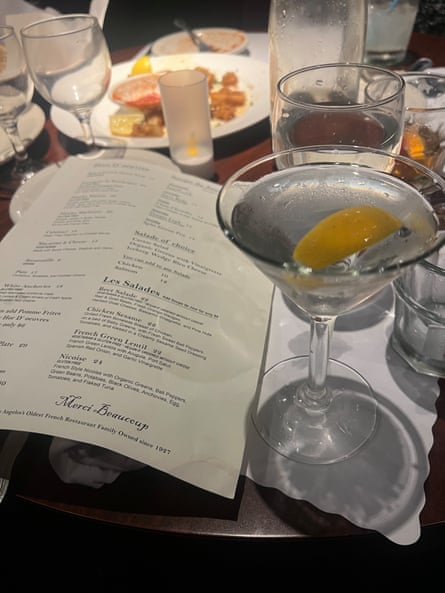
Darrow buys me a martini (which came in two parts, because the harried and overworked staff ran out of martini glasses) and pushes me to sample the calamari that’s cooling on the table. He swears the cocktail sauce that accompanies the dish is one of the best things on the menu, but his favorite thing is the moules maison – mussels in white wine sauce. The joy he gets from describing the dishes on the menu is palpable.
As I’m wrapping up my drink, I ask him if he’d come visit Taix when it reopens in the new building. Without hesitation, he says yes. To Darrow, Taix is not about the building, the light fixtures, the old paintings, the cherry wood bar, the neon signs outside, or the ornate doors. It’s about life. And food.
“ People are the thing that animates the space. Without people, it’s just building. It’s the memories of the people who are living. My grandparents are gone, my parents are gone. We’re making our own memories here.” And, as Karri Taix says to me: “Every day is a brand new memory.”
I shake Darrow’s hand and let him get back to making some more memories. Human beings naturally obsess over things, places, the physical. We can touch a building, imagine ourselves in a different time. That’s the beauty of places like Taix, but a building is just a place to be alive. And isn’t being alive the thing that really matters?