2 months ago
65
2 months ago
65
Luis García was “super cool”, he says. That, at least, was the plan, but things have a habit of working out differently. When the former Atlético Madrid, Barcelona and Liverpool player retired in 2016, it was the second time: he walked out of the game in 2014 and walked back in again six months later. But this time, he wasn’t going to be affected. All that suffering and satisfaction, the pressure, the emotion: that was no more.
“I was always very competitive and once I had left football, I thought I wasn’t going to have those feelings I had before,” he says. “I still enjoy football, still play seven-a-side with my friends – every Saturday at 10am, Los Jareños Club de Futbol – but I thought I had lost that and it wasn’t coming back. In fact, I was trying to avoid it; I didn’t want it. So when it happened, it surprised me. I didn’t expect football to give me that again. But there I was, crying.”
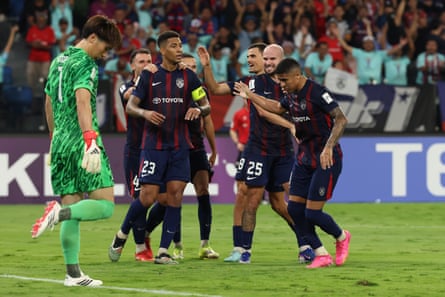
It was mid-February in Iskandar Puteri, Malaysia, and the players García was watching celebrating a historic win were his, the feeling shared. “When I saw them jumping with joy, having been with them every day, sharing the long journeys, from Malaysia to Vietnam and back, on to Japan, and then saw them win I got that emotion again.” For the first time in their history, the Malaysian club Johor Darul Ta’zim had reached the quarter-finals of the Asian Champions League, defeating Sanfrecce Hiroshima 3-2 on aggregate. On Friday, they face Al-Ahli or Al-Duhail in Jeddah. García will be with them. He is their chief executive.
It’s different, that’s for sure. A big responsibility, too. Which is why García sits on the bench at Atlético’s Metropolitano Stadium watching two of his former clubs warm up pre-game and chatting about his playing career and a new adventure after it. When Barcelona come here in the Champions League on Tuesday night he will have to follow it on television. He will also follow Liverpool against Paris Saint-Germain; although he travelled to Saudi Arabia on Sunday night and divides his time between Madrid and Malaysia, he doesn’t miss a game and the connection remains, the impact profound.
García still plays for Liverpool’s legends team – “the best are probably Mark González and Fábio Aurélio, Stevie G [Steven Gerrard] always plays well” – and says there’s nothing quite like getting back to Anfield. When he’s asked for his perfect seven-a-side team from all those he has played with, he comes up with: Victor Valdés in goal,
Carles Puyol, Sergio Ramos and Sami Hyypiä at the back, Gerrard, Andrés Iniesta and Xavi Hernández in midfield and Ronaldinho up front. Until, that is, he cracks up and says: “Wait, that’s eight.” But still he refuses to take one out.
Istanbul is always there, too. Asked about his goal against Chelsea in the semi-finals of the Champions League in 2005, the response is immediate: “Yes, it went in.” And when he’s reminded of the half-time team-talk in the final when Rafa Benítez wrote the names up on the board and someone said: “Boss, that’s 12,” he starts laughing.

“Someone told you that one, eh? It’s true, but there was a lot going on,” García says. “What most sticks with me is how Rafa handled it all. There was frustration at 3-0 down, but seeing how calm he was, how he reorganised us, bringing on Didi Hamann to give us balance and push Stevie further forward.
“That was how the first goal came and we believed. The second arrived quick and after the third we breathed. And Jerzy Dudek had the most fantastic night of his life. I was down for the sixth penalty. Stevie was fifth. I asked for one, kept insisting, but Rafa didn’t let me.
“When I retired, I was relaxed, welcomed the pause, but I had also spent years getting ready for other opportunities that might arise in football. I did a master’s with Uefa, a sporting director’s course, my coaching badges. Any qualification that was on the table, I took it. But I didn’t want to coach. I always preferred the business side of it to the on-pitch stuff because I suffered a lot on the pitch.”
García nods towards the pitch. “Tell me I can play now and I’m out there,” he says. “But the idea of being a coach, being the other side of the line, all that pressure without being able to personally impact the game, didn’t appeal. Coaches always tell me: ‘No, but, you can’t imagine the feeling when it comes off.’ Sure, but I didn’t want to have that feeling. Or more to the point, I didn’t feel the call, the pull.”
“I had always been curious about things. I don’t know if I was different, but I played the piano, the guitar. I had started guitar at 15 and always liked it: acoustic, then electric in a band.”
Any good? “Decent. Less so on the piano, although I got better during the pandemic. There were always things to do, learn. I was fascinated by gadgets, new technology, the explosion of the internet.
“I did magic. With [former forward] Santi Ezquerro at Barcelona we learned to do tricks together. Proper tricks, not just cards: practising in front of the mirror, making sure you do the movements right so you don’t get detected. I had just always been curious about things. So, whatever comes … ”
Of his move to Johor Darul Ta’zim, García says: “I was cool, relaxed working with ESPN, but last year I got a call to go and meet Tunku Ismail Idris, the crown prince of Malaysia, who is the owner of the club.”
On the other end of the line: Kiko Insa, who played in Spain, but also in Belgium, Iceland, Latvia, Indonesia, Thailand and Malaysia, where he had been for years. He had been at Oxford United, too. It was pretty left-field, but that is the way García likes it: his career had closed in Greece and Mexico; six months later he came out of retirement to go to Atlético Kolkata and then all the way to Australia to play for the Central Coast Mariners.
“I just like new challenges, trying new things, something different, and this was one,” he says. “I went to see the prince and listen to his ideas. It was spectacular. He’s very active, inquisitive. He’s pretty good at football. I saw him in a game with [Robert] Pires and [Ludovic] Giuly, some other former players, and he scored a belting goal. An assist to me, too. He genuinely knows the game, what he wants.
“ The club has grown massively since [he re-established it in] 2013. He took Johor to 12 league titles. Opta ranks us No 1 in south-east Asia.
“Why me? I don’t know. He wanted someone with a past in football and a different vision, based on what I have lived in three different continents. There is work to do, real work. I go every month for 10 days, two weeks. I’ve been learning for the last year, understanding the structure, have an input. I try to find ways of implementing the vision. How do we get there? What do we do?
“We’re getting 13,000 or so in league games, more like 30,000 in the Champions League, the biggest in Asia, and we’re growing that, building the connection, the community. We want people to come and be part of it. There are school visits, hospitals. Sponsors: Nike, Toyota. The sporting director looks at players, we travel a lot together. I liaise with the operations manager. There’s that view from the places I have been.”
What is the most important lesson from Europe? “One of the things done well in England, which we have tried to emulate, is the intensity of the work. We have 37 players, which is a huge number, but we play 70 games a year; two cups, the league, the Champions League. No one plays as many. You need practically three teams when you work on that intensity, the pace. We’re very methodical. People think: ‘Meh, you’re in Malaysia … ’ But we have the full structure: coaches, analysis, assistants, fitness staff, dead ball, digital. The vision was in place; I said these are the things we have to do to get there.
“We play 3-5-2 and that doesn’t change, although you maybe have to adapt in the Champions League, where the level is higher and you can’t press the same. At most places a CEO wouldn’t be involved in those conversations but, as a former player, I am. Xisco Muñoz, who was at Watford and gets the philosophy, is coach. The team is international, with Malaysians who are playing very well and an academy that is winning practically every title.”
There are Australians, New Zealanders, Americans, Koreans, Portuguese, Spaniards, Argentinians, Brazilians, a Colombian, and the former Wolves midfielder Hong Wan, from Croydon. Plus Arif Aiman – “the pearl of Malaysia”, García says. “Quick, good one on one, strong, scores goals, he could play in Europe easily.”
Johor drew at the weekend. It was the first time they had dropped points, 21 games into the Malaysia Super League season, but they maintained their long unbeaten league run: 105 games now, three off the world record.
“Malaysian football is taking big steps,” García says. “It’s still a long way behind Europe, but Kuala Lumpur are working well, Kuching, Selangor … we all need those teams to improve. Malaysia only has one Champions League place. We have won the league every year for a decade.
“We’re four games from the longest run in history, we hope to reach the cup final again and the big challenge for us this year was the Champions League. We got through, the first time a Malaysian team got this far. Vietnam, Japan, Malaysia, now Saudi: the effort the players make is titanic and when I saw what that meant to them, to everyone, I could feel the tears.”