3 months ago
70
3 months ago
70
“Here in Marseille your blood is not red, it’s blue,” says Les Marseillaises’ manager, Corinne Diacre. “Even today it can be hard for some parents to see their girls wanting to play football, but here they don’t play football: they play for Marseille. It’s seen as completely different.”
Diacre is happy and relaxed. The rebranded and independent Marseille women’s team, still owned by the American businessman Frank McCourt, through the investment arm McCourt Global, after his purchase of the wider Marseille club in 2016, are being given an injection of resource and energy while maintaining strategic ties.
Diacre was a statement appointment last October by the promoted top-tier side, and she has been reenergised by the project. This is the 51-year-old’s first head coach role since her contract as manager of the France women’s team was terminated in 2023 because of what the French Football Federation described as “a very significant divide” with the players that “reached the point of no return”.
Diacre was ready to return to management after some time away and some work for Fifa and Uefa. Despite the fractious end with the national team, she comes with pedigree too, as the first woman in France to achieve the country’s senior BEPF coaching licence and the first woman there to manage a men’s professional team in a competitive match when she took charge of the Ligue 2 side Clermont Foot 63 in 2014.
“Before coming to Marseille I was without a job for a long time but it was also an important time to rest, to do other things and to spend time with friends and family,” Diacre says. “So, it was a good, good break for me, an important break to be completely ready for when an opportunity came along that I liked.”
Part of the pull was the chance to help shape the women’s academy. It marked a return to the roots of the coaching game she fell in love with.
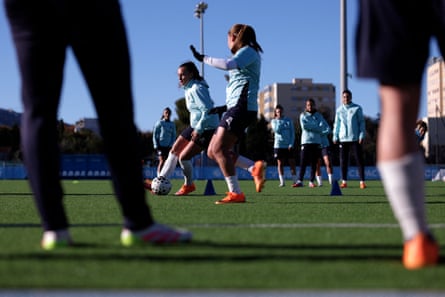
“When I began to be a coach I didn’t know that I could be a pro coach and I was very happy to coach young players and help them to grow,” says Diacre. “So, it is in my DNA to work with young people and now I’m reconnected with that work in getting to work very well and very closely with the director of the academy. We have an opportunity to show people outside the club that we are ready to put some young players into our senior set-up.”
Marseille has a rich football culture and history. The city has been a talent factory, churning out men’s players for decades, though famously the homegrown superstar Zinedine Zidane never played for the club. The city has also produced good women’s footballers, despite a smaller set-up and newer history, including Louisa Nécib, a three-time Champions League winner with Lyon, and the current Real Madrid player Maëlle Lakrar. However, it is largely an underdeveloped and untapped talent pool.
Stefano Petruzzo, the CEO tasked with leading the women’s side, says “developing our own talent is not only about having top players that win us matches eventually, it’s also about becoming an engine for women’s football in Marseille”.
He adds: “It’s both selfish and altruistic. Altruistic, because the role of OM is to do good for Marseille – it’s a social role that we have. On the other hand, selfishly, even if we don’t develop exclusively players that end up with our pro team, we will develop players that maybe then choose to become coaches, choose to become physios, choose to become analysts. So, our role is to develop the next level of women working throughout the game.”
Promotion from the second division came in the first year of the revamp. Now, the goal is to stay up. Les Marseillaises sit ninth in the 12-team Première Ligue with five games remaining, six points above the bottom two, Saint-Étienne and Montpellier. On 28 March they host Montpellier in their first women’s fixture at the Stade Vélodrome.
“We probably need two more wins to stay in first division,” Diacre says, “so we have time, we don’t have pressure and we’ve worked hard to obtain this position in the league very quickly. I hope we can ensure we stay up as quickly as possible so the club is in a good place to prepare for next season.”
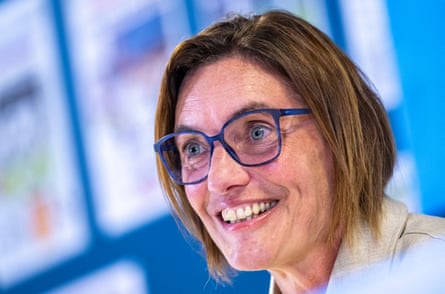
Petruzzo says that when he joined in September 2024 the women’s section was less a startup and more “in an incubation phase within the club”.
Now, it is one season from the end of phase one of a 10-year vision. If they stay up, next season’s goal is to become more comfortable and competitive, pushing towards the top four but “not necessarily hitting that top four because things take time”, says Petruzzo.
The big goal? To become a global women’s football powerhouse, challenging domestically and in Europe. “There’s different ways of becoming iconic though, right?” says Petruzzo. “We want to do it by representing Marseille and through a sustainable business model, and a sustainable business model takes time, it requires patient capital, good people and building the right attitude and culture.”
The rebrand is a part of that ambition. The team have kept the Marseille logo on their shirts but also have their own logo featuring a figure inspired by Marianne. “La Marseillaise and Marianne are probably the most recognisable symbols of France,” says Petruzzo. “The Les Marseillaises rebrand is about being true to our heritage, but also revolutionary enough, rebellious enough and different enough to stand out.”
Are the investors committed for the long term and prepared to weather the ups and downs that come with developing a football team? The CEO of McCourt Global, Shéhérazade Semsar-de Boisséson, is confident that is the case. “This is going to be a long run, this isn’t a quick turn, and it’s going to be fun,” she says. “Obviously promotion to the top division is huge; that was the biggest challenge and the biggest milestone. There are some clubs who’ve been in the league a lot longer than we have, so staying in there is the focus.
“The investment level required is very reasonable on how this can grow, but we do need the stability so that from there we can feel how other milestones can be more or less easily attainable.”
Part of the excitement comes from being able to go at “speedboat pace” rather than “what it can sometimes be like when you’re working with an over 100-year-old football club with legacy and history, and that’s just very refreshing to see”, says Semsar-de Boisséson. That room for innovation without the weight of tradition can also benefit the men’s club.
“On the business side, we’re going to try new things,” says Semsar-de Boisséson. “Then there’s the opportunity for what I call some reverse engineering. Sometimes the mothership has to learn from the daughter.”
Get in touch
If you have any questions or comments about any of our newsletters please email [email protected].
-
This is an extract from our free email about women’s football, Moving the Goalposts. To get the full edition, visit this page and follow the instructions. Moving the Goalposts is delivered to your inboxes every Tuesday and Thursday.